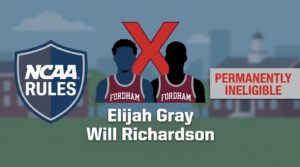
The NCAA has declared former Fordham University players Elijah Gray and Will Richardson permanently ineligible, a decision that effectively ends both athletes’ collegiate careers. The ruling, which carries no pathway for reinstatement, lands at a moment when transfer portal disputes and eligibility questions are reshaping how institutions and athletes navigate compliance. For Fordham, a member of the Atlantic 10 Conference, the fallout extends beyond two roster spots — it raises pointed questions about institutional oversight and the enforcement posture the NCAA intends to maintain heading into a new era of college athletics governance.
What the Permanent Ineligibility Ruling Means for Fordham and College Athletics
Permanent ineligibility is among the harshest outcomes the NCAA can impose on a student-athlete. Before examining the broader implications, here are the core takeaways from this decision:
- Both Elijah Gray and Will Richardson lose all remaining collegiate eligibility — there is no appeal mechanism that would restore their playing status under current NCAA bylaws.
- Fordham’s roster planning for upcoming seasons will need to account for the loss of two experienced players, potentially accelerating recruiting or transfer portal activity.
- The ruling signals the NCAA’s willingness to enforce eligibility rules strictly, even as the broader regulatory environment around college sports shifts toward athlete empowerment.
- Other programs monitoring transfer or eligibility disputes may recalibrate their compliance strategies in light of this precedent.
- The case underscores the tension between athlete mobility rights and institutional accountability — a friction point that isn’t going away
Who Are Elijah Gray and Will Richardson?
Elijah Gray and Will Richardson both contributed to Fordham’s athletics program before the eligibility dispute surfaced. Gray, a versatile player who had drawn attention for his on-field production, and Richardson, a contributor whose role had grown over recent seasons, now find themselves without a collegiate home. Neither player can suit up for any NCAA member institution going forward.
That finality is worth sitting with.
Permanent ineligibility differs from a suspension or a limited ban. It removes the athlete from the NCAA ecosystem entirely. In practice, this means Gray and Richardson would need to pursue opportunities outside the collegiate framework — whether professional leagues, international circuits, or other non-NCAA pathways — if they wish to continue competing.
The NCAA’s Enforcement Posture Under Scrutiny
This ruling arrives during a period of extraordinary flux for the NCAA. Between ongoing antitrust litigation, the proposed revenue-sharing settlement that could reshape Division I economics, and state-level NIL legislation creating a patchwork of compliance standards, the governing body has faced criticism from nearly every direction. Some argue it enforces too aggressively; others say it has lost the capacity to enforce at all.
Permanently barring two athletes from competition suggests the NCAA is not retreating from its enforcement authority, at least in cases where it determines the violations warrant maximum consequences. Yet the organization has not released granular details about the specific infractions that triggered this outcome (a pattern that has frustrated transparency advocates for years). What remains less clear is whether this case involved violations that other institutions might have handled through internal discipline rather than escalating to the national level.
The asymmetry matters. When enforcement appears inconsistent across conferences and institutions, it erodes trust in the system — not just among athletes, but among the compliance officers tasked with interpreting the rules.
How Does Permanent Ineligibility Compare to Other NCAA Sanctions?
| Sanction Type | Duration | Reinstatement Possible? | Typical Trigger |
|---|---|---|---|
| Game Suspension | 1–several games | Yes, automatic | Minor infractions, first offenses |
| Season-Long Ban | One full season | Yes, upon completion | Transfer violations, academic issues |
| Multi-Year Ineligibility | 2+ seasons | Case-by-case review | Serious or repeated violations |
| Permanent Ineligibility | Indefinite | No | Severe violations deemed irreversible by the NCAA |
Ripple Effects Across the Transfer Portal Landscape
College athletics has seen an explosion in transfer activity since the NCAA loosened its one-time transfer rules. During the 2023–24 cycle alone, thousands of athletes entered the portal seeking new opportunities. But the Gray and Richardson case serves as a stark reminder: mobility within the system still operates within boundaries, and crossing those boundaries carries consequences that can be career-ending.
Programs that have been aggressive in portal recruiting may now pay closer attention to the eligibility histories of incoming transfers. Compliance departments, already stretched thin at mid-major institutions like Fordham, face the added burden of vetting not just talent but regulatory risk. And athletes themselves, particularly those navigating complex eligibility situations involving multiple institutions, should arguably treat compliance counsel as essential — not optional.
Reframing the Athlete’s Decision-Making Process
From a behavioral perspective, this case illustrates a broader challenge facing student-athletes: the gap between perceived opportunity and actual regulatory constraint. Neuro-linguistic programming principles offer a useful lens here. Athletes often anchor their decisions to visible outcomes — playing time, NIL deals, conference prestige — while underweighting procedural risks that feel abstract until they materialize. The framing effect is powerful: when the transfer portal is presented as a marketplace of freedom, the compliance infrastructure governing it fades into the background.
Effective decision-making in this environment requires what NLP practitioners call “reframing” — shifting the mental model from “where do I want to play?” to “what are the structural conditions that determine whether I can play at all?” Coaches, advisors, and families who help athletes build this cognitive framework early are providing something more valuable than a highlight reel. They’re providing risk literacy. Institutions that invest in educating athletes about eligibility mechanics — not through legalistic briefings but through scenario-based, outcome-oriented communication — will likely see fewer catastrophic outcomes. The athletes who internalize this reframe won’t just protect their eligibility; they’ll make sharper decisions about every aspect of their collegiate careers.
Frequently Asked Questions
Can Elijah Gray or Will Richardson appeal the NCAA’s decision?
Under current NCAA bylaws, permanent ineligibility carries no standard reinstatement pathway. Both athletes would need an extraordinary procedural basis to challenge the ruling, and the NCAA has not indicated any such avenue exists in this case.
Does this affect Fordham’s program beyond losing two players?
Potentially. Depending on whether the NCAA ties any institutional violations to the case, Fordham could face additional scrutiny or sanctions. Even without further penalties, the reputational dimension complicates recruiting conversations.
What options do Gray and Richardson have now?
Both players could pursue professional or semi-professional opportunities outside the NCAA’s jurisdiction. International leagues, developmental circuits, and non-affiliated competitions remain open — though none carry the visibility or structure of Division I athletics.
Is permanent ineligibility becoming more common?
Not significantly. The NCAA reserves this sanction for cases it considers the most severe. Still, as transfer volume increases and compliance complexity grows, the raw number of eligibility disputes is rising, which could produce more extreme outcomes at the margins.



