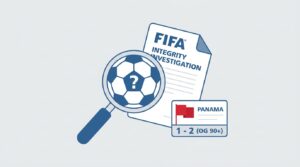
A late own goal during a World Cup qualifier in Panama has triggered a formal integrity investigation by FIFA, casting a shadow over preparations for the 2026 tournament. The incident, which occurred in the closing minutes of a CONCACAF qualifying match, drew immediate scrutiny from betting monitors and football governance bodies alike. FIFA’s integrity department confirmed it had opened a case, though no individuals or federations have been publicly named as subjects of the probe. The timing is particularly sensitive, with the expanded 48-team World Cup now less than a year away.
Why a Single Goal Has Sparked a Formal FIFA Probe
Match-fixing investigations in football rarely begin with a single moment. They typically emerge from a convergence of signals: unusual betting patterns, suspicious in-game events, and intelligence gathered through monitoring networks. In this case, the own goal in question reportedly coincided with irregular activity flagged by betting integrity firms that track global wagering markets in real time. That overlap between on-pitch action and off-pitch financial movement is precisely the kind of trigger that compels governing bodies to act.
FIFA has invested heavily in its Early Warning System, operated in partnership with Sportradar, which monitors betting flows across hundreds of markets worldwide. When statistical anomalies surface alongside a visually questionable passage of play, the system escalates the case for human review. From there, the decision to open a formal investigation rests with FIFA’s integrity division.
Still, an open case is not an accusation. It signals that the governing body considers the incident worthy of deeper examination (a distinction that matters enormously for the players and federations involved).
What This Means for CONCACAF Qualifying and the 2026 World Cup
- The investigation lands at a critical juncture in CONCACAF’s qualifying cycle, where several nations are fighting for remaining berths in the expanded 48-team tournament.
- If the probe substantiates match-fixing, FIFA’s disciplinary code allows for sanctions ranging from individual bans to point deductions or even disqualification of a national team.
- Betting integrity firms flagged irregular wagering activity linked to the match, suggesting the incident was not isolated to on-field behavior alone.
- FIFA’s integrity department has not disclosed a timeline for the investigation, but precedent suggests preliminary findings could emerge within weeks.
- The case may accelerate broader reforms around monitoring and enforcement in CONCACAF, a confederation that has faced governance challenges in the past.
A Pattern That Extends Beyond Panama
This is not the first time a World Cup qualifying match has attracted integrity scrutiny. In recent cycles, games in Africa, Asia, and the Caribbean have all been flagged for suspicious activity. What makes this case notable is its proximity to a tournament being co-hosted by the United States, Mexico, and Canada, three nations whose domestic leagues have pushed aggressively for betting transparency and regulatory alignment.
CONCACAF itself has faced a turbulent decade. The 2015 FIFA corruption scandal, which led to the indictment of several senior officials, exposed deep structural vulnerabilities across the confederation. Reforms followed, but enforcement capacity remains uneven across its 41 member associations. Whether this latest case reflects a systemic gap or an isolated incident is something the investigation will need to determine.
And while FIFA’s public posture has emphasized zero tolerance for match manipulation, the practical reality of policing 211 member federations across every tier of competition is far more complex than any policy document suggests.
How Betting Integrity Monitoring Actually Works
For those unfamiliar with the mechanics, betting integrity monitoring operates on a straightforward premise: markets don’t lie easily. When large volumes of money move in unusual directions before or during a match, algorithms flag the activity. Analysts then cross-reference the betting data with match footage, team context, and intelligence from informant networks.
Sportradar’s integrity services division processes data from over 850 betting operators globally. The sheer scale of this surveillance net means that even relatively obscure fixtures generate enough data points for anomaly detection. In practice, most flagged matches turn out to have benign explanations: a key injury, a tactical surprise, or simply volatile odds in thin markets. But a meaningful percentage do not.
The challenge lies in converting statistical suspicion into disciplinary evidence. Betting data alone rarely suffices. Investigators need corroborating material: communications, financial records, witness testimony. That evidentiary threshold is where many cases stall.
The Psychological Dimension: Pressure, Vulnerability, and Decision-Making
Beyond the regulatory mechanics, there is a human layer to match-fixing that deserves attention. Players competing in qualifiers for smaller CONCACAF nations often earn modest wages compared to their counterparts in Europe’s top leagues. Financial vulnerability, combined with the intense psychological pressure of representing a country on the global stage, creates conditions that fixers have historically exploited.
Research into decision-making under stress shows that individuals facing financial precarity are significantly more susceptible to external influence, particularly when the perceived risk of detection is low. This is not a justification. It is a contextual reality that any serious anti-corruption framework must account for. Education programs, whistleblower protections, and minimum wage standards for international players are all tools that FIFA’s governance framework has begun to explore, though implementation varies wildly by region.
Framing the issue purely as criminal behavior misses the structural incentives that enable it. Players who feel financially secure and institutionally supported are far less likely to engage with match-fixers. That much the behavioral evidence makes clear.
What Happens Next?
FIFA’s integrity division will now gather evidence from multiple sources: betting data, match officials’ reports, broadcast footage, and potentially communications records. If the case advances beyond preliminary review, the individuals or entities involved could face proceedings before FIFA’s disciplinary committee.
| Possible Outcome | Precedent | Likelihood |
|---|---|---|
| Individual player ban | Multiple cases across AFC and CAF qualifiers | Moderate, if direct involvement is established |
| Federation sanction or point deduction | Rare in qualifying; more common in club competitions | Low unless institutional complicity is found |
| Case closed with no action | A significant portion of flagged matches result in insufficient evidence | Possible |
| Referral to national law enforcement | Used in cases involving organized crime links | Depends on the scale of the network identified |
Frequently Asked Questions
Does an open FIFA integrity case mean someone has been found guilty?
No. An open case means FIFA considers the incident serious enough to investigate. No guilt is implied, and no sanctions apply until proceedings conclude.
Can a team be disqualified from the World Cup over a single match?
In theory, yes. FIFA’s disciplinary code permits disqualification for match-fixing. In practice, such a drastic measure would require overwhelming evidence of institutional involvement, and it has never been applied to a World Cup qualifier at this stage.
How long do these investigations typically take?
Timelines vary considerably. Some cases resolve within weeks when evidence is clear-cut. Others, particularly those involving cross-border financial trails, can stretch over months or even years.
What role do betting companies play in detecting match-fixing?
Licensed betting operators share real-time data with integrity monitoring firms. Their cooperation is essential to the detection process, though the quality and speed of data sharing differs across jurisdictions and regulatory environments.



