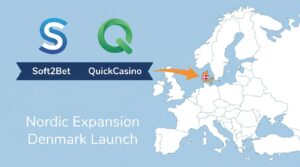
Soft2Bet has officially launched its QuickCasino igaming and betting brand in Denmark, marking a deliberate push deeper into the regulated Nordic market. The move positions the operator alongside established competitors in one of Europe’s most tightly supervised gambling jurisdictions. Denmark’s licensing framework, governed by the Danish Gambling Authority (Spillemyndigheden), demands strict compliance on responsible gambling, anti-money laundering, and advertising standards. For Soft2Bet, this launch signals more than geographic expansion; it reflects a calculated bet on a mature, high-trust market where regulatory credibility translates directly into player acquisition.
What Soft2Bet’s Danish Entry Means for the Nordic Market
The Danish igaming market has long attracted operators willing to meet its rigorous compliance bar. Soft2Bet’s decision to deploy QuickCasino here carries several strategic implications worth unpacking.
- Regulatory validation: Securing a Danish licence reinforces Soft2Bet’s positioning as a multi-jurisdictional operator capable of meeting some of Europe’s strictest standards.
- Nordic clustering: Denmark joins what appears to be a broader Nordic strategy, giving the company a foothold in a region where player spending per capita on igaming remains among the highest globally.
- The brand enters a competitive field that includes Kindred, Betsson, and Flutter-owned assets, all of which have deep roots in Scandinavian markets.
- Product-market fit: QuickCasino’s emphasis on speed and simplicity in the user experience may resonate with Danish players who increasingly favour streamlined, mobile-first platforms.
Denmark’s Regulatory Landscape: Why It Matters
Denmark re-regulated its gambling market in 2012, creating a licensing regime that balances commercial openness with consumer protection. Spillemyndigheden oversees all licensed operators, and enforcement actions against unlicensed platforms have been consistent. Tax rates on gross gaming revenue sit at 28% for online casino and 28% for sports betting (a distinction regulators have been slow to harmonise across product verticals).
What makes Denmark particularly demanding is the layered compliance architecture. Operators must integrate with the national self-exclusion register, ROFUS, and adhere to advertising restrictions that have tightened in recent years. The Danish market generated approximately DKK 7.5 billion in gross gaming revenue in 2023, according to Spillemyndigheden’s published data, with online casino and betting accounting for the dominant share.
Soft2Bet’s willingness to absorb these compliance costs suggests confidence in the brand’s ability to compete on product quality rather than regulatory arbitrage. That distinction matters.
QuickCasino’s Positioning and Product Strategy
QuickCasino, as the name implies, has built its identity around a frictionless player experience. Registration is streamlined. Deposits are fast. The interface strips away the visual clutter that characterises many legacy casino platforms. In a market like Denmark, where players are digitally sophisticated and accustomed to high UX standards across consumer services, this approach could prove effective.
Still, speed alone won’t differentiate. The Danish market rewards operators who combine a clean product with robust responsible gambling tools and localised content. Soft2Bet’s multi-brand igaming portfolio already spans several European jurisdictions, and the company has invested in proprietary technology that supports rapid market adaptation. Whether QuickCasino can carve out meaningful share against entrenched incumbents remains the open question.
How Soft2Bet Compares in the Danish Context
| Factor | QuickCasino (Soft2Bet) | Established Nordic Operators |
|---|---|---|
| Market presence in Denmark | New entrant, 2025 | Active since 2012 re-regulation |
| Brand recognition | Limited locally; growing in other EU markets | Strong, multi-year player relationships |
| Technology stack | Proprietary, mobile-first platform | Mix of proprietary and third-party solutions |
| Responsible gambling integration | ROFUS-compliant, standard toolset | ROFUS-compliant, often with additional proprietary features |
| Regulatory track record in Denmark | No prior enforcement history | Varies; some operators have faced minor sanctions |
The Broader Strategic Calculus Behind Nordic Expansion
Operators expanding into regulated Nordic markets are making a long-term play. Player acquisition costs are higher. Margins are compressed by tax and compliance obligations. But the payoff is stability: regulated markets offer predictable revenue streams, lower churn among high-value players, and protection from the kind of abrupt regulatory shifts that destabilise grey-market operations.
Soft2Bet’s trajectory over the past two years has pointed toward exactly this kind of jurisdiction-by-jurisdiction buildout. And while Denmark is a relatively small market by population (roughly 5.9 million), its per-capita igaming spend punches well above its weight. For a mid-sized operator looking to establish credibility before approaching larger regulated markets, Denmark functions as both a revenue opportunity and a proof point.
Even so, the timing raises questions. Nordic regulators have signalled appetite for tighter advertising rules and enhanced duty-of-care obligations. Entering now means Soft2Bet must build its Danish player base under conditions that may become more restrictive within the next regulatory cycle.
Frequently Asked Questions
Is QuickCasino licensed to operate in Denmark?
Yes. Soft2Bet has launched QuickCasino under a Danish licence, which means the brand operates under the supervision of Spillemyndigheden and must comply with all applicable regulations, including integration with the ROFUS self-exclusion system.
What types of gambling does QuickCasino offer in Denmark?
QuickCasino provides both igaming (online casino) and sports betting products to Danish players, covering the two primary verticals permitted under the Danish licensing framework.
How does Denmark’s gambling regulation compare to other European markets?
Denmark’s regime is among the stricter in Europe. It combines a 28% GGR tax rate with mandatory responsible gambling tools, advertising restrictions, and active enforcement against unlicensed operators. Few jurisdictions match its combination of market openness and regulatory oversight.
Who are QuickCasino’s main competitors in Denmark?
The Danish market features well-established operators including Kindred Group, Betsson, Flutter Entertainment’s brands, and Danske Spil, the state-owned operator. QuickCasino enters as a challenger brand against deeply rooted competition.



