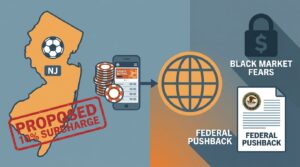
A proposed 10% surcharge on sports betting and other consumer activities in New Jersey has triggered a fierce legislative standoff between state lawmakers and federal representatives. Bill A4838, introduced to help bankroll the state’s hosting obligations for the 2026 FIFA World Cup, would layer a temporary tax on top of existing levies — with sports wagering squarely in the crosshairs. U.S. Congressman Josh Gottheimer (NJ-5) has emerged as the bill’s most prominent critic, warning that the measure risks reversing years of progress in channeling bettors away from unlicensed operators. The stakes, both fiscal and political, are considerable.
What Bill A4838 Would Actually Do to New Jersey Bettors
At its core, the legislation targets consumer-facing activities to generate revenue for World Cup-related security, transportation, and infrastructure upgrades. Sports betting, already one of the most heavily taxed verticals in the state’s regulated gambling ecosystem, would absorb a 10% surcharge on top of the existing tax framework. That’s not a trivial bump. New Jersey’s regulated sportsbooks currently operate on thin margins, and any additional cost passed through to consumers — whether via reduced odds, higher vigorish, or direct fees — changes the competitive calculus against offshore and black-market alternatives.
Proponents of the bill frame it as pragmatic. Hosting FIFA World Cup matches at MetLife Stadium carries obligations that run into the hundreds of millions of dollars, spanning venue preparation, law enforcement deployment, transit capacity, and fan zone infrastructure. Someone has to pay for it.
But the question nobody in Trenton seems eager to answer: why sports bettors specifically?
Why Federal Lawmakers and Industry Groups Are Pushing Back Hard
Congressman Gottheimer’s opposition isn’t rooted in abstract tax philosophy. His argument is grounded in a pattern that regulators across the country have observed since the repeal of PASPA in 2018: when the cost of legal betting rises, consumers migrate. Not to other legal platforms. To unregulated ones.
New Jersey was the state that fought for and won the Supreme Court case that dismantled the federal sports betting ban. It has since built one of the most mature legal wagering markets in the United States, with annual handle figures regularly exceeding $10 billion. That market didn’t materialize by accident. It required competitive pricing, accessible platforms, and a tax structure that allowed operators to offer odds close enough to offshore books to make legality the easier choice.
- A 10% surcharge could erode the pricing advantage that legal New Jersey sportsbooks hold over unlicensed competitors
- Operators may absorb part of the cost, compressing already slim profit margins and potentially reducing marketing spend that drives new customer acquisition
- Gottheimer has warned that the bill sets a dangerous precedent — using event-specific costs to justify targeted taxes on a single industry
- Industry groups argue the surcharge would disproportionately affect casual bettors, the segment most sensitive to price shifts
Still, the bill’s sponsors maintain that the surcharge is temporary and narrowly scoped. Whether that distinction holds up under political pressure remains an open question.
The Black Market Equation: How Price Sensitivity Shapes Betting Behavior
One of the less discussed but arguably more consequential dynamics at play here involves behavioral economics. Legal sports betting markets function, in part, because they reduce friction and offer a perceived value proposition: consumer protections, responsible gambling tools, and the absence of legal risk. But that value proposition has a price ceiling. When the cost gap between regulated and unregulated options widens, a meaningful segment of bettors — particularly high-volume players — will seek out better terms elsewhere.
Research from jurisdictions with higher effective tax rates on sports wagering (a distinction regulators have been slow to enforce uniformly) suggests that channelization rates drop measurably when consumer-facing costs rise. In France, where online sports betting taxes are applied to handle rather than gross gaming revenue, the regulated market has struggled to capture more than 80% of total activity. New Jersey, by contrast, has achieved channelization rates above 90% in recent years.
A surcharge that nudges even 5% of current legal handle back toward offshore books would represent hundreds of millions in wagering volume lost to the regulated ecosystem — and with it, the tax revenue and consumer protections that come attached.
Comparative Tax Burden on Sports Betting: Select U.S. States
| State | Online Sports Betting Tax Rate | Proposed or Additional Surcharges |
|---|---|---|
| New Jersey | 14.25% (GGR) | +10% proposed under A4838 |
| New York | 51% (GGR) | None currently proposed |
| Pennsylvania | 36% (GGR) | None currently proposed |
| Illinois | Up to 40% (GGR, tiered) | Recently restructured progressive rate |
| Colorado | 10% (GGR) | None |
Even without the surcharge, New Jersey’s combined regulatory costs place it in the middle of the national pack. Adding 10% on the consumer side would create a unique and largely untested dynamic — a state where the operator tax is moderate but the bettor-facing levy is among the highest in the country.
What This Means for the 2026 World Cup Funding Model
The broader issue extends beyond sports betting. If A4838 fails or gets amended beyond recognition, New Jersey still needs to fund its World Cup hosting commitments. MetLife Stadium, located in East Rutherford, is expected to host multiple matches including potentially a semifinal. The FIFA World Cup 2026 organizing framework places significant financial responsibility on host cities and states, covering everything from venue upgrades to security perimeters spanning miles around match sites.
Alternative funding mechanisms — general fund appropriations, federal grants, tourism-linked levies, or broader-based temporary taxes — haven’t gained the same traction in the legislature. Targeting sports betting was, at least on paper, a politically convenient choice: the industry is profitable, visible, and lacks the grassroots constituency that would mobilize against a sales tax increase.
That calculus may prove shortsighted. And the industry’s organized opposition, combined with Gottheimer’s federal-level platform, suggests the bill faces a difficult path to passage in its current form.
Frequently Asked Questions
Would the 10% surcharge apply directly to bettors or to operators?
Bill A4838 targets consumer activities, which means the surcharge would likely be passed through to bettors in some form — whether as a direct fee, adjusted odds, or reduced promotional offers. The exact mechanism would depend on how operators choose to absorb or distribute the cost.
Is this surcharge permanent?
No. The bill frames it as temporary, tied specifically to the 2026 FIFA World Cup hosting period. However, critics point out that temporary taxes in New Jersey have a history of outlasting their stated purpose.
How much revenue would the surcharge generate?
No official projections have been released by the bill’s sponsors. Given New Jersey’s annual sports betting handle exceeding $10 billion, even a modest effective rate could generate significant revenue — though actual collections would depend on whether betting volume contracts in response to higher costs.
Could this push bettors to illegal offshore sportsbooks?
That is the central concern raised by Congressman Gottheimer and multiple industry stakeholders. Historical evidence from other jurisdictions suggests that price sensitivity among bettors is real, and that widening the cost gap between legal and illegal options reduces channelization into the regulated market.



