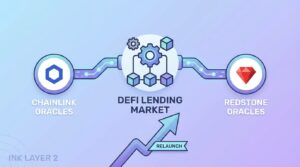
The dominant DeFi protocol operating on Kraken’s Ink Layer 2 network is preparing to resume its lending markets after integrating oracle price feeds from both Chainlink and RedStone. The move signals a deliberate effort to shore up data reliability before reopening markets to users, a step that reflects broader industry caution around oracle infrastructure following several high-profile exploits in decentralized lending. By onboarding two separate oracle providers rather than relying on a single source, the protocol is adopting a redundancy-first approach that could set a precedent for other projects building on newer L2 chains.
What the Oracle Integration Means for Ink’s DeFi Ecosystem
Before unpacking the strategic implications, it’s worth grounding what’s actually happening here. The protocol, which holds the largest total value locked (TVL) on Ink, paused its lending operations and is now layering in price feed infrastructure from two well-established oracle networks. That dual integration isn’t cosmetic. It’s a risk management decision.
- Redundant oracle architecture: By sourcing price data from both Chainlink’s decentralized oracle network and RedStone, the protocol reduces single-point-of-failure risk, a vulnerability that has cost DeFi protocols hundreds of millions in past incidents.
- Lending market resumption tied to infrastructure readiness: Rather than rushing back online, the protocol is conditioning its relaunch on verified oracle performance, suggesting a maturity in operational governance rarely seen in early-stage L2 ecosystems.
- The integration positions Ink as a more credible environment for institutional-grade DeFi activity, even at this early stage of the network’s lifecycle.
- Competitive signal to other L2s: Kraken’s Ink chain gains legitimacy by association. Protocols building on it are choosing battle-tested infrastructure over speed-to-market shortcuts.
Why Two Oracles Instead of One?
Oracle manipulation remains one of the most persistent attack vectors in decentralized finance. Flash loan exploits, stale price feeds, and single-source dependencies have collectively drained billions from lending protocols since 2020. The decision to integrate both Chainlink and RedStone reflects a growing consensus among protocol architects: no single oracle provider, however reputable, should be the sole gatekeeper of price truth.
Chainlink is arguably the most widely deployed oracle solution in DeFi, with integrations across hundreds of protocols and multiple blockchains. RedStone, while newer, has carved out a niche with its modular design and on-demand data delivery model. The two systems operate differently enough that pairing them creates genuine diversity in data sourcing, not just the appearance of it (a distinction that matters more than many project teams acknowledge).
Still, dual-oracle setups introduce their own complexity. Conflict resolution logic, latency differences between feeds, and the cost of maintaining two integrations simultaneously all add engineering overhead. Whether the protocol has addressed these tradeoffs publicly remains less clear.
Ink’s Position in the Layer 2 Landscape
Kraken launched Ink as its proprietary Layer 2 solution, entering a crowded field that includes Coinbase’s Base, Arbitrum, Optimism, and a growing roster of application-specific rollups. For Ink to differentiate itself, the quality and security of its native DeFi ecosystem matters enormously. A flagship lending protocol that takes oracle infrastructure seriously sends a stronger signal than any marketing campaign could.
The broader L2 market has seen explosive growth in 2024 and into 2025, with aggregate TVL across rollups exceeding $40 billion at various points. But raw TVL numbers obscure a harder question: how much of that capital is genuinely sticky, and how much migrates at the first sign of a better yield or a security scare? Protocols that invest in robust infrastructure before scaling tend to retain users longer. That’s the bet being made here.
How Oracle Choice Shapes Protocol Trust
| Factor | Chainlink | RedStone |
|---|---|---|
| Deployment model | Push-based, continuously updated feeds | Modular, on-demand data delivery |
| Market presence | Dominant across DeFi, hundreds of integrations | Growing, with a focus on cost-efficient and flexible architectures |
| Data sourcing | Decentralized node operator network | Aggregated from multiple premium sources with a lighter on-chain footprint |
| Risk profile | Battle-tested but higher gas cost in some configurations | Newer track record, though increasingly adopted by mid-tier protocols |
The Broader Shift Toward Infrastructure-First DeFi
What’s unfolding on Ink mirrors a wider pattern across decentralized finance. The era of launching lending markets with minimal safeguards and iterating post-exploit is, at least on paper, giving way to a more deliberate approach. Protocols are increasingly treating oracle selection, liquidation logic, and risk parameter calibration as prerequisites rather than afterthoughts.
This matters for executives and institutional allocators evaluating L2 ecosystems. The presence of RedStone’s modular oracle infrastructure alongside Chainlink on a Kraken-backed chain suggests a maturing supply chain for on-chain financial services. And while no oracle setup eliminates risk entirely, the layered approach reduces the probability of the kind of cascading failures that have historically wiped out protocol treasuries overnight.
Even so, the real test comes after the lending markets go live. Oracle integrations are only as good as their performance under stress, during volatile market conditions when price feeds are most likely to diverge or lag.
Frequently Asked Questions
What is Kraken’s Ink Layer 2?
Ink is Kraken’s proprietary Layer 2 blockchain built to support decentralized applications with lower transaction costs and faster settlement than Ethereum’s mainnet. It competes with other exchange-backed L2s like Coinbase’s Base.
Why are oracle feeds important for DeFi lending?
Lending protocols rely on real-time asset price data to calculate collateral ratios, trigger liquidations, and prevent bad debt. Inaccurate or manipulated oracle data has been the root cause of some of the largest DeFi exploits in history, making oracle selection a foundational security decision.
Does using two oracle providers guarantee safety?
No. Dual-oracle setups reduce single-point-of-failure risk significantly, but they introduce new challenges around conflict resolution and latency management. They raise the floor for security without eliminating risk altogether.