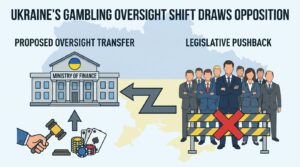
A proposed restructuring of Ukraine’s gambling regulatory framework has ignited a fierce debate among lawmakers, industry stakeholders, and policy analysts. The Ukrainian government is weighing whether to transfer gambling policy formulation — and possibly the operational functions of the Commission for the Regulation of Gambling and Lotteries (KRAIL) — to the Ministry of Finance. Member of Parliament Nina Yuzhanina has emerged as one of the most vocal critics of the plan, questioning whether a department oriented around fiscal management can adequately handle the social, technical, and consumer protection dimensions of a modern betting market. The proposal arrives at a moment when Ukraine’s regulated gambling sector, still relatively young after its 2020 legalisation, arguably needs more specialised oversight, not less.
Why This Regulatory Shift Has Sparked Alarm
Before examining the specific objections, it helps to understand the stakes. Ukraine legalised gambling in 2020 after years of operating in a grey market, and the regulatory apparatus built around KRAIL was designed to be an independent, purpose-built body. Folding its responsibilities into a ministry with a fundamentally different mandate raises questions that go well beyond administrative convenience.
- Independence at risk: Moving gambling oversight under the Ministry of Finance could subordinate consumer protection and responsible gambling priorities to revenue collection targets
- KRAIL was established specifically to manage licensing, enforcement, and market integrity for a sector with unique social risks — capabilities that a generalist ministry may lack
- Transparency concerns: MP Yuzhanina has flagged the potential for reduced public accountability if regulatory decisions become embedded within a larger ministerial bureaucracy
- Timing matters: Ukraine’s gambling market is still maturing, and regulatory disruption during this phase could deter legitimate operators while creating openings for unlicensed activity
- Industry analysts warn that consolidating gambling regulation under a fiscal authority sends a signal to international operators that Ukraine views the sector primarily as a tax base, not a market requiring balanced governance
The Yuzhanina Critique: More Than a Turf War
Nina Yuzhanina’s objections carry weight partly because of her background. As a lawmaker with experience on fiscal and economic committees, she is not reflexively opposed to the Ministry of Finance’s involvement in revenue-related policy. Her concern is more specific: that gambling regulation demands a distinct skill set, one that blends technical licensing expertise, anti-money laundering enforcement, responsible gambling frameworks, and digital market monitoring.
That combination doesn’t sit naturally inside a ministry whose core function is budgetary planning and tax administration. And while the Ministry of Finance would presumably inherit KRAIL’s staff and institutional knowledge, the question of whether those functions retain their priority — or get quietly deprioritised beneath fiscal targets — remains unanswered.
Still, the government’s rationale isn’t entirely without logic. Consolidation can reduce bureaucratic duplication. It can streamline reporting lines. At least on paper, it offers a cleaner chain of accountability from regulator to cabinet. But the gap between organisational charts and operational reality is where most regulatory failures live.
What Independent Gambling Regulation Actually Requires
Gambling oversight in any jurisdiction sits at the intersection of several complex policy domains. It is not simply about collecting licence fees.
| Regulatory Function | Primary Focus | Ministry of Finance Alignment |
|---|---|---|
| Licensing & market entry | Operator vetting, technical standards | Low — requires sector-specific expertise |
| Responsible gambling enforcement | Player protection, addiction prevention | Minimal — not a fiscal priority |
| Anti-money laundering | Transaction monitoring, suspicious activity reporting | Partial — AML overlaps with financial regulation but gambling-specific patterns differ significantly |
| Tax & revenue collection | GGR taxation, fee structures | High — core ministry competency |
| Digital & technical compliance | Platform audits, RNG certification, geolocation | Low |
Only one of those five functions aligns strongly with the Ministry of Finance’s institutional strengths. Which raises a harder question: is this consolidation designed to improve regulation, or to simplify government structure at the expense of regulatory depth?
Signals to the International Market
Ukraine’s gambling sector has attracted interest from international operators since legalisation, and the regulatory environment is a key factor in those investment decisions. The Ukrainian gambling and lotteries regulator KRAIL has been building credibility as an independent authority. Undermining that independence — even perceptually — could cool foreign operator interest at precisely the wrong moment.
Operators evaluating market entry weigh regulatory stability heavily. A jurisdiction that reshuffles its oversight structure mid-development signals unpredictability. Not everyone sees it that way, of course; some argue that ministry-level backing could actually accelerate decision-making and reduce bottlenecks. But the counterargument is straightforward: speed without specialisation produces bad regulation.
Reframing the Debate: What Effective Oversight Looks Like
Effective gambling regulation operates on a principle that behavioural science and NLP-informed policy design have long recognised: the frame through which a problem is viewed determines the solutions that emerge. When gambling is framed primarily as a revenue source, the regulatory apparatus optimises for extraction — higher taxes, more licences, fewer compliance barriers. When it is framed as a consumer market with embedded social risks, the apparatus optimises for sustainability — player protection, market integrity, long-term sector health.
This distinction matters because regulatory framing shapes operator behaviour. Operators in revenue-first jurisdictions tend to push boundaries on marketing, bonus structures, and player retention tactics. Operators in protection-first jurisdictions invest more in compliance infrastructure, self-exclusion tools, and transparent reporting. The regulatory home of the oversight body sends a signal about which frame dominates.
Ukraine’s choice here will also influence how its citizens perceive the legitimacy of legal gambling. Public trust in regulatory independence is a prerequisite for channelling players away from unlicensed platforms (a distinction regulators have been slow to enforce in many post-legalisation markets). If the public views the regulator as an arm of the tax ministry, the social licence for legal gambling erodes — and with it, the very revenue the government hopes to capture.
Anchoring the regulatory identity in consumer protection rather than fiscal extraction is not just good policy. It is, in practical terms, better economics. Jurisdictions that maintain independent gambling authorities tend to report higher channelisation rates, stronger compliance cultures, and more durable tax revenues over time.
Frequently Asked Questions
What is KRAIL?
KRAIL is the Commission for the Regulation of Gambling and Lotteries in Ukraine, established as an independent body to oversee licensing, enforcement, and market regulation following the country’s 2020 gambling legalisation.
Why is the proposed transfer to the Ministry of Finance controversial?
Critics argue that gambling regulation requires specialised expertise in areas like responsible gambling, anti-money laundering, and technical compliance — functions that don’t align with a finance ministry’s core mandate. There are also concerns about reduced transparency and the subordination of player protection to revenue goals.
Could this change affect international operators considering Ukraine?
Potentially, yes. Regulatory stability and independence are significant factors in operator market-entry decisions. A mid-development restructuring could be interpreted as a sign of institutional unpredictability, though some observers believe ministry-level oversight might streamline certain processes.
Has Ukraine’s gambling market been successful since legalisation?
The market has grown since 2020, attracting both domestic and international interest. But it remains in a formative phase where regulatory credibility and consistent enforcement are still being established — making the timing of any structural overhaul particularly sensitive.



