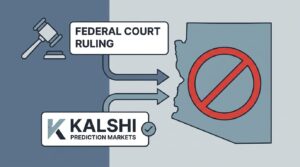
Prediction market operator Kalshi has secured a significant legal victory in Arizona after a federal judge blocked the state from pursuing enforcement action against the platform. The ruling, which prevents Arizona regulators from treating Kalshi’s event contracts as unlicensed gambling, marks a pivotal moment in the ongoing jurisdictional tug-of-war between state gambling authorities and federally regulated derivatives exchanges. For an industry still defining its legal perimeter, the decision carries weight well beyond a single state border.
What the Arizona Ruling Means for Prediction Market Operators
The legal dispute centered on a fundamental question that has shadowed prediction markets since their emergence into the mainstream: are event contracts regulated financial instruments, or are they gambling products subject to state oversight? Arizona regulators had signaled intent to treat Kalshi’s offerings as the latter. The federal court disagreed.
By granting the injunction, the court effectively affirmed that Kalshi’s status as a Commodity Futures Trading Commission (CFTC)-regulated designated contract market preempts state-level gambling enforcement. That distinction matters enormously. It establishes a legal template that other prediction market platforms (and their legal teams) will study closely, and one that state regulators in other jurisdictions will have to contend with.
- Federal preemption affirmed: The court ruled that CFTC oversight of Kalshi’s event contracts takes precedence over Arizona’s gambling laws, reinforcing the platform’s regulatory standing as a derivatives exchange rather than a gambling operation.
- State enforcement halted: Arizona cannot pursue action against Kalshi under its current gambling statutes while the injunction holds, removing an immediate operational threat.
- The ruling does not resolve the broader national debate, but it hands prediction market operators a concrete legal precedent to cite in future disputes.
- Industry signal: Other CFTC-regulated platforms may leverage this outcome to push back against similar state-level challenges, potentially accelerating the sector’s geographic expansion.
A Pattern of Legal Confrontation
This is not Kalshi’s first courtroom battle, and it almost certainly won’t be the last. The New York-based company has been at the center of several high-profile regulatory disputes, including its protracted fight with the CFTC itself over the right to list congressional election contracts. That case, which Kalshi ultimately won in 2024, opened the door to political event trading on a regulated U.S. exchange for the first time.
Arizona’s attempt to classify the platform’s contracts as gambling products followed a pattern visible in multiple states. Regulators, often operating under statutes written decades before prediction markets existed, have struggled to categorize these instruments. The result: a patchwork of enforcement postures that creates uncertainty for operators and users alike.
Still, the federal court’s willingness to intervene on preemption grounds suggests that Kalshi’s CFTC-regulated prediction market platform occupies legal terrain that state authorities cannot easily override. Whether other states will test that boundary remains an open question.
Why State Regulators Keep Pushing Back
The tension is not purely academic. State gambling commissions exist to protect consumers and collect revenue from licensed operators. When a federally regulated exchange offers contracts that look, to a casual observer, like bets on real-world outcomes (elections, weather events, economic data releases), the line between a derivative and a wager blurs. At least on paper.
Arizona’s position reflected a concern shared by regulators in several states: that prediction markets could function as a backdoor around state gambling frameworks, siphoning activity away from licensed operators without contributing to state coffers or adhering to local consumer protection standards. The federal court’s ruling doesn’t erase that concern. It simply establishes that, for now, CFTC jurisdiction wins the hierarchy contest.
Regulatory Landscape at a Glance
| Jurisdiction | Regulatory Posture | Status |
|---|---|---|
| Federal (CFTC) | Recognizes Kalshi as a designated contract market | Active oversight |
| Arizona | Attempted gambling enforcement | Blocked by federal injunction |
| Other U.S. states | Varies widely; some permissive, others reviewing | No unified approach yet |
How This Shapes the Prediction Market Industry’s Strategic Calculus
For Kalshi and its competitors, the Arizona decision reshapes the risk matrix. Legal costs associated with state-by-state defense remain substantial, but a federal preemption precedent lowers the ceiling on what state regulators can credibly threaten. That changes the math on market expansion.
Arguably, the bigger implication sits with institutional participants. Asset managers, proprietary trading firms, and corporate hedgers have been cautious about prediction markets partly because of regulatory ambiguity. A clearer jurisdictional hierarchy (federal trumps state on CFTC-regulated products) reduces one layer of that uncertainty. Not all of it. But enough to matter.
And while the ruling is specific to Arizona, its reasoning travels. Legal teams advising prediction market operators in states with aggressive gambling regulators now have a federal court opinion to anchor their arguments. The precedent doesn’t guarantee outcomes elsewhere, but it shifts the burden.
Broader Implications for Financial Innovation and Regulatory Frameworks
What makes this case worth watching extends beyond prediction markets themselves. The underlying legal question (when does federal financial regulation preempt state consumer protection authority?) surfaces in crypto, fintech lending, and digital asset custody disputes as well. Courts that draw clear lines in one domain tend to influence reasoning in adjacent ones.
The prediction market sector has grown rapidly, with platforms reporting surges in trading volume around major political and economic events. Kalshi alone processed hundreds of millions of dollars in notional volume during the 2024 U.S. election cycle. That scale attracts regulatory attention. It also attracts the kind of legal scrutiny that, paradoxically, can strengthen a platform’s legitimacy when the rulings go its way.
One dynamic worth tracking: whether Congress intervenes. Legislative proposals to clarify the status of event contracts have circulated in various forms, though none have advanced meaningfully. A string of federal court victories for prediction market operators could reduce the urgency lawmakers feel to act, or it could provoke a legislative response from states seeking to reassert authority.
Frequently Asked Questions
Does this ruling make prediction markets legal in all U.S. states?
No. The injunction applies specifically to Arizona’s enforcement action against Kalshi. Other states retain the ability to pursue their own regulatory approaches, though the federal preemption reasoning could influence future cases.
What is a designated contract market?
A designated contract market (DCM) is a CFTC-regulated exchange authorized to list futures and options contracts for trading. Kalshi holds this designation, which subjects it to federal oversight requirements including reporting, compliance, and market surveillance obligations.
Could Arizona appeal the decision?
State regulators could seek to challenge the injunction through appellate courts. Whether they choose to do so likely depends on political priorities and the resources available for what would be a complex federal preemption appeal.
How does this affect users trading on Kalshi?
For Arizona-based users, the immediate effect is continued access to the platform without the threat of state-level prohibition. The longer-term impact depends on whether the legal precedent holds and whether additional states mount similar challenges.