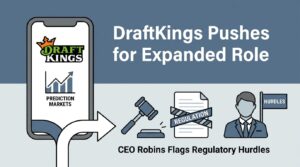
DraftKings is actively pursuing a larger footprint in sports prediction markets, but CEO Jason Robins has acknowledged that the category still faces significant regulatory friction before it can scale. The Boston-headquartered operator, already one of the dominant forces in U.S. online sports betting, sees prediction markets as a natural extension of its core business. Yet the path forward depends on how federal and state regulators choose to classify and oversee these products, a question that remains far from settled.
What DraftKings’ Prediction Market Ambitions Signal for the Industry
Robins’ public comments mark a deliberate shift in how major operators are framing prediction markets. Rather than treating them as a niche curiosity or a regulatory grey zone, DraftKings appears ready to treat them as a genuine growth vertical. Here’s what matters most from a strategic standpoint:
- Mainstream operator interest legitimises the category — when a publicly traded company with a $15 billion-plus market cap signals intent, regulators and investors pay closer attention
- Regulatory classification remains the bottleneck; whether prediction markets fall under gambling law, commodity futures regulation, or something else entirely will determine who can offer them and where
- The CFTC’s posture is pivotal. The Commodity Futures Trading Commission has historically resisted broad approval of event contracts tied to sports, though political prediction markets (notably Kalshi) have gained ground
- DraftKings’ existing state-by-state licensing infrastructure could give it a distribution advantage over pure-play prediction platforms that lack those relationships
- Consumer demand is already proven — platforms like Polymarket and Kalshi have demonstrated that users will trade on real-world outcomes when given the chance
Why Prediction Markets Are Drawing Operator Attention Now
The timing is not accidental. Several forces have converged to make prediction markets a live conversation in boardrooms across the gaming and fintech sectors. Polymarket’s breakout moment during the 2024 U.S. presidential election cycle showed that event-based trading could capture mainstream attention (and volume) at a scale few anticipated. Kalshi, meanwhile, has been waging a legal and regulatory campaign to expand the types of contracts it can list, including sports-adjacent events.
For DraftKings, the calculus is straightforward. The company already operates in 25-plus legal U.S. sports betting jurisdictions. It has the user base, the brand recognition, and the technology stack. What it lacks, at least on paper, is regulatory clearance to offer prediction-style products that sit outside traditional sports wagering frameworks.
And that gap is where things get complicated.
The Regulatory Maze: CFTC, State Legislatures, and Competing Frameworks
Prediction markets occupy an awkward space between financial derivatives and gambling. The CFTC has jurisdiction over event contracts under the Commodity Exchange Act, but its appetite for approving sports-linked contracts has been limited. In 2024, the commission moved to block certain categories of event contracts, even as courts pushed back on some of those restrictions.
State gambling regulators, meanwhile, have their own concerns. If prediction markets look and feel like sports bets, should they require a sports betting licence? Should they be taxed the same way? These questions don’t have uniform answers, and the patchwork of state-level approaches to online gambling in the U.S. makes a federal solution unlikely in the near term.
| Regulatory Body | Current Stance on Prediction Markets | Key Open Question |
|---|---|---|
| CFTC | Selective approval; blocked some sports-related contracts | Will the commission broaden event contract categories under new leadership? |
| State Gaming Commissions | Largely silent or evaluating | Do prediction markets require existing gambling licences? |
| SEC | No direct action on prediction markets to date | Could securities classification apply to certain contract structures? |
Less clear is whether DraftKings would pursue a CFTC-regulated path, a state-by-state gambling licence approach, or some hybrid. Each carries distinct compliance costs and timelines.
How DraftKings Stacks Up Against Pure-Play Competitors
Kalshi and Polymarket built their businesses around prediction markets from the ground up. DraftKings would be entering as a lateral move from sports betting. That distinction matters. Pure-play platforms have deeper expertise in contract design and order-book mechanics, but they lack the massive customer acquisition engines that DraftKings’ sportsbook and daily fantasy platform provide.
There’s also a branding question. Prediction markets have cultivated an identity closer to fintech than gambling. Some users are drawn precisely because the framing feels more like trading than betting. Whether DraftKings can credibly occupy that positioning, or whether its gambling-industry DNA becomes a liability in certain regulatory conversations, remains an open thread.
What This Means for Operators, Regulators, and Investors
DraftKings’ interest in prediction markets isn’t just a product roadmap decision. It’s a signal that the boundary between sports betting and event-based trading is eroding faster than regulators have been able to respond. For competing operators like FanDuel, BetMGM, and Flutter Entertainment, the question becomes whether to follow or wait for regulatory clarity.
Investors should watch two things closely. First, any formal regulatory filings or licence applications from DraftKings related to prediction market products. Second, the CFTC’s evolving posture under its current leadership, particularly regarding sports-adjacent event contracts. The commission’s next set of rulings could either open the floodgates or freeze operator ambitions for years.
Still, Robins’ willingness to discuss the category publicly suggests DraftKings has done enough internal legal and strategic work to believe the opportunity is real. Whether the regulatory infrastructure catches up to that conviction is arguably the single most consequential variable in this space right now.
Frequently Asked Questions
What are sports prediction markets?
Sports prediction markets allow participants to buy and sell contracts based on the outcome of real-world sporting events. Unlike traditional sports bets placed with a bookmaker, these markets often function more like financial exchanges where prices fluctuate based on supply and demand.
Does DraftKings currently offer prediction market products?
Not in the traditional sense. DraftKings operates sports betting and daily fantasy sports, but has not launched a dedicated prediction market product. CEO Jason Robins has indicated the company sees the category as a growth opportunity pending regulatory developments.
Who regulates prediction markets in the United States?
It depends on the product structure. The CFTC oversees event contracts that qualify as commodity derivatives. State gaming commissions may also claim jurisdiction if the products resemble sports wagering. This overlapping authority is one reason the regulatory picture remains unsettled.
How do prediction markets differ from sports betting?
The core mechanic differs. Sports betting typically involves placing a wager against a bookmaker’s odds. Prediction markets operate as peer-to-peer exchanges where contract prices reflect collective probability assessments. In practice, the user experience can feel similar, which is partly why regulators are grappling with classification.



