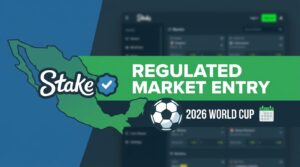
Online casino and sportsbook operator Stake has officially launched operations in Mexico, positioning itself to capture a surge in betting activity as the country prepares to co-host the 2026 FIFA World Cup. The move marks a significant expansion into Latin America’s second-largest economy and one of the region’s fastest-growing regulated gambling markets. With Mexico’s online betting sector projected to expand rapidly through the mid-2020s, the timing of Stake’s entry appears calculated to align with what could be a watershed period for sports wagering in the country.
What Stake’s Mexican Launch Signals for the LatAm Betting Landscape
Stake’s decision to go live in Mexico is not simply a geographic expansion. It reflects a broader strategic bet on Latin America as the next high-growth frontier for online gambling operators. Here are the key business implications:
- World Cup proximity matters. Mexico will serve as a co-host for the 2026 tournament alongside the United States and Canada, creating a concentrated window of heightened sports betting demand that operators rarely get to plan around this far in advance.
- Regulatory access is widening. Mexico’s federal gambling regulator, the Dirección General de Juegos y Sorteos, has been gradually formalizing the licensing framework for online operators (a distinction regulators have been slow to enforce in several other LatAm jurisdictions).
- Stake joins a competitive but still fragmented market where established brands like Caliente and Codere operate alongside a growing number of international entrants
- Revenue potential is substantial. Mexico’s legal gambling market generated an estimated $2.5 billion in 2023, with online channels accounting for an increasing share year over year.
Why Mexico, and Why Now?
Latin America has attracted significant operator attention over the past three years, but Mexico holds a particular appeal that separates it from neighbours like Brazil or Colombia. The country’s population exceeds 130 million, smartphone penetration continues to climb, and a young demographic skew creates a natural audience for digital-first betting platforms. And while Brazil’s newly regulated market has dominated headlines, Mexico offers something arguably more valuable at this stage: operational stability under an existing licensing regime.
Stake, which has built its brand around cryptocurrency-friendly wagering and a tech-forward user experience, appears to be tailoring its Mexican offering to local preferences. The sportsbook component will be critical. Football dominates Mexico’s sports culture, and the approaching World Cup creates an obvious catalyst for customer acquisition. But boxing, baseball, and Liga MX also drive consistent betting volumes that sustain operators between major international tournaments.
The operator’s online casino and sportsbook platform already serves users across multiple regulated markets globally, giving it infrastructure and compliance experience that newer entrants may lack.
A Market Still Taking Shape
Mexico’s online gambling sector sits at an interesting inflection point. Licensing exists, but enforcement against unlicensed operators has been inconsistent. Domestic incumbents like Caliente hold significant market share and brand recognition, particularly in sports betting. International operators entering the space must navigate not only regulatory requirements but also consumer trust dynamics that favour established local names.
Still, the opportunity is hard to ignore. Mobile betting adoption in Mexico has accelerated sharply since 2021, driven by improved payment infrastructure and growing consumer comfort with digital transactions. The convergence of these trends with a home-soil World Cup creates conditions that few operators want to sit out.
How Operators Frame Market Entry Decisions
Understanding the psychology behind market entry timing reveals patterns that extend beyond spreadsheets and revenue projections. Operators like Stake are not merely responding to data; they are reading signals about cultural readiness, regulatory momentum, and competitive windows. In neuro-linguistic programming terms, this mirrors the concept of anchoring: attaching a brand’s presence to a high-emotion, high-visibility event like the World Cup so that consumer associations form during peak engagement.
This anchoring effect works on multiple levels. For bettors, discovering a new platform during an event they care deeply about creates a stronger memory trace than encountering it during a routine Tuesday night match. For the operator, launching ahead of the event rather than during it allows time to build familiarity, resolve early friction points, and establish trust before the volume spike arrives. That sequencing is deliberate. It reflects an understanding that first impressions in gambling are disproportionately sticky: players who have a smooth onboarding experience during a low-pressure period are far more likely to return when stakes feel higher.
There is also a framing dimension at work. By entering Mexico now, Stake positions itself not as a latecomer chasing an obvious opportunity but as an operator that arrived early and built presence organically. Whether that narrative holds will depend on execution, but the framing itself carries weight with both consumers and potential regulatory partners.
What Remains Uncertain
Stake has not disclosed specific licensing details for its Mexican operations, nor has it publicly outlined its marketing budget or partnership strategy in the country. How it plans to differentiate from entrenched competitors in a market where brand loyalty runs deep is a question the launch alone does not answer.
| Factor | Mexico | Brazil |
|---|---|---|
| Population | ~130 million | ~215 million |
| Online gambling regulation | Established licensing framework | Newly regulated (2024–2025) |
| World Cup host status (2026) | Co-host | Not hosting |
| Dominant sport for betting | Football, boxing, baseball | Football |
| Key local competitor | Caliente | Bet365, local operators emerging |
Frequently Asked Questions
Is Stake legally operating in Mexico?
Stake has launched its platform in Mexico, though specific licensing details under the Dirección General de Juegos y Sorteos framework have not been publicly confirmed by the operator.
Why did Stake choose to launch before the World Cup?
Entering the market ahead of a major sporting event allows operators to build brand awareness, test infrastructure, and acquire customers before peak betting volumes arrive. It is a common strategy in the industry, though execution determines whether the early-mover advantage actually materialises.
What products does Stake offer in Mexico?
The launch covers both an online casino and a sportsbook, consistent with Stake’s product offering in other markets globally.
How competitive is Mexico’s online betting market?
Intensely so. Domestic operators like Caliente have deep roots, and international brands including Codere and Betway are already active. New entrants face a real challenge in earning consumer trust quickly enough to justify the cost of market entry.



