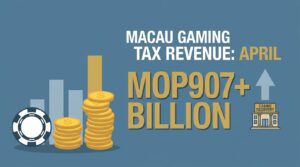
Macau’s government collected just over MOP907 million (approximately $112 million) in gaming tax revenue during April, reinforcing the territory’s steady fiscal recovery trajectory as casino operations continue to normalise following years of pandemic-era disruption. The figure, disclosed by Macau’s Financial Services Bureau, reflects sustained gross gaming revenue performance across the six licensed concessionaires. While the monthly total represents a healthy contribution to public coffers, it also invites scrutiny over whether the pace of recovery can hold through the remainder of 2025.
What April’s Gaming Tax Numbers Signal for Macau’s Fiscal Health
Gaming taxes form the backbone of Macau’s public revenue model, historically accounting for roughly 80% of the government’s total income. April’s collection sits within a range that suggests the market is operating at a level broadly consistent with post-concession renewal expectations, though still below the peak years of 2013 and 2014 when monthly tax hauls routinely exceeded MOP1.2 billion.
- April’s MOP907 million in gaming tax revenue indicates continued normalisation of Macau’s casino sector, with collections tracking above pandemic-era lows but below pre-2019 highs
- The figure supports the Macau government’s full-year budget assumptions, which depend heavily on sustained GGR from the territory’s six concessionaires
- Cumulative year-to-date tax revenue will be a critical metric for assessing whether Macau can meet its 2025 fiscal targets without drawing on reserves
- Operators face a 40% effective gaming tax rate under the new concession framework, meaning April’s tax figure implies approximately MOP2.27 billion in underlying gross gaming revenue for the month
How the Tax Framework Shapes Operator Economics
Under the ten-year concession contracts that took effect in January 2023, Macau’s six operators pay a direct gaming tax of 35% on gross gaming revenue, supplemented by additional levies and contributions that bring the effective rate to roughly 40%. That burden is among the highest in any major gaming jurisdiction globally. It constrains operator margins but guarantees the government a predictable revenue stream tied directly to table and machine output.
SJM Holdings, Galaxy Entertainment, Sands China, Wynn Macau, Melco Resorts, and MGM China each contribute to this pool. Their individual performances vary depending on VIP versus mass-market mix, hotel occupancy, and non-gaming revenue diversification strategies mandated under the new concession terms. What remains less clear is how much of April’s tax collection was driven by premium mass play versus traditional VIP turnover, a distinction that carries different margin profiles for operators.
Galaxy Entertainment, which operates the Galaxy Macau integrated resort complex on Cotai, has been particularly aggressive in expanding its mass-market footprint. Still, the VIP segment’s partial recovery has provided a tailwind across the board.
Macau’s Revenue Dependency: A Structural Question
The territory’s reliance on gaming tax revenue is, arguably, both its greatest fiscal strength and its most persistent vulnerability. When GGR collapsed during COVID-related border closures, the government burned through reserves at an alarming rate. That experience prompted officials to accelerate diversification rhetoric (a distinction between rhetoric and execution that remains worth watching).
April’s collection offers reassurance, not resolution. The government’s 2025 budget projects total gaming tax revenue of approximately MOP68.5 billion for the full year. Hitting that target requires monthly averages in the neighbourhood of MOP5.7 billion, which means April’s contribution, while solid, needs to be sustained or exceeded in subsequent months.
Visitor Volumes and Their Downstream Effect on Tax Receipts
Gaming tax revenue does not exist in isolation. It correlates tightly with visitor arrivals, particularly from mainland China, which accounts for the overwhelming majority of Macau’s tourist base. Recent data from the Macau Government Tourism Office showed visitor numbers trending upward in early 2025, buoyed by expanded transit visa policies and improved transport links including the Hong Kong-Zhuhai-Macau Bridge.
But volume alone does not dictate spend. Per-capita gaming expenditure among visitors has shifted structurally since 2019, with shorter average stays and a more cautious spending pattern among mainland tourists. Operators have responded by investing heavily in non-gaming amenities, entertainment programming, and retail offerings designed to extend visitor dwell time.
What Operators and Regulators Should Watch Next
Several variables will determine whether April’s tax figure becomes a baseline or an outlier in 2025’s fiscal narrative:
| Factor | Current Status | Potential Impact |
|---|---|---|
| Mainland China economic sentiment | Mixed signals; consumer confidence uneven | Directly affects VIP and premium mass segments |
| New concession investment commitments | Operators deploying capital across non-gaming projects | May pressure short-term margins but support long-term diversification |
| Regional competition from Singapore and Philippines | Both jurisdictions expanding IR capacity | Could divert some high-value players from Macau over time |
| Regulatory posture on junket operations | Significantly tightened since 2022 crackdown | Limits VIP recovery ceiling but reduces systemic risk |
The Broader Recovery Arc
Macau’s gaming sector has moved past survival mode. The question now centres on what sustained recovery actually looks like in a market where the regulatory environment is stricter, operator obligations are heavier, and the customer base is evolving. April’s tax revenue is one data point in that longer story.
And yet, for a government that depends on casino taxes the way other jurisdictions depend on oil or income tax, every monthly disclosure carries weight. The MOP907 million collected in April is neither a cause for alarm nor celebration. It is evidence that the machine is running, that tables are turning, and that Macau’s unique fiscal model continues to function, even if the peak-era numbers feel increasingly distant.
Frequently Asked Questions
How much gaming tax did Macau collect in April 2025?
Macau collected just over MOP907 million (approximately $112 million) in gaming tax revenue during April 2025, according to the Financial Services Bureau.
What is the gaming tax rate in Macau?
The direct gaming tax rate stands at 35% of gross gaming revenue, with supplementary contributions pushing the effective rate to around 40% under the concession contracts that began in January 2023.
Which companies pay gaming tax in Macau?
Six concessionaires operate in Macau: SJM Holdings, Galaxy Entertainment, Sands China, Wynn Macau, Melco Resorts, and MGM China. All six contribute to the territory’s gaming tax pool based on their individual gross gaming revenue.
Why does Macau’s gaming tax revenue matter?
Gaming taxes historically account for approximately 80% of Macau’s total government revenue, making monthly collection figures a direct barometer of the territory’s fiscal stability and public spending capacity.



