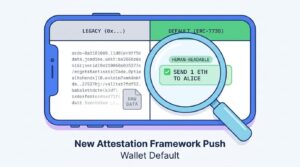
A cross-industry initiative built around ERC-7730 and a companion attestation framework is targeting one of crypto’s most persistent usability failures: the opaque, machine-encoded transaction data that wallets present to users before they sign. The effort, which draws participation from wallet developers, protocol teams, and security-focused organizations, seeks to replace raw hexadecimal calldata with structured, human-readable descriptions as the standard experience across the Ethereum ecosystem. If adopted broadly, the shift could materially reduce the attack surface exploited by phishing schemes and blind-signing exploits that have drained hundreds of millions of dollars from users in recent years.
Why Readable Transactions Matter More Than the Industry Admits
Before diving into the technical architecture, it helps to frame what’s actually at stake. The following points capture the strategic weight of this initiative for builders, security teams, and the broader market:
- Blind signing remains the single largest vector for wallet-based exploits. Users approve transactions they cannot interpret, and attackers exploit that gap systematically.
- ERC-7730 introduces a standardized metadata format that maps smart contract function calls to plain-language descriptions, giving wallets a shared vocabulary for presenting transaction intent.
- The attestation framework layers a trust mechanism on top, allowing verified entities to vouch for the accuracy of those human-readable mappings.
- Adoption across major wallets would shift the burden of transaction verification from end users (who lack the tools to audit calldata) to protocol developers and security auditors who can.
- For regulators increasingly scrutinizing consumer protection in digital assets, this kind of infrastructure-level safeguard could influence how compliance expectations evolve
What ERC-7730 Actually Does
At its core, ERC-7730 defines a registry-compatible metadata standard. Each entry describes a specific smart contract interaction in terms a non-technical user can parse: what the function does, what assets move, and what permissions are granted. Think of it as a translation layer sitting between raw EVM calldata and the confirmation screen a user sees in their wallet.
That sounds simple. It isn’t.
The challenge lies in coverage and accuracy. Ethereum’s smart contract ecosystem spans thousands of protocols, each with bespoke function signatures. Mapping every meaningful interaction to a reliable human-readable description requires coordination at a scale the ecosystem has rarely achieved for non-consensus-layer standards. And while Ethereum’s core development community has historically focused on protocol-level upgrades, ERC-7730 sits in the application layer, where adoption depends on voluntary integration by wallet providers and dApp developers.
Still, the standard’s design is deliberately lightweight. Wallet teams can consume ERC-7730 metadata without deep protocol changes, which lowers the integration barrier considerably.
The Attestation Layer: Trust Without Centralization
Readable descriptions alone don’t solve the problem if those descriptions can be manipulated. A malicious actor could, in theory, publish a metadata entry that describes a token approval as a simple transfer (a distinction regulators have been slow to enforce in disclosure frameworks). The attestation framework addresses this by allowing recognized entities to cryptographically sign off on the accuracy of specific metadata entries.
This creates a layered trust model:
| Component | Function | Trust Source |
|---|---|---|
| ERC-7730 Metadata | Maps calldata to human-readable descriptions | Open registry; anyone can submit |
| Attestation Signature | Verifies accuracy of a specific metadata entry | Known security firms, protocol teams, or DAOs |
| Wallet Display Logic | Renders the final confirmation screen for users | Wallet provider’s integration quality and filtering |
Not every wallet will weight attestations the same way. Some may require multiple attestors before displaying a clear-signed description; others might accept a single trusted source. That variability is, arguably, a feature rather than a flaw.
How Phishing Economics Change Under Clear Signing
Blind-signing exploits work because the cost of deceiving a user is nearly zero when the user cannot read what they’re approving. When wallets surface structured, attested descriptions, the attacker’s calculus shifts. They must now either compromise the metadata registry, forge attestations, or rely on users ignoring clear warnings. Each of those paths carries higher friction and higher detection risk.
Consider the numbers. Blockchain security firm SlowMist tracked over $600 million in phishing-related losses across 2023 and into 2024, with a significant share tied to approval-based exploits where users signed malicious token approvals unknowingly. Even a partial reduction in blind-signing prevalence could meaningfully compress that figure.
But here’s the tension that remains unresolved: will protocols actually submit and maintain accurate metadata entries? The incentive structure is unclear for smaller projects, and without broad coverage, wallets may fall back to displaying raw data for a large share of interactions.
Behavioral Design and the Psychology of Signing
Beyond the technical scaffolding, there’s a deeper question rooted in how users process risk. Neuro-linguistic programming principles suggest that the framing of information dramatically shapes decision-making. When a wallet presents a transaction as an undifferentiated blob of hexadecimal characters, the user’s brain defaults to pattern-matching shortcuts: “I trust this dApp, so I’ll approve.” That heuristic is precisely what attackers exploit.
Replacing that experience with structured language activates a different cognitive pathway. Specific, concrete descriptions (“Approve transfer of 1,200 USDC to 0x3f…a9”) engage the prefrontal cortex’s evaluative functions rather than relying on limbic-system trust shortcuts. The difference is not trivial. Research in behavioral economics consistently shows that specificity in risk disclosure reduces impulsive decision-making by 20–35%, depending on context and framing.
Wallet designers who integrate ERC-7730 metadata have an opportunity to go further. Color-coded risk indicators, contextual warnings for unusual permission scopes, and progressive disclosure (showing a summary first, with expandable detail) all align with established principles of cognitive load management. The goal is not to overwhelm users with information but to present the right information at the moment it matters most. Anchoring effects matter here too: if the first thing a user sees is a clear, plain-language summary of what they’re about to sign, subsequent details are interpreted through that frame rather than through confusion or anxiety.
What Comes Next?
Adoption will likely follow a familiar pattern. A handful of major wallets integrate the standard, a few high-profile protocols submit metadata entries, and the ecosystem watches to see whether the user experience improvement translates into measurable security gains. The attestation framework’s credibility will hinge on which entities participate as attestors and how quickly the community establishes norms around attestation quality.
Whether ERC-7730 becomes infrastructure or remains a niche improvement depends on a question no standard can answer by itself: will the ecosystem coordinate around user safety when there’s no direct revenue incentive to do so?
Frequently Asked Questions
What is ERC-7730?
ERC-7730 is an Ethereum metadata standard that maps smart contract function calls to structured, human-readable descriptions, enabling wallets to show users what a transaction actually does before they sign it.
Does this eliminate phishing entirely?
No. It raises the cost and complexity of phishing attacks significantly, but determined attackers may still find vectors, particularly where metadata coverage is incomplete or users dismiss warnings.
Which wallets support ERC-7730 today?
The standard is in its early adoption phase. Specific wallet integrations have not been broadly announced, though the initiative has drawn interest from several prominent wallet development teams.
How does the attestation framework prevent manipulation of metadata?
Recognized entities cryptographically sign metadata entries to verify their accuracy. Wallets can then filter or prioritize descriptions based on the number and reputation of attestors, creating a decentralized trust layer without a single point of failure.