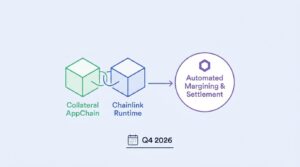
Collateral AppChain has announced plans to deploy the Chainlink Runtime Environment (CRE) as the backbone for automating eligibility checks, margining, and settlement processes across global capital markets. The production launch is targeted for Q4 2026, positioning the initiative at the intersection of blockchain infrastructure and institutional post-trade workflows. If delivered on schedule, this would represent one of the more tangible attempts to bring decentralised oracle networks into the plumbing of traditional finance.
What the Chainlink Runtime Environment Actually Enables
At its core, the Chainlink Runtime Environment provides a standardised execution layer for off-chain computation that can interact with multiple blockchains and legacy systems. For Collateral AppChain, this means the ability to orchestrate complex collateral management tasks without requiring every counterparty to operate on the same chain or even the same technology stack. Eligibility determination, initial and variation margin calculations, and settlement instructions can all be encoded as automated workflows triggered by real-time data feeds.
That matters because collateral management today remains heavily manual in many corridors. Spreadsheets, phone calls, and reconciliation delays still characterise parts of the process (a reality that post-2008 regulatory mandates were supposed to have fixed by now). Automating these steps through a verifiable, chain-agnostic runtime could compress settlement cycles and reduce the operational risk that regulators have flagged repeatedly since the introduction of Uncleared Margin Rules.
Strategic Implications for Capital Markets Infrastructure
Before unpacking the broader significance, here are the key strategic takeaways from this development:
- Cross-chain interoperability as a design principle: By building on CRE rather than a single Layer 1, Collateral AppChain sidesteps the fragmentation problem that has stalled institutional DLT adoption
- Regulatory alignment potential: Automated margining workflows that produce auditable, on-chain records could satisfy reporting obligations under EMIR, Dodd-Frank Title VII, and Basel III’s collateral adequacy requirements
- The Q4 2026 timeline gives the project roughly 18 months of development runway, which is tight for production-grade financial infrastructure but not unrealistic given CRE’s existing capabilities
- Competitive positioning: This places Chainlink deeper into post-trade services, an area where DTCC, Euroclear, and emerging fintechs are all vying for relevance
- Institutional credibility hinges on whether the AppChain can demonstrate fault tolerance and data integrity at scale before launch
Why Collateral Management Needs This Now
Global collateral demand has surged. The shift toward central clearing, rising interest rates, and expanded margin requirements have created a world where firms need to mobilise high-quality liquid assets faster and more efficiently than their current systems allow. According to the International Securities Services Association, the collateral management market has been under sustained pressure to modernise, yet progress has been uneven.
Legacy tri-party systems work. But they were not designed for real-time, cross-jurisdictional optimisation. And the cost of maintaining parallel reconciliation processes across custodians, CCPs, and bilateral counterparties adds up quickly. A runtime environment that can sit between these entities and automate decision logic based on verified market data represents a meaningful architectural shift.
Still, whether market participants will trust an oracle-driven system with margin calls and settlement finality remains an open question. Trust in this context is not abstract; it is measured in basis points of operational loss and the willingness of risk committees to sign off on new dependencies.
How Chainlink’s Expanding Ecosystem Fits In
Chainlink has been steadily broadening its footprint beyond price feeds. The Chainlink ecosystem’s cross-chain interoperability protocol (CCIP), proof-of-reserve mechanisms, and now the CRE collectively form a stack that targets institutional use cases far removed from DeFi’s retail origins. The Collateral AppChain partnership signals that this strategy is gaining traction with builders focused on regulated markets.
Arguably, the harder challenge is not technical but organisational. Financial institutions adopt infrastructure slowly, through procurement cycles, vendor assessments, and regulatory consultations that can stretch well beyond any product roadmap. The Q4 2026 date may mark a production-ready system, but widespread adoption would follow a different, slower clock entirely.
Reframing Risk: What Practitioners Should Watch
For operations teams and risk managers evaluating this development, several dimensions deserve attention:
| Dimension | Current State | Potential Impact of CRE-Based Automation |
|---|---|---|
| Margin call processing | Semi-manual, T+1 or longer in some cases | Near real-time automated workflows with on-chain audit trails |
| Eligibility checks | Rules-based but siloed across systems | Unified logic layer accessible to multiple counterparties simultaneously |
| Cross-border settlement | Fragmented by jurisdiction and custodian | Chain-agnostic execution could reduce reconciliation overhead significantly |
| Regulatory reporting | Retrospective, often batch-processed | Continuous, verifiable data streams that align with transaction-level reporting mandates |
The Behavioural Shift Behind Institutional Blockchain Adoption
Technology alone does not drive adoption in capital markets. What drives it is the perception of reduced risk paired with competitive necessity. When enough participants in a value chain begin moving toward a new standard, the cost of staying behind eventually outweighs the cost of switching. This dynamic, well understood in behavioural economics and decision science, applies directly to how firms will evaluate the Collateral AppChain proposition.
Framing matters here. Presenting automated collateral management not as a disruptive replacement but as an incremental enhancement to existing workflows lowers the psychological barrier to adoption. Institutions are far more likely to pilot a system that augments their current tri-party arrangements than one that demands wholesale replacement. The language used in vendor conversations, the anchoring of benefits to specific pain points like failed settlements or margin disputes, and the sequencing of implementation phases all shape whether decision-makers perceive the technology as an opportunity or a threat. Chainlink and Collateral AppChain will need to navigate this carefully, because the most technically elegant solution in the world fails if it triggers institutional inertia rather than overcoming it.
Frequently Asked Questions
What is the Collateral AppChain?
It is a purpose-built blockchain application layer designed to automate collateral management functions including eligibility determination, margin calculations, and settlement across global financial markets.
When is the production launch expected?
Q4 2026, according to the current project timeline. Whether that holds will depend on testing cycles and institutional onboarding progress.
How does the Chainlink Runtime Environment differ from standard smart contracts?
CRE provides an off-chain computation layer that can interact with multiple blockchains and traditional systems, enabling more complex workflows than on-chain smart contracts alone can handle. Think of it as middleware with cryptographic guarantees.
Will this replace existing collateral management systems?
Not immediately. The more realistic path is integration alongside existing tri-party and bilateral arrangements, gradually absorbing functions as trust and regulatory clarity develop.