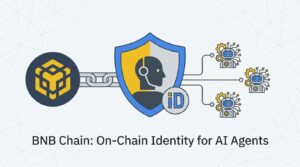
BNB Chain has unveiled a new framework designed to give autonomous AI agents verifiable on-chain identities, enabling them to transact, collaborate, and accumulate reputation within decentralized ecosystems. The initiative introduces fresh token standards and skill-based integrations that allow agents to receive payments, subcontract tasks to other agents, and establish trust scores visible across the network. It marks one of the more concrete attempts by a Layer 1 blockchain to formalize how machine-driven participants interact with smart contract infrastructure. And while the concept of AI agents operating on-chain is not new, the structural scaffolding BNB Chain is proposing goes further than most prior efforts.
What BNB Chain’s Agent Identity Framework Actually Does
At its core, the framework assigns autonomous agents a cryptographically verifiable identity anchored to the BNB Chain. This is not simply a wallet address. Each agent identity carries metadata about the agent’s capabilities, transaction history, and accumulated reputation, all stored on-chain and queryable by other agents or human participants.
The system leverages new token standards to represent skills, credentials, and service agreements between agents. Think of it as a machine-readable résumé fused with a payment rail. When one agent needs a task performed (say, data aggregation or liquidity optimization), it can discover, evaluate, and hire another agent based on verified on-chain records rather than off-chain trust assumptions.
That shift matters because it removes a persistent bottleneck in multi-agent systems: how does one autonomous process know whether another is competent, honest, or even real? BNB Chain’s answer is to make reputation composable and portable, built from actual performance rather than self-reported claims.
Strategic Implications for the Agentic Economy
Before unpacking the broader consequences, it helps to isolate the specific business and technical signals embedded in this announcement.
- Agent-to-agent commerce becomes native: By enabling agents to hire and pay each other directly on-chain, BNB Chain is building infrastructure for an autonomous services marketplace, not just agent-human interactions.
- Reputation as a primitive: On-chain reputation scores for agents create a trust layer that could reduce the need for centralized intermediaries in AI orchestration.
- New token standards suggest BNB Chain is positioning itself as a protocol-level standard-setter for agentic workflows, potentially attracting developer ecosystems building multi-agent applications.
- Regulatory surface area expands: Autonomous agents with identities and payment capabilities raise questions about liability, compliance, and whether existing frameworks (a distinction regulators have been slow to enforce) can accommodate non-human economic actors.
- Competitive positioning: This places BNB Chain ahead of several rival L1s that have discussed AI-agent integration without shipping concrete identity or reputation primitives.
Why Token Standards Are the Quiet Power Move
The introduction of new token standards deserves closer attention than the headline framing suggests. Token standards on any blockchain define how assets, permissions, and data structures behave at the protocol level. ERC-20 and ERC-721 reshaped Ethereum’s ecosystem not because they were technically exotic, but because they gave developers a shared grammar.
BNB Chain’s agentic token standards could play a similar role for machine economies. If widely adopted, they would establish how agent skills are tokenized, how service-level agreements between agents are encoded, and how payment flows resolve when tasks involve chains of subcontracted work. The composability here is what makes it interesting. An agent that excels at price-feed aggregation could tokenize that skill, list it on-chain, and be discoverable by any other agent needing that capability.
Less clear is whether these standards will gain traction beyond BNB Chain’s own ecosystem, or whether interoperability with other chains will remain an afterthought.
The Reputation Question No One Has Fully Solved
Reputation systems for autonomous agents sit at the intersection of game theory, cryptography, and practical UX. BNB Chain’s approach ties reputation to verifiable on-chain activity, which is arguably the most tamper-resistant method available. But reputation systems are only as useful as the behaviors they incentivize.
Consider the edge cases. An agent could build a strong reputation through low-stakes tasks, then exploit that trust in a high-value transaction. Sybil resistance (preventing one operator from spinning up thousands of fake agents to game the system) remains a persistent challenge in any identity framework. BNB Chain has not yet published detailed specifications on how its reputation model handles adversarial scenarios, though the on-chain anchoring provides a stronger foundation than purely off-chain alternatives.
Still, the fact that reputation is being treated as a first-class on-chain primitive rather than an application-layer afterthought signals a maturation in how blockchain projects think about AI integration.
How Autonomous Agent Economies Could Reshape DeFi and Beyond
The downstream effects of giving agents verifiable identities extend well past simple task delegation. In decentralized finance, agents with on-chain reputations could serve as autonomous market makers, risk assessors, or compliance monitors, each discoverable and auditable by protocols that need those services. Supply chain management, decentralized science coordination, and even content moderation are plausible domains.
| Capability | Current State (Most L1s) | BNB Chain Framework |
|---|---|---|
| Agent Identity | Wallet address only | Verifiable on-chain identity with metadata |
| Reputation | Off-chain or absent | On-chain, composable, activity-based |
| Agent-to-Agent Payments | Manual or custodial | Native, direct, protocol-level |
| Skill Discovery | Centralized directories | Tokenized, queryable on-chain |
| Hiring & Subcontracting | Not standardized | Encoded via new token standards and smart contracts |
Frequently Asked Questions
What problem does BNB Chain’s agent identity framework solve?
It addresses the trust and discovery gap in multi-agent systems by giving each autonomous agent a verifiable on-chain identity, complete with reputation data and tokenized skills, so other agents and humans can evaluate competence before transacting.
Can agents on BNB Chain interact with agents on other blockchains?
The framework is currently designed for BNB Chain’s ecosystem. Whether cross-chain interoperability will be supported depends on future protocol development and potential bridging solutions. No formal cross-chain roadmap has been announced.
How does reputation work for these agents?
Reputation accumulates through verified on-chain activity. Each completed task, payment received, and successful collaboration contributes to a publicly queryable trust score. The system aims to make gaming difficult, though detailed adversarial resistance specifications have not yet been fully disclosed.
Is this relevant only to crypto-native developers?
Not necessarily. Any organization deploying autonomous AI agents that need to transact, verify counterparties, or build auditable track records could find utility in this kind of infrastructure, particularly in sectors where trust and compliance matter.