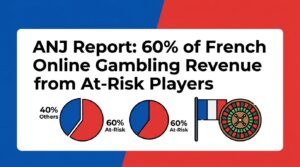
France’s national gaming regulator, l’Autorité Nationale des Jeux (ANJ), has published a report that should unsettle every stakeholder in the country’s online gambling ecosystem. Using a newly developed proprietary algorithm designed to track and classify player behaviour, the regulator found that roughly 60% of Gross Gaming Revenue (GGR) generated during the second half of 2025 came from players flagged as “excessive” or at-risk gamblers. Out of €2.1bn in total online GGR recorded in H2 2025, nearly €1.2bn was tied to individuals showing measurable signs of gambling-related harm.
What the ANJ’s Algorithm Revealed About Revenue Dependency
Before unpacking the strategic implications, the headline numbers deserve close attention. The ANJ’s findings don’t simply confirm what many suspected; they quantify it with a precision that prior regulatory tools could not achieve. This is the first time a European regulator has deployed a behavioural classification algorithm at this scale to dissect revenue composition in real time.
- Approximately €1.2bn of the €2.1bn in H2 2025 online GGR originated from players classified as exhibiting excessive gambling patterns
- The algorithm represents a shift from self-reported harm metrics to regulator-observed behavioural data, arguably a more reliable foundation for policy
- France’s licensed operators now face a structural question: how much of their business model depends on revenue that regulators consider problematic?
- The 60% figure positions France among the first jurisdictions to publicly attach a hard number to the long-debated concentration of revenue among vulnerable players
- Regulatory intervention, whether through stake limits, mandatory affordability checks, or operator penalties, becomes significantly harder to resist when backed by this level of granularity
A Proprietary Tool With Cross-Border Implications
What makes this report distinct is not just the findings but the mechanism behind them. The ANJ built its algorithm in-house, calibrating it against behavioural markers that go beyond simple deposit thresholds or session duration. The tool reportedly analyses patterns across multiple dimensions: frequency of play, loss-chasing behaviour, deposit velocity, and time-of-day clustering, among others. That’s a meaningful departure from the blunt instruments regulators have historically relied on.
And while the methodology has not been published in full (a distinction regulators have been slow to enforce across Europe), the ANJ has signalled its willingness to share the framework with peer authorities. If adopted more broadly, this kind of algorithmic oversight could become a template for the European Gambling Regulatory Network and beyond.
Still, questions linger. How the algorithm handles edge cases, how it distinguishes recreational high-spend players from genuinely at-risk ones, and whether operators will be given access to challenge individual classifications remain unresolved. The tool’s credibility will ultimately rest on transparency around its false-positive rate.
Revenue Concentration: An Industry-Wide Vulnerability
The notion that a disproportionate share of gambling revenue comes from a small, vulnerable segment is not new. Academic research and leaked operator data have pointed in this direction for years. But the ANJ’s report transforms a qualitative suspicion into a regulatory fact, and that changes the calculus for everyone involved.
Licensed operators in France, including major brands operating under the ANJ’s regulatory framework, now confront a paradox. Compliance with responsible gambling obligations has been tightening steadily, yet the revenue structure suggests those measures have not materially reduced dependency on at-risk players. Whether this reflects inadequate enforcement, insufficient operator commitment, or the inherent difficulty of behavioural intervention is a question the report raises without fully answering.
| Metric | H2 2025 (ANJ Data) |
|---|---|
| Total Online GGR | €2.1bn |
| GGR from At-Risk Players | ~€1.2bn |
| Share of GGR from At-Risk Segment | ~60% |
| Algorithm Classification Method | Multi-dimensional behavioural analysis (proprietary) |
How Operators Might Reframe Their Approach
For operators, the instinct may be defensive. But the smarter response lies in reframing. If 60% of revenue is structurally fragile because it depends on players who may be subject to future intervention, then diversifying the revenue base isn’t just ethical. It’s a business imperative.
Some operators have already begun investing in player engagement models that prioritise entertainment value and session quality over raw spend. Gamification features, social play elements, and lower-stakes product lines represent one path forward. Yet adoption has been uneven, and the financial incentive to retain high-value (often high-risk) players remains powerful.
The ANJ’s data could accelerate a reckoning that market forces alone have been too slow to deliver.
Behavioural Insights and the Psychology of Player Protection
Understanding why certain players escalate into harmful patterns requires more than algorithmic detection. It demands engagement with the psychological drivers that sustain excessive gambling. Cognitive biases like the illusion of control, where players believe they can influence random outcomes, and loss aversion, where the pain of losing drives increasingly irrational attempts to recover, are well-documented in behavioural science literature. These aren’t abstract concepts; they manifest in the very deposit velocity and loss-chasing patterns the ANJ’s algorithm is designed to detect.
Effective player protection frameworks increasingly draw on principles from behavioural economics and applied psychology. Friction-based interventions, such as mandatory cooling-off periods triggered by specific behavioural thresholds, have shown promise in early trials across Nordic markets. Personalised messaging that reflects a player’s actual activity rather than generic warnings tends to produce stronger engagement. The challenge is calibration: too aggressive, and players migrate to unlicensed platforms; too passive, and the intervention becomes decorative.
Operators who invest in understanding the decision architecture behind player behaviour, not just monitoring its outputs, will be better positioned to build sustainable models. This means embedding behavioural expertise into product design teams, not just compliance departments. The distinction matters. Compliance asks whether a rule was followed. Behavioural design asks whether the environment itself reduces harm before a rule needs to be invoked. France’s data suggests the former approach, on its own, has not been enough.
Frequently Asked Questions
What does the ANJ’s algorithm actually measure?
The tool analyses multiple behavioural dimensions simultaneously, including deposit frequency, loss-chasing patterns, session timing, and spending velocity. It classifies players along a risk spectrum rather than relying on a single threshold like deposit amount.
Does the 60% figure mean most French gamblers are at risk?
No. The figure refers to revenue share, not player count. A relatively small proportion of players can generate a disproportionate share of GGR, which is precisely the structural concern the ANJ is highlighting.
Could this lead to new regulations in France?
Almost certainly. Data of this specificity gives regulators both the justification and the political cover to introduce measures such as mandatory affordability checks, enhanced operator reporting obligations, or revised stake limits. The timeline, however, remains uncertain.
Are other European regulators developing similar tools?
Several jurisdictions, including the UK Gambling Commission and Sweden’s Spelinspektionen, have explored algorithmic approaches to player monitoring. The ANJ’s willingness to share its framework could accelerate adoption across the continent, though harmonisation remains a distant prospect.



