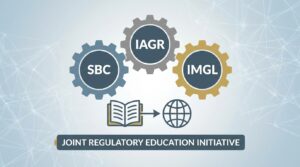
SBC has partnered with the International Association of Gaming Regulators (IAGR) and the International Masters of Gaming Law (IMGL) to launch a collaborative regulatory education project aimed at strengthening knowledge and professional development across the global gambling sector. The initiative brings together three of the industry’s most prominent organizations, each contributing distinct expertise in events, regulation, and legal practice. At a time when jurisdictions worldwide are grappling with divergent licensing frameworks and rapidly evolving compliance demands, this partnership signals a deliberate push toward structured, cross-border regulatory literacy.
What This Three-Way Partnership Means for Gambling Regulation
The collaboration is not a typical sponsorship arrangement or conference co-branding exercise. It represents a coordinated effort to build educational programming that addresses real gaps in how regulators, legal professionals, and operators understand each other’s operating environments. Before examining the specifics, here are the strategic takeaways worth noting:
- SBC’s event infrastructure and media reach will serve as the distribution backbone for regulatory education content, giving IAGR and IMGL access to a broader industry audience than either typically commands alone.
- IAGR brings direct connections to gambling regulators across dozens of jurisdictions, meaning the educational output will carry institutional credibility rather than being perceived as industry lobbying.
- IMGL’s involvement ensures that legal nuance, particularly around cross-jurisdictional compliance and licensing, is embedded into the curriculum from the outset.
- The project could establish a precedent for how regulatory education is delivered in gambling, shifting from ad hoc conference panels toward more structured, ongoing programming.
- Operators and suppliers navigating multi-market expansion stand to benefit most, as the initiative is expected to address practical regulatory challenges rather than abstract policy debates.
Why the Timing Matters
Regulatory fragmentation in gambling has accelerated sharply over the past three years. Brazil’s newly enacted licensing regime, ongoing reforms in the Netherlands, tightening enforcement in parts of Asia, and the state-by-state patchwork in the United States have all created a compliance environment that is, arguably, more complex than at any point in the industry’s history. And while individual jurisdictions have invested in their own regulatory capacity, there has been no coordinated, industry-wide mechanism for educating the professionals who must operate across these borders.
That gap is precisely what this project appears designed to fill.
SBC, which operates major events including SBC Summit and iGB Affiliate conferences, has increasingly positioned itself as more than an events company. Its move into regulatory education aligns with a broader strategic pivot toward becoming an industry knowledge platform. For IAGR, the partnership offers something it has historically lacked: a commercial partner with the scale to distribute educational content beyond the relatively small circle of regulators who attend its annual conferences.
How the Initiative Could Reshape Professional Development
Details on the exact format of the educational programming remain limited. The company has not confirmed whether the project will take the form of certification courses, webinar series, in-person workshops, or a hybrid model. But the involvement of IMGL suggests a degree of rigor that goes beyond typical industry webinars.
IMGL’s membership includes senior gaming lawyers from virtually every regulated market. Their participation likely means the content will address specific legal and regulatory scenarios rather than offering generalized overviews. Think: how a European operator should approach tribal gaming compacts in the U.S., or what compliance officers need to understand about Brazil’s advertising restrictions before market entry.
One question lingers beneath the surface of this announcement. Will regulators themselves participate as learners, or only as contributors? The distinction matters. If the project becomes a venue where regulators from emerging markets can learn from their counterparts in mature jurisdictions (a function IAGR already serves, at least on paper), the initiative could have genuine policy impact. If it remains primarily operator-facing, it will be useful but narrower in scope.
Stakeholder Roles at a Glance
| Organization | Primary Contribution | Audience Reach |
|---|---|---|
| SBC | Event infrastructure, media distribution, commercial scale | Broad industry: operators, affiliates, suppliers, investors |
| IAGR | Regulatory network, institutional credibility, policy expertise | Regulators across 50+ jurisdictions globally |
| IMGL | Legal analysis, cross-jurisdictional compliance frameworks | Senior gaming attorneys and compliance professionals in regulated markets worldwide |
The Broader Shift Toward Structured Regulatory Knowledge
For years, regulatory education in gambling has been fragmented and reactive. Operators learned compliance requirements through costly trial and error, or by hiring external counsel market by market. Regulators, meanwhile, often developed expertise in isolation, with limited exposure to how their counterparts in other jurisdictions handled similar challenges. IMGL and IAGR have individually tried to bridge these gaps through their respective conferences and publications, but neither organization had the commercial infrastructure to scale those efforts.
SBC’s involvement changes that equation. Still, scale alone does not guarantee quality. The credibility of this initiative will ultimately depend on whether the content produced is genuinely educational or drifts toward the kind of panel-discussion format that dominates most industry events (a distinction that matters more than organizers typically acknowledge).
What sets this apart from previous efforts is the explicit framing as an “education project” rather than a conference track or thought-leadership series. That language implies something more systematic. Whether it delivers on that promise will become clearer as programming details emerge in the coming months.
Frequently Asked Questions
Who is behind this regulatory education initiative?
Three organizations are collaborating: SBC, which runs major gambling industry events; the International Association of Gaming Regulators (IAGR); and the International Masters of Gaming Law (IMGL). Each brings a different capability to the table.
What will the educational content cover?
Specific curriculum details have not been released yet. Based on the partners involved, the content is expected to address cross-jurisdictional compliance, licensing frameworks, and practical regulatory challenges facing operators expanding into new markets.
Is this aimed at regulators or industry professionals?
Both, though the balance remains to be seen. IAGR’s involvement suggests regulators will play a role as both contributors and potential participants, while SBC’s audience skews toward operators, suppliers, and affiliates.
When does the project launch?
No official launch date has been confirmed. Further details are expected as the three organizations finalize the format and scope of the programming.
Why does this matter for operators?
Companies operating across multiple regulated markets face mounting compliance complexity. A structured educational resource backed by regulators and legal experts could reduce the cost and risk of navigating unfamiliar jurisdictions, particularly for mid-sized operators without large in-house legal teams.