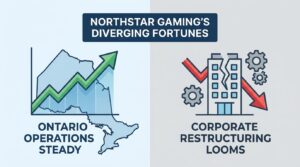
NorthStar Gaming finds itself straddling two distinct realities. Its Ontario-facing sportsbook continues to accept wagers and serve customers in Canada’s most populous province, but the corporate entity behind it is navigating a far more precarious path. The company’s financial position has deteriorated to a point where restructuring discussions are no longer hypothetical, raising pointed questions about what happens when a licensed operator’s balance sheet can no longer support its regulated obligations.
What NorthStar’s Split Reality Means for Stakeholders
The situation unfolding at NorthStar Gaming is less a single story than two parallel narratives running on different clocks. For bettors in Ontario, the platform still functions. For investors and creditors, the picture looks considerably grimmer. Here’s what matters most:
- Ontario operations remain active under the province’s regulated iGaming framework, meaning player funds and betting activity continue, at least on paper, without disruption
- The corporate parent faces mounting financial pressure that has pushed restructuring onto the table as a serious near-term possibility
- Regulatory implications could intensify if the Alcohol and Gaming Commission of Ontario determines that financial instability threatens consumer protection standards
- Any restructuring outcome will likely reshape NorthStar’s competitive positioning in a market already crowded with better-capitalized rivals
- Investor confidence has eroded substantially, and the gap between operational continuity and corporate solvency keeps widening
How Ontario’s Regulated Market Complicates the Picture
Ontario launched its open iGaming market in April 2022, creating a regulated environment where private operators could offer sports betting and casino products under oversight from iGaming Ontario and the AGCO. NorthStar Gaming was among the operators that entered this market, positioning itself as a Canadian-owned alternative to the international heavyweights.
That positioning carried symbolic weight. But symbolism doesn’t cover operating costs.
The province’s framework requires licensed operators to meet ongoing financial and compliance obligations, including maintaining adequate reserves to protect player funds, submitting to regular audits, and demonstrating operational fitness. When a company’s financial health deteriorates, regulators face a judgment call: at what point does corporate distress become a consumer protection issue? The AGCO has not publicly commented on NorthStar’s current standing, though the regulator has historically moved to suspend or revoke registrations when operators fail to meet prescribed standards (a distinction regulators have been slow to enforce uniformly across the sector).
What remains less clear is whether NorthStar’s financial difficulties have yet triggered any formal regulatory review. The absence of a public enforcement action doesn’t necessarily mean the regulator isn’t watching closely.
The Financial Strain Behind the Brand
NorthStar Gaming has struggled to achieve the scale needed to compete effectively in Ontario’s iGaming market. The province hosts more than 40 registered operators, including global brands with deep marketing budgets and established customer acquisition engines. For a smaller, domestically focused operator, the cost of acquiring and retaining players in that environment is punishing.
Revenue figures have not kept pace with the capital required to sustain operations. While specific recent financial disclosures paint a challenging picture, the broader pattern is one familiar across the North American iGaming landscape: smaller operators burning through cash in pursuit of market share that never quite materializes at the necessary rate. NorthStar’s Ontario sportsbook continues to operate, yet the economics underpinning it have grown increasingly fragile.
And while restructuring can take many forms, from debt renegotiation to asset sales to outright acquisition, each path carries different consequences for the brand’s future in Ontario. A sale to a larger operator might preserve the platform but erase the Canadian-owned identity that was central to NorthStar’s market narrative.
Why Smaller Operators Keep Hitting the Same Wall
NorthStar’s predicament is not unique. Across North America, the post-legalization wave of sports betting has consistently favored operators with the deepest pockets. FanDuel and BetMGM dominate U.S. state markets. In Ontario, bet365 and BetVictor carry significant advantages in brand recognition and operational infrastructure. The pattern repeats with almost mechanical regularity: smaller entrants launch with optimism, spend aggressively to build a user base, then find themselves squeezed between rising customer acquisition costs and insufficient revenue to justify continued investment.
Still, the Ontario market was supposed to be different for Canadian operators. Provincial regulators explicitly designed the framework to welcome a diverse range of participants, and early commentary from industry groups emphasized the opportunity for homegrown brands. Three years into the experiment, the evidence suggests that regulatory access alone cannot substitute for financial firepower.
Restructuring Scenarios and Their Market Impact
| Scenario | Likelihood | Impact on Ontario Operations | Stakeholder Outcome |
|---|---|---|---|
| Debt restructuring / refinancing | Moderate | Operations likely continue with tighter cost controls | Creditors take haircuts; equity holders diluted |
| Acquisition by larger operator | Moderate-to-high | Platform may persist under new ownership and branding | Shareholders may recover partial value; employees face uncertainty |
| Voluntary wind-down | Lower, but not negligible | Player accounts migrated or closed; license surrendered | Minimal recovery for most stakeholders |
| Regulatory intervention | Depends on compliance posture | Forced suspension or conditions imposed on operations | Reputational damage compounds financial losses significantly |
The Broader Signal for Canada’s iGaming Ambitions
Ontario remains the only Canadian province with a fully open, competitive iGaming market. Other provinces have watched its development closely, with some considering similar frameworks. NorthStar’s difficulties send an uncomfortable signal to policymakers who viewed open markets as engines for domestic industry growth. If a Canadian-focused operator cannot survive in the very market designed to accommodate it, the argument for regulatory openness becomes harder to make on nationalist grounds.
That said, the market itself is thriving by most aggregate measures. Total gaming revenue in Ontario has grown quarter over quarter since launch, and player participation continues to climb. The issue isn’t whether the market works. The issue is who it works for.
Frequently Asked Questions
Can I still place bets on NorthStar Gaming’s Ontario platform?
Yes. As of now, the Ontario-facing sportsbook remains operational and continues to accept wagers under its existing iGaming Ontario registration.
Are player funds at risk?
Ontario’s regulatory framework requires operators to segregate player funds from operational accounts. Whether NorthStar’s current financial difficulties affect this obligation has not been publicly addressed by the AGCO, though the safeguard exists precisely for situations like this one.
What would restructuring mean for existing customers?
It depends entirely on the form restructuring takes. An acquisition would likely preserve customer accounts under new ownership. A wind-down scenario, while less probable, could require account closures and fund withdrawals within a regulated timeline.
Is NorthStar Gaming publicly traded?
NorthStar Gaming has been listed on Canadian markets, though trading activity and share price have reflected the company’s financial challenges in recent periods.



