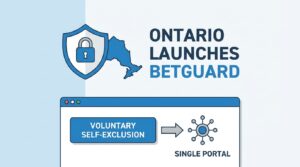
Ontario has introduced BetGuard, a centralized self-exclusion tool that allows individuals aged 19 and older to voluntarily ban themselves from every regulated online gaming platform in the province through a single online portal. The launch marks a significant step in Canada’s approach to responsible gambling infrastructure, giving players a streamlined mechanism to restrict their own access without navigating each operator’s individual process. It arrives at a moment when Ontario’s iGaming market continues to expand rapidly, with dozens of licensed operators now active in the province.
What BetGuard Means for Ontario’s Responsible Gambling Framework
Self-exclusion programs are not new. Most regulated jurisdictions offer some version of them. But the friction involved in signing up with each operator individually has long been a barrier to effectiveness. BetGuard eliminates that friction by consolidating the process into one action, covering all regulated platforms at once.
That distinction matters more than it might appear on the surface. Here are the key strategic takeaways from the launch:
- Single-portal coverage: One registration applies across all licensed online gaming operators in Ontario, removing the need for multiple self-exclusion requests
- Age threshold set at 19: Aligned with Ontario’s legal gambling age, the tool is available to any adult resident or visitor who wants to opt out
- The tool is voluntary, which positions it as a player-empowerment mechanism rather than a regulatory enforcement action
- Market signal to operators: Licensed platforms will need to integrate with BetGuard’s exclusion registry, adding a compliance layer that could affect onboarding and verification workflows
- Potential precedent for other provinces: Ontario’s model, if successful, could pressure other Canadian jurisdictions to adopt similar centralized systems
Why Centralized Self-Exclusion Has Been Slow to Arrive
Ontario opened its regulated iGaming market in April 2022 under the oversight of the Alcohol and Gaming Commission of Ontario (AGCO) and its subsidiary, iGaming Ontario. Since then, the market has grown to include more than 50 licensed operators. Revenue figures have climbed quarter over quarter, with total wagers in the billions.
Yet responsible gambling tools have not always kept pace with that growth (a pattern familiar across most newly regulated markets). Individual operators were required to offer their own self-exclusion options, but no unified system existed to cover the entire ecosystem. A person wanting to self-exclude from, say, 30 platforms would need to initiate 30 separate processes. In practice, that rarely happened.
BetGuard addresses this gap directly. And while the concept of a centralized registry sounds straightforward, the technical and legal coordination required to connect dozens of independent operators to a shared exclusion database is anything but simple.
How BetGuard Works in Practice
The tool operates through Ontario’s dedicated BetGuard online portal, where users can register for self-exclusion. Once enrolled, the individual’s information is shared with all regulated operators, who are then obligated to block that person from accessing their platforms.
Details on the duration of exclusion periods, the process for reinstatement, and the specific data-sharing protocols between BetGuard and operators have not been fully disclosed publicly at this stage. Whether the system allows for tiered exclusion periods or only a single fixed term remains to be confirmed by the administering bodies.
Operational Implications for Licensed Operators
For operators, BetGuard introduces a new compliance touchpoint. Platforms will need to cross-reference their active user databases against the BetGuard registry, likely in real time or near-real time. This has implications for:
| Area | Impact |
|---|---|
| Player onboarding | New account creation must include a check against the BetGuard exclusion list before activation |
| Existing accounts | Operators must identify and restrict accounts belonging to newly self-excluded individuals, potentially mid-session |
| Data handling | Sharing personal exclusion data across a centralized registry raises privacy and security considerations under Canadian law |
| Compliance costs | Integration and ongoing maintenance of BetGuard connectivity adds operational overhead, though the scale varies by operator size and existing infrastructure |
The Broader Context: Responsible Gambling as Market Infrastructure
Ontario’s move reflects a wider shift in how regulators view responsible gambling tools. They are no longer afterthoughts bolted onto licensing conditions. Increasingly, they function as core market infrastructure, as essential to a regulated ecosystem as licensing itself.
Sweden, the Netherlands, and several U.S. states have explored or implemented similar centralized exclusion mechanisms, though the scope and enforcement vary considerably. Ontario’s version, if it achieves broad adoption and reliable enforcement, could become a reference model for Canadian provinces still developing their own frameworks. Whether Alberta, British Columbia, or Quebec follow suit will depend partly on political appetite and partly on how measurable BetGuard’s outcomes prove to be.
Still, a tool is only as effective as its adoption rate. Voluntary self-exclusion programs historically suffer from low awareness among the populations they are designed to serve. Marketing the existence of BetGuard to at-risk individuals, without stigmatizing them, will arguably be as important as the technical infrastructure behind it.
Reframing Player Agency in Regulated Markets
One dimension worth examining is how BetGuard reframes the psychology of self-exclusion. Traditional models placed the burden on the individual to seek out each operator and request removal. That process, repeated across dozens of platforms, carried an implicit message: protecting yourself is your problem, and it will cost you time and effort.
BetGuard inverts that dynamic. A single decision, executed once, propagates across the entire regulated market. The psychological weight of the action shifts from repetitive administrative burden to a single moment of agency. In behavioral terms, reducing the number of steps between intention and action dramatically increases follow-through. This is a well-documented principle in decision architecture, and its application here is deliberate.
For individuals experiencing problem gambling, the window of motivation to seek help can be narrow. A system that captures that motivation in one step, rather than demanding it be sustained across thirty, is fundamentally different in its capacity to intervene. The design of BetGuard, at least on paper, respects that reality.
There is also a signaling effect. When a regulator builds centralized infrastructure for self-exclusion, it communicates that the system takes harm reduction seriously enough to invest in it structurally. That signal matters to public trust, to advocacy groups, and to the operators themselves, who can point to it as evidence that the market they participate in is genuinely regulated, not just nominally so.
Frequently Asked Questions
Who is eligible to use BetGuard?
Any individual aged 19 or older can voluntarily register for self-exclusion through BetGuard. The tool is designed for anyone who wants to restrict their access to regulated online gaming platforms in Ontario.
Does BetGuard cover land-based casinos as well?
Based on available information, BetGuard applies to regulated online gaming platforms. Whether it extends to physical gambling venues has not been confirmed and may fall under separate provincial programs.
Is registration permanent?
The specific terms regarding exclusion duration and reinstatement processes have not been fully detailed publicly. Individuals considering registration should consult the BetGuard portal directly for the most current terms.
How does this affect operators already offering their own self-exclusion tools?
Operators will still maintain their individual responsible gambling obligations. BetGuard adds a centralized layer on top of existing requirements, meaning platforms must now integrate with the shared registry in addition to their own internal systems.



