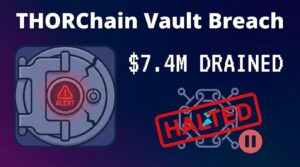
THORChain developers disclosed that one of the protocol’s six Asgard vaults was compromised, with roughly $7.4 million siphoned through unauthorized outbound transactions. The network moved to halt signing activity after detecting the anomalous transfers, a measure designed to prevent further losses. The incident marks one of the more significant security events for the cross-chain liquidity protocol in recent memory, raising pointed questions about vault architecture and multi-chain risk exposure.
What the $7.4M THORChain Vault Compromise Means for DeFi Security
Before diving into the specifics, it helps to frame what’s at stake. THORChain operates a decentralized liquidity network enabling native cross-chain swaps without wrapped tokens. Its Asgard vault system distributes assets across multiple vaults to limit single points of failure. That one of six vaults was breached, rather than the entire system, suggests the compartmentalized design functioned as intended (at least on paper). Still, $7.4 million is not a rounding error.
- Vault isolation limited the blast radius: Only one of six Asgard vaults was affected, preventing what could have been a far larger loss across the protocol’s total value locked.
- Signing halt acted as a circuit breaker: The network’s ability to freeze outbound transactions after detection likely prevented additional unauthorized outflows.
- The breach exposes ongoing tension between decentralization and operational security in cross-chain protocols, where validator coordination must be both fast and trustless.
- Reputational cost compounds: THORChain has faced previous exploits, and repeated incidents erode confidence among liquidity providers weighing risk-adjusted returns.
- How the team handles post-incident transparency and remediation will shape whether institutional and retail participants continue routing volume through the protocol.
How the Breach Unfolded
According to THORChain’s developer communications, the compromised vault processed unauthorized outbound transactions before the anomaly was flagged. The protocol’s node operators then moved to halt signing, effectively freezing the vault’s ability to execute further transfers. What remains less clear is the precise attack vector: whether this was a validator-level compromise, a smart contract exploit, or something else entirely.
THORChain’s Asgard vaults rotate periodically, redistributing assets among active validator nodes. This churn mechanism is meant to reduce the window of vulnerability for any single vault configuration. That the attacker managed to extract $7.4 million before the halt suggests either rapid execution or a delay in detection, possibly both.
The THORChain cross-chain liquidity protocol has not yet published a full post-mortem, though the developer team indicated one is forthcoming.
A Pattern Worth Watching
This is not THORChain’s first encounter with exploits. In 2021, the protocol suffered two separate attacks within weeks, losing approximately $13 million combined. Those incidents led to significant architectural changes, including enhanced vault security and more aggressive churn schedules. And while the protocol recovered and grew substantially in the years since, each new breach reopens the same fundamental debate: can decentralized cross-chain infrastructure be made robust enough to handle adversarial conditions at scale?
The answer, arguably, depends on how quickly the ecosystem matures its tooling around real-time monitoring, validator accountability, and incident response. DeFi protocols operating across multiple chains face a combinatorial explosion of attack surfaces. Every chain integration adds not just functionality but risk.
Broader Implications for Cross-Chain Protocols
Cross-chain bridges and liquidity networks have become the soft underbelly of decentralized finance. According to data from blockchain security firms, bridge-related exploits accounted for over $2.5 billion in losses across 2022 and 2023 alone. THORChain’s vault model differs from traditional bridge designs, but the underlying challenge is shared: securing assets that must be accessible across heterogeneous blockchain environments.
| Factor | THORChain Vault Model | Traditional Bridge Design |
|---|---|---|
| Asset custody | Distributed across rotating Asgard vaults | Typically held in a single multisig or smart contract |
| Validator coordination | Threshold signature scheme (TSS) | Varies; often multisig with fixed signers |
| Attack surface | Spread across multiple vaults, but each vault is a potential target | Concentrated in one contract or custody layer |
| Recovery mechanism | Signing halt and vault churn | Pause function, governance vote, or manual intervention — response times vary significantly |
What Liquidity Providers Should Consider Now
For LPs currently deployed in THORChain pools, the immediate concern is whether the protocol’s treasury or insurance mechanisms will cover the $7.4 million shortfall. Previous incidents saw the protocol use its reserve to reimburse affected parties, though the timeline and completeness of reimbursement varied.
Risk assessment in DeFi is not static. Protocols that have been exploited before carry a dual signal: they have been tested under adversarial conditions, but they have also demonstrated vulnerability. The distinction between those two readings often comes down to how transparently the team communicates and how substantively the architecture evolves afterward.
Even so, liquidity providers operating across multiple protocols should recalibrate their exposure. Concentration risk in any single cross-chain venue, regardless of its design philosophy, remains one of the least-priced risks in decentralized finance.
Frequently Asked Questions
What exactly are THORChain’s Asgard vaults?
Asgard vaults are the protocol’s primary custody mechanism, holding pooled assets across supported blockchains. They use threshold signature schemes among active validator nodes, and the vaults rotate periodically to limit prolonged exposure to any single validator set.
Has THORChain been exploited before?
Yes. The protocol experienced two notable exploits in mid-2021, losing roughly $13 million combined. Both incidents prompted architectural overhauls, though this latest breach suggests residual or new vulnerabilities persist.
Will affected users be reimbursed?
THORChain has historically used its protocol reserve to compensate affected parties after exploits. The team has not yet confirmed whether the same approach will apply here, and the timeline for any reimbursement remains unspecified.
Is it safe to use THORChain right now?
Signing activity has been halted, meaning no outbound transactions are currently being processed. Users should monitor official developer channels for updates before interacting with the protocol. The halt itself is a protective measure, not an indication that all vaults are compromised.