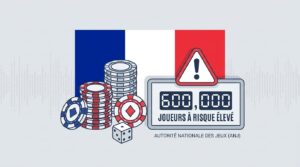
France’s national gambling authority, the Autorité Nationale des Jeux (ANJ), has issued a pointed call to licensed operators: do more on responsible gaming. The regulator estimates that roughly 600,000 players across the country are “highly likely” gambling at excessive levels, a figure that accounts for 8.7 per cent of the entire active player base. That proportion, while not unprecedented in European markets, carries weight in a jurisdiction where the regulatory framework has been tightening steadily since the ANJ assumed expanded oversight powers in 2020.
What the ANJ’s Warning Signals for Licensed Operators
Before diving into the specifics, it’s worth framing the business and regulatory stakes. The ANJ’s disclosure is not merely a statistical observation. It functions as a regulatory precursor, one that puts operators on notice and sets the stage for potential enforcement action if voluntary improvements fall short. Here are the key strategic takeaways:
- Scale of the problem: 600,000 players flagged as at-risk represents a significant minority that operators can no longer treat as a marginal compliance concern
- The 8.7 per cent figure gives the ANJ a concrete, citable benchmark against which future operator performance will almost certainly be measured
- Regulatory escalation risk: operators that fail to demonstrate meaningful progress on responsible gaming could face tighter licence conditions, financial penalties, or both
- Competitive implications: operators investing early in advanced player protection tools may gain a reputational and regulatory advantage over slower-moving rivals
- The announcement aligns with a broader European trend where regulators are shifting from reactive enforcement to proactive, data-driven intervention frameworks
How the ANJ Arrived at 600,000
The regulator’s methodology draws on behavioural data collected from licensed platforms operating in the French market. By analysing patterns such as deposit frequency, session duration, loss-chasing behaviour, and self-exclusion triggers, the ANJ identified a cohort of players whose activity profiles indicate a high probability of problematic gambling. The 8.7 per cent threshold is not arbitrary. It reflects a classification model that the ANJ has been refining as part of its broader digital monitoring capabilities.
Still, questions linger about how granular that model really is.
Whether the regulator’s algorithms can distinguish between a high-spending recreational player and someone genuinely at risk of harm remains a methodological tension that neither the ANJ nor its European counterparts have fully resolved (a distinction regulators have been slow to enforce). What is clear is that the ANJ now possesses enough data infrastructure to make population-level claims with regulatory consequence.
Operator Obligations Under French Law
Licensed operators in France are already subject to a suite of responsible gaming requirements. These include mandatory deposit limits, self-exclusion mechanisms, and real-time monitoring obligations. The Autorité Nationale des Jeux responsible gaming framework has expanded considerably since the body replaced the former ARJEL in 2020, gaining broader jurisdiction over both online and land-based gambling sectors.
But compliance on paper and compliance in practice are not the same thing. The ANJ’s latest statement suggests that existing measures, while structurally in place, are not producing outcomes proportionate to the scale of the problem. Operators may need to move beyond checkbox compliance toward genuinely adaptive intervention systems that respond to individual player behaviour in real time.
What Operators Are Expected to Improve
| Area | Current Requirement | Expected Enhancement |
|---|---|---|
| Deposit Controls | Mandatory deposit limits set by player | Dynamic limits adjusted based on behavioural risk signals |
| Self-Exclusion | Voluntary opt-in via national registry | Proactive outreach to flagged players before self-exclusion becomes necessary |
| Session Monitoring | Basic time-on-site tracking | Algorithmic detection of loss-chasing and escalation patterns, with more granular intervention triggers |
| Player Communication | Standard responsible gaming messaging | Personalised, behaviourally-timed interventions rather than generic pop-ups that most players dismiss |
A Broader European Pattern Takes Shape
France is not operating in isolation. Across Europe, gambling regulators have been converging on a similar posture: less tolerance for passive compliance, more demand for measurable harm-reduction outcomes. The UK Gambling Commission’s ongoing review of affordability checks, Italy’s evolving advertising restrictions, and the Netherlands’ aggressive enforcement against unlicensed operators all point in the same direction. And while each jurisdiction has its own political and cultural dynamics, the underlying regulatory logic is converging.
For multinational operators active in France, the ANJ’s announcement adds another layer to an already complex compliance landscape. The cost of building jurisdiction-specific responsible gaming systems is rising. Yet the cost of failing to do so, measured in fines, licence suspensions, and reputational damage, arguably rises faster.
The Psychology Behind Effective Player Protection
Responsible gaming interventions work best when they account for how players actually think and behave, not just how regulators assume they do. Insights from behavioural psychology and neuro-linguistic programming offer operators a more nuanced toolkit. Framing effects, for instance, matter enormously: a message that tells a player “you’ve spent 80 per cent of your weekly budget” lands differently than one that says “you have 20 per cent remaining.” Both convey the same fact. The emotional response they trigger is not the same.
Anchoring bias also plays a role. When operators set default deposit limits, the chosen number becomes a psychological anchor. Set it too high and it normalises excessive spending. Set it thoughtfully and it shapes behaviour before the player even begins a session. Operators that understand these cognitive mechanisms can design interventions that feel less like compliance theatre and more like genuine support. The difference between a pop-up a player ignores and a message that actually prompts reflection often comes down to timing, tone, and contextual relevance.
Loss aversion, one of the most robust findings in behavioural economics, suggests that players feel losses roughly twice as intensely as equivalent gains. Responsible gaming systems that surface loss data clearly, rather than burying it in account history pages, can leverage this natural asymmetry to encourage self-regulation. Personalisation matters too. A generic warning shown to every player at the same interval is easy to tune out. An intervention triggered by a specific behavioural shift, say a sudden increase in deposit frequency after a losing streak, carries far more psychological weight.
Frequently Asked Questions
What does the 8.7 per cent figure actually represent?
It represents the proportion of France’s active online gambling population that the ANJ considers “highly likely” to be gambling excessively, based on behavioural data analysis across licensed platforms.
Could operators face penalties for not acting on this warning?
The ANJ has not announced specific sanctions tied to this disclosure. But the regulator has a track record of escalating from public warnings to formal enforcement actions when operators fail to demonstrate improvement. The signal is hard to misread.
How does France’s approach compare to the UK?
Both jurisdictions are moving toward outcome-based regulation, though the mechanisms differ. The UK has focused heavily on affordability checks and stake limits, while France’s ANJ is placing greater emphasis on operator-level behavioural monitoring and proactive intervention. Neither model has yet produced a definitive template that other markets are rushing to copy.



