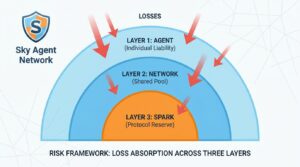
Spark has published a detailed risk framework governing the Sky Agent Network, laying out the mechanics of loss absorption and risk containment across its three core components: Spark Savings, SparkLend, and the Spark Liquidity Layer. The framework arrives at a moment when DeFi protocols face mounting scrutiny over how they manage systemic risk and protect depositors. By formalizing the boundaries of exposure across each layer, Spark is attempting to answer a question most decentralized finance platforms have left uncomfortably vague: who bears the loss when things go wrong?
What the Spark Risk Framework Actually Addresses
Before diving into the structural details, it’s worth framing what this release signals for the broader DeFi ecosystem. Risk frameworks in traditional finance are table stakes. In decentralized protocols, they remain the exception rather than the norm (a distinction that has cost users billions in aggregate losses over the past three years). Spark’s move to codify risk boundaries across its product suite represents an effort to bridge that gap, at least on paper.
- Loss absorption hierarchy is now explicit: The framework defines how losses cascade through the system, starting with protocol reserves before reaching end users, giving participants a clearer picture of their actual exposure.
- Risk is bounded per product layer: Spark Savings, SparkLend, and the Spark Liquidity Layer each operate under distinct risk parameters, preventing contagion from one layer destabilizing the others.
- Transparency as a competitive lever: By publishing the framework publicly, Spark positions itself against competitors that rely on opaque or undocumented risk management practices.
- The framework aligns with the Sky Agent Network’s broader governance architecture, suggesting deeper integration between risk management and protocol-level decision-making.
- Institutional relevance: Formalized risk documentation of this kind is arguably a prerequisite for any protocol seeking to attract institutional capital or regulatory engagement.
Three Layers, Three Risk Profiles
The framework segments risk across Spark’s product stack with deliberate asymmetry. Not every layer carries the same depth of exposure, and the documentation reflects that.
Spark Savings
Designed as the most conservative layer, Spark Savings functions as a yield-bearing deposit mechanism within the Sky ecosystem. Risk here is bounded primarily by the quality of underlying collateral and the protocol’s reserve buffers. The framework specifies that Spark Savings depositors sit higher in the loss absorption waterfall, meaning they are among the last to bear losses in a stress scenario.
SparkLend
SparkLend carries a more complex risk profile. As a lending protocol, it faces the standard hazards of overcollateralized lending: liquidation failures, oracle manipulation, and rapid collateral depreciation. The framework addresses each of these vectors with defined thresholds and fallback mechanisms. What remains less clear is how these thresholds perform under correlated market stress, where multiple collateral types decline simultaneously.
Spark Liquidity Layer
This is where things get interesting. The Liquidity Layer acts as the connective tissue between Spark’s products and external DeFi markets. Its risk profile is inherently more dynamic, exposed to smart contract risk, counterparty behavior, and liquidity fragmentation. The framework acknowledges this complexity without pretending to eliminate it. Instead, it defines exposure caps and circuit-breaker conditions designed to contain losses before they propagate.
How Loss Absorption Works in Practice
The framework introduces a tiered loss absorption model. Protocol-owned reserves absorb initial losses. If those reserves are depleted, losses flow to specific risk tranches within each product layer. Only after those tranches are exhausted do end users face direct exposure.
| Layer | Primary Risk Vector | Loss Absorption Priority |
|---|---|---|
| Spark Savings | Collateral quality, reserve adequacy | Last to absorb losses |
| SparkLend | Liquidation failure, oracle risk | Mid-tier, after protocol reserves |
| Spark Liquidity Layer | Smart contract risk, liquidity fragmentation | First exposure after reserves, with defined caps |
This tiered structure borrows conceptually from traditional structured finance, where senior and junior tranches absorb losses in sequence. The difference, of course, is that enforcement here relies on smart contracts rather than legal agreements.
Why Formalized Risk Boundaries Matter Now
DeFi’s credibility problem has never been about technology alone. It has been about trust, specifically whether users can assess their real exposure before a crisis forces the answer. Protocols that suffered catastrophic losses in 2022 and 2023 often had no published risk framework at all, leaving users to discover their position in the loss hierarchy only after funds were already gone.
Spark’s decision to publish this framework reflects a broader shift. Protocols competing for serious capital, whether from DAOs, treasuries, or institutions, increasingly need to demonstrate governance maturity. The Spark protocol’s risk documentation for the Sky Agent Network is one attempt to meet that bar.
Still, documentation alone doesn’t guarantee resilience. The real test comes during market dislocations, when assumptions embedded in risk models collide with actual liquidity conditions. Whether Spark’s defined thresholds and circuit breakers hold under genuine stress is a question only the next downturn can answer.
Frequently Asked Questions
What is the Sky Agent Network?
The Sky Agent Network is the governance and operational framework within which Spark’s products operate, coordinating risk management and protocol-level decisions across Spark Savings, SparkLend, and the Spark Liquidity Layer.
How does the loss absorption model protect depositors?
Protocol-owned reserves take the first hit. Losses only reach end users after both reserves and designated risk tranches within each product layer have been fully depleted. Spark Savings depositors sit at the top of this waterfall, bearing losses last.
Does this framework eliminate risk for Spark users?
No. It bounds and formalizes risk, but cannot eliminate it entirely. Smart contract vulnerabilities, extreme market conditions, and oracle failures remain potential vectors. The framework’s value lies in making those risks visible and structured rather than hidden.
Why is this relevant to institutional participants?
Institutions typically require documented risk management processes before allocating capital. Published frameworks like this one lower the due diligence barrier and signal governance maturity, though they do not substitute for independent risk assessment.