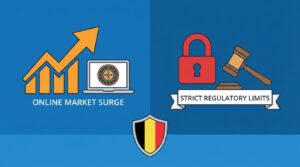
Belgium’s online gambling sector has expanded sharply since 2018, defying expectations set by one of Europe’s more restrictive regulatory frameworks. The Belgian Gaming Commission (BGC) has enforced tight advertising curbs, deposit limits, and a closed licensing system that permits only land-based operators to offer digital products. Yet the market has grown steadily, driven by shifting consumer behaviour and the structural advantages enjoyed by licensed incumbents. The trajectory raises pointed questions about whether restriction-based models actually constrain demand or simply concentrate it.
What Belgium’s Growth Numbers Signal for Regulated Markets
The Belgian case offers a useful counterpoint to jurisdictions still debating how tightly to regulate online gambling. Below are the strategic takeaways that matter most for operators, regulators, and investors watching this space.
- Closed licensing hasn’t stalled growth. By tying online permits to existing brick-and-mortar licences, Belgium created a small pool of authorised operators that have collectively grown revenue year over year since 2018.
- Advertising restrictions, including a near-total ban on gambling ads introduced in 2023, have not visibly dampened player acquisition among licensed platforms.
- Channelisation remains high. Belgium’s model appears to keep most activity within the regulated perimeter, a metric many open-licence jurisdictions struggle with.
- The deposit cap of €200 per week (unless a player requests an increase) functions as both a consumer protection tool and, arguably, a brake on high-value player migration to unlicensed sites.
- Incumbent advantage is baked in. Without new standalone online licences available, the competitive landscape is essentially frozen, giving existing operators pricing power and brand consolidation.
How Belgium’s Regulatory Architecture Differs
Most European gambling jurisdictions operate some version of an open licensing model. Operators apply, meet capital and compliance thresholds, and receive authorisation to serve the market. Belgium took a different path. Only holders of a physical casino, arcade, or betting shop licence (known as A+, B+, or F1+ licences) can extend their operations online. That structural choice has shaped everything downstream.
The result: a market with fewer than 20 licensed online operators serving a population of roughly 11.6 million. Compare that to the UK, where the Gambling Commission lists hundreds of active remote licences, or to markets like Ontario, which opened its iGaming regime to dozens of private operators within its first year.
Belgium’s approach concentrates revenue among a handful of players. Operators like Napoleon Games and Circus have built dominant positions in part because the licensing wall keeps new entrants out. Whether that concentration benefits consumers is a matter of ongoing debate (not all market participants agree on this point).
The Advertising Ban and Its Ripple Effects
In mid-2023, Belgium implemented one of Europe’s strictest gambling advertising bans. Television, radio, social media, and sponsorship deals were all swept into the prohibition. The policy was championed as a public health measure, particularly aimed at shielding younger demographics from gambling normalisation.
But here is where it gets interesting. Early indications suggest that the ban has not materially reduced online gambling participation. Existing players, already registered and depositing, continued their activity. Brand awareness built before the ban appears to carry forward. And the closed licensing system means there are no new operators trying to enter the market who would need advertising to build a customer base from scratch.
Still, what remains less clear is the long-term effect on problem gambling prevalence. Advertising bans are blunt instruments. They may reduce visibility without addressing the behavioural drivers that lead to harmful play.
Revenue Trajectory Since 2018
| Year | Trend | Key Regulatory Event |
|---|---|---|
| 2018 | Baseline growth begins | Enhanced KYC requirements introduced |
| 2020 | Accelerated shift to online | COVID-19 lockdowns close land-based venues |
| 2022 | Continued expansion | Deposit limit enforcement tightened |
| 2023 | Growth persists post-ad ban | Near-total advertising prohibition enacted |
| 2024 | Market stabilisation at higher base | BGC enforcement actions increase against unlicensed sites |
Why Channelisation Holds in a Restricted Model
One of the persistent fears with restrictive gambling regulation is that players will simply migrate to offshore, unlicensed platforms. Belgium’s experience suggests this risk, at least on paper, is manageable when enforcement is consistent and the licensed product is competitive enough.
The BGC has pursued ISP blocking of unlicensed gambling domains and works with payment processors to cut off transactions to unauthorised sites. These measures are not foolproof. VPN usage and cryptocurrency payments create workarounds. But the friction they introduce appears sufficient to keep the majority of casual and moderate-risk players within the regulated ecosystem.
A harder question looms for high-spending players. The €200 weekly deposit cap, while protective, creates an incentive for those players to seek platforms without such limits. Whether Belgium’s channelisation rate holds across all player segments is something the available data does not fully resolve.
Broader Lessons for European Regulators
Belgium’s model is not easily transplanted. It depends on a pre-existing land-based infrastructure, a relatively small and linguistically segmented market, and a regulatory body willing to maintain aggressive enforcement. Yet several principles from the Belgian approach are gaining traction elsewhere in Europe.
The idea that fewer, more accountable operators can deliver better consumer outcomes is influencing policy discussions in the Netherlands, where KSA has tightened its licensing regime, and in Italy, where a new concession framework is under development. Belgium’s advertising ban has also emboldened regulators in Spain and Ireland to consider similar measures.
And while the Belgian framework has its critics, particularly among operators locked out of the market, the growth trajectory since 2018 demonstrates something counterintuitive: restriction and revenue growth are not mutually exclusive. The tension between protecting consumers and enabling a viable commercial market may be less binary than the industry’s loudest voices suggest.
Frequently Asked Questions
Who can legally offer online gambling in Belgium?
Only operators holding a land-based casino, gaming arcade, or betting shop licence (A+, B+, or F1+ categories) are permitted to extend their services online. Standalone digital-only licences do not exist under Belgian law.
What is the weekly deposit limit for Belgian players?
The default cap sits at €200 per week. Players can request an increase, but the process involves additional verification steps designed to flag potential problem gambling behaviour before any adjustment is approved.
Has Belgium’s advertising ban reduced online gambling activity?
Not in any immediately measurable way. Early data points suggest that player participation and revenue have remained stable or continued to grow following the 2023 ban, though longer-term effects on new player acquisition remain an open question.
How does Belgium enforce against unlicensed operators?
The Belgian Gaming Commission uses ISP domain blocking and coordinates with financial institutions to restrict payment flows to unauthorised gambling sites. Enforcement is active, though technological workarounds like VPNs limit its reach.



