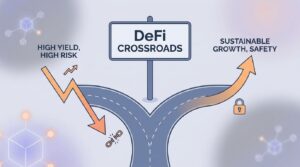
Decentralized finance is staring down a reckoning. After a relentless string of exploits, protocol failures, and mounting questions about what actually underpins advertised yields, the sector faces a credibility test that no governance vote can resolve. The conversation has shifted — from chasing double-digit APYs to interrogating the structural fragility beneath them. For institutional allocators and retail participants alike, the calculus around DeFi risk is being rewritten in real time.
Why the DeFi Risk Equation Has Changed
Before unpacking the specific vulnerabilities, it helps to understand what has brought DeFi to this inflection point. The sector’s total value locked (TVL) has fluctuated dramatically over the past two years, and while capital has returned in pockets, the nature of that capital is different. Institutional participants now demand transparency around smart contract audits, counterparty exposure, and liquidity depth in ways that early DeFi protocols were never designed to accommodate. Here are the strategic takeaways shaping the current landscape:
- Smart contract risk remains the sector’s most persistent threat. Despite billions spent on auditing, exploits in 2024 alone drained over $1.5 billion from DeFi protocols, according to blockchain security firms.
- Liquidity risk is poorly understood by most participants. Thin order books and concentrated liquidity pools mean that exit conditions during stress events are far worse than headline TVL figures suggest.
- Hidden dependencies between protocols create contagion channels that are difficult to map, even for sophisticated risk teams
- Yield sustainability is under scrutiny. Protocols offering outsized returns often rely on token emissions or recursive leverage strategies that compress violently when sentiment turns.
- Regulatory attention is intensifying. Enforcement actions and proposed frameworks from the SEC, CFTC, and European regulators under MiCA are narrowing the operational latitude DeFi projects once enjoyed.
The Anatomy of Hidden Dependencies
What makes DeFi fragile isn’t always visible on a dashboard. Protocols routinely build on top of other protocols, creating layered exposure that compounds in ways traditional finance would flag immediately. A lending platform might accept a liquid staking derivative as collateral, which itself depends on the solvency of a staking pool, which in turn relies on validator performance and network-level slashing conditions. Each layer adds a failure surface.
And while composability was once celebrated as DeFi’s defining innovation, it has become the sector’s most underpriced risk vector.
Consider the cascading liquidations that have periodically swept through platforms like Aave’s lending markets. When collateral values drop sharply, automated liquidation mechanisms can trigger a feedback loop — selling pressure begets more selling pressure, and participants who believed they held uncorrelated positions discover otherwise. The 2022 stETH depeg episode remains a case study in how quickly composability turns from feature to liability. Yet the structural conditions that enabled it have not fundamentally changed.
What Smart Contract Audits Actually Tell You (and What They Don’t)
There is a widespread misconception that a completed audit equals safety. It doesn’t. Audits are point-in-time assessments of known vulnerability classes. They cannot account for economic exploits, governance attacks, or novel interaction patterns between contracts that didn’t exist when the audit was conducted. Some of the most damaging DeFi exploits in recent memory occurred on audited codebases.
This gap between perceived security and actual security is arguably the most dangerous dynamic in the space right now. Protocols display audit badges like insurance certificates, and users treat them as such. But no audit firm guarantees solvency. No audit firm covers losses.
Key Audit Limitations at a Glance
| Dimension | What Audits Cover | What They Miss |
|---|---|---|
| Code vulnerabilities | Known exploit patterns, reentrancy, overflow | Novel attack vectors, cross-protocol interactions |
| Economic design | Sometimes reviewed at a high level | Incentive misalignment under stress, oracle manipulation |
| Governance risk | Rarely in scope | Malicious proposals, admin key compromises |
| Ongoing changes | Snapshot at audit date only | Post-audit upgrades, parameter changes by multisig holders that alter the risk profile entirely |
Reframing Risk: An NLP-Informed Perspective for DeFi Participants
Behavioral patterns play an outsized role in how DeFi participants evaluate and respond to risk. Neuro-linguistic programming offers a useful lens here, not as a trading strategy, but as a framework for understanding the cognitive shortcuts that lead to poor capital allocation decisions in volatile environments.
One of the most common distortions is anchoring. When a protocol advertises a 20% APY, that number becomes a reference point against which all other opportunities are measured, regardless of whether the yield is sustainable or the underlying mechanism is sound. Participants anchor to the number and discount the probability distribution of outcomes that includes partial or total loss of principal.
Framing effects compound this. Protocols that describe their mechanisms as “staking rewards” or “liquidity mining” activate mental models associated with earning and accumulation. The same economic exposure described as “leveraged directional bet with counterparty risk” would attract far fewer deposits. Language shapes risk perception, and DeFi marketing has been exceptionally effective at framing speculative exposure as passive income.
Then there is the availability heuristic. After a period without major exploits, participants systematically underestimate the probability of the next one. Memory fades. The emotional weight of a $600 million bridge hack dissipates within weeks, and capital flows back into structurally similar protocols. Recognizing these patterns — anchoring, framing, availability bias — doesn’t eliminate risk, but it creates a deliberate pause between stimulus and response. That pause, in practice, is where better decisions live.
Still, awareness alone isn’t enough. What separates resilient allocators from reactive ones is the willingness to build decision frameworks before capital is deployed, not after a loss forces reflection.
Where Does DeFi Go From Here?
The protocols that survive this period of scrutiny will likely share a few characteristics: transparent risk disclosures, conservative collateral policies, and governance structures that resist capture. Whether the broader market rewards those qualities over raw yield remains an open question.
Regulatory frameworks, particularly MiCA in Europe and evolving guidance from U.S. agencies, will impose external discipline where self-regulation has fallen short. But regulation moves slowly, and DeFi moves in blocks. The gap between those two speeds is where the next crisis will probably originate.
Frequently Asked Questions
What is the biggest risk in DeFi right now?
Hidden dependencies between protocols create systemic exposure that most participants underestimate. A failure in one layer can cascade through lending platforms, DEXs, and derivative protocols simultaneously.
Are DeFi audits reliable?
They’re useful but limited. Audits assess known vulnerability classes at a single point in time. They do not guarantee ongoing security, nor do they cover economic design flaws or governance attacks. Treating an audit badge as a seal of safety is a mistake the industry keeps repeating.
How can investors better assess DeFi yield?
Start by asking where the yield comes from. If the answer involves token emissions or recursive leverage rather than genuine economic activity, the sustainability of that return is questionable at best.