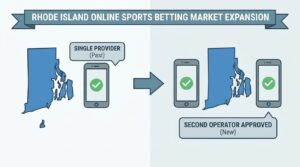
Rhode Island’s sports betting landscape is about to shift. After operating with a single licensed online sportsbook since the state legalized mobile wagering, regulators have approved a second operator to enter the market. The move breaks a prolonged monopoly structure that had drawn criticism from bettors and industry observers alike, and it signals a broader willingness among smaller-market states to embrace competitive frameworks.
What Rhode Island’s Second Operator Approval Means for the Market
The addition of a second online sports betting platform in Rhode Island carries implications well beyond the state’s borders. For a market that has functioned with limited consumer choice, this is a structural correction that could reshape revenue dynamics, user acquisition strategies, and regulatory posture across New England.
- Consumer competition arrives: Rhode Island bettors will, for the first time, have the ability to compare odds, promotions, and platform features between two licensed operators.
- Revenue pressure on the incumbent: The existing operator faces the prospect of market share erosion, particularly among price-sensitive bettors who shop lines.
- Regulatory confidence is growing — approving a second license suggests the state’s oversight infrastructure can handle a multi-operator environment.
- Tax revenue implications: A competitive market typically drives higher handle volumes, which could lift the state’s take even if individual operator margins compress.
- Regional signal: Other small-population states watching Rhode Island may view this as a template for cautious market expansion.
Why Did It Take So Long?
Rhode Island was among the earliest states to legalize sports betting after the Supreme Court struck down PASPA in 2018. But its approach was conservative from the start. The state partnered with a single provider through its lottery system, a structure that prioritized control over competition. That model delivered predictable revenue and simplified regulatory oversight, yet it also capped the market’s ceiling.
Bettors noticed. Many crossed into neighboring states or used offshore platforms (a distinction regulators have been slow to enforce) to access better odds and broader markets. The leakage wasn’t just theoretical; handle figures in Rhode Island consistently underperformed relative to population-adjusted benchmarks from comparable jurisdictions like Connecticut and New Hampshire.
Still, the political calculus took time to evolve. Lawmakers had to weigh the administrative simplicity of a single-operator model against mounting evidence that it was leaving money on the table.
How Rhode Island’s Betting Market Compares
| State | Population (approx.) | Licensed Online Operators | Year Mobile Launched |
|---|---|---|---|
| Rhode Island | 1.1 million | 2 (newly approved) | 2019 |
| Connecticut | 3.6 million | 3 | 2021 |
| New Hampshire | 1.4 million | 2 | 2020 |
| Delaware | 1.0 million | 1 (lottery-based) | 2018 |
The table underscores an important pattern: Rhode Island’s delay in adding a second operator placed it behind peers that moved faster despite launching later. Connecticut, with roughly three times the population, supports three platforms. New Hampshire, with a comparable demographic footprint, had already embraced a two-operator model years ago.
The Competitive Dynamics Ahead
Whoever enters as the second operator will face an unusual challenge. The incumbent has had years to build brand recognition and a user base in a small state where word-of-mouth carries weight. Breaking through that inertia requires aggressive promotional spending, which compresses margins in the short term.
But there’s an upside. Rhode Island’s existing bettors are, arguably, underserved. A new entrant with sharper odds, a more modern interface, or deeper in-play betting options could convert users quickly. The state’s compact geography means marketing spend goes further per capita than in sprawling markets like New York or Pennsylvania.
What remains less clear is whether Rhode Island will eventually open the door to a third or fourth operator. The state’s regulatory posture suggests incremental expansion rather than a wide-open licensing regime, but competitive pressure from neighboring markets could accelerate that timeline.
Reframing Bettor Behavior Through Choice Architecture
The introduction of a second operator doesn’t just change the market mechanically. It reshapes how bettors think about their decisions. When only one platform exists, users anchor to whatever experience that platform provides. There’s no frame of reference, no basis for comparison. Psychologically, this creates a kind of learned passivity where bettors accept suboptimal odds or limited features simply because no alternative exists.
Adding a second option activates what behavioral economists call the “contrast effect.” Suddenly, every line, every promotion, every withdrawal speed becomes measurable against a competitor. Bettors begin to develop preferences they didn’t know they had. This shift in perception often drives engagement upward across both platforms, not just the new entrant. The incumbent, forced to compete, typically improves its own product. And bettors, now empowered with choice, tend to wager more frequently because the act of choosing itself becomes part of the experience.
Rhode Island’s regulators may not have framed it this way, but the decision to approve a second license is as much a behavioral intervention as a commercial one. It resets the default from passive acceptance to active evaluation. For a state trying to recapture handle that leaked to neighboring jurisdictions and offshore sports betting platforms, that psychological shift could matter more than any promotional offer.
Frequently Asked Questions
How many online sports betting operators does Rhode Island currently have?
Rhode Island has operated with a single licensed online sportsbook since mobile wagering launched in 2019. A second operator has now been approved, though the timeline for its full launch has not been publicly confirmed.
Why did Rhode Island only have one operator for so long?
The state’s original framework routed sports betting through its lottery system, favoring a controlled, single-provider model. Political and administrative caution kept that structure in place for several years despite growing evidence of revenue leakage to competing states.
Will this affect tax revenue for the state?
Competitive markets generally produce higher total handle volumes. Even if individual operator margins tighten, the state’s share of a larger pie could grow — though the magnitude depends on how quickly the second operator scales.
Could Rhode Island add more operators in the future?
That remains an open question. The state’s approach has been deliberately incremental, but pressure from neighboring markets and evolving legislative attitudes could push the door wider.