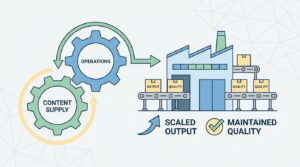
A content supplier has announced a significant operational restructuring designed to increase production capacity while maintaining the editorial and creative standards that built its reputation. The company says the new framework introduces layered workflows, dedicated quality gates, and expanded team specialization. While details on headcount or capital investment remain undisclosed, the stated ambition is clear: scale output without diluting quality. It’s a challenge that has tripped up more than a few content businesses in recent years.
What the Restructuring Signals for Content-Driven Businesses
Operational overhauls in the content supply chain rarely make headlines on their own. But when a supplier explicitly ties structural change to a quality-preservation mandate, it reflects a broader tension across the industry. Below are the strategic takeaways worth watching.
- Quality as a scaling constraint is now a boardroom-level concern. The decision to restructure around quality gates suggests that previous growth may have tested internal standards.
- Specialization across teams points to a shift away from generalist production models, which tend to buckle under volume pressure
- Workflow layering implies the company is building redundancy into its review process, a move that adds cost but reduces reputational risk.
- The language used (“scale without diluting”) is defensive in tone, suggesting the company may be responding to client feedback or competitive pressure, or both.
Why Scaling Content Without Losing Quality Is Harder Than It Sounds
Every content operation hits a ceiling. At low volumes, quality control is informal. Editors catch errors, tone stays consistent, and clients rarely complain. Then volume doubles. Or triples. And the informal system cracks.
The fundamental problem is that content quality doesn’t scale linearly with headcount. Adding writers doesn’t automatically produce more good content. It produces more content, period. The gap between those two outcomes is where reputations erode. What makes this supplier’s announcement noteworthy is the explicit acknowledgment of that gap (a distinction many competitors avoid making publicly). By restructuring workflows rather than simply hiring, the company appears to be investing in process architecture over raw capacity.
That matters.
In practice, layered workflows typically involve separating content creation from content review, assigning subject-matter specialists to vertical-specific briefs, and introducing stage-gate checkpoints before delivery. Each layer adds time and cost. The bet is that clients will pay a premium for reliability, or at least that they won’t tolerate the alternative. Whether the math works depends on margins that the company has not disclosed.
How Team Specialization Reshapes the Production Model
Generalist content teams are efficient at small scale. One writer covers fintech on Monday, healthcare on Tuesday, and logistics by Thursday. But generalism has a shelf life. As output grows, the depth of expertise thins. Clients notice. Especially B2B clients, who tend to have low tolerance for surface-level coverage of their industries.
The supplier’s move toward dedicated specialization suggests a pivot to vertical-aligned pods or squads. This model, borrowed from software development, assigns cross-functional teams to specific content domains. Each pod typically includes writers, editors, and strategists who build cumulative expertise in a single sector. The result: a production unit that gets sharper with every brief, rather than one that resets with each new topic.
| Production Model | Strengths | Weaknesses |
|---|---|---|
| Generalist Teams | Flexible, lower overhead, fast onboarding | Quality inconsistency at scale, limited domain depth |
| Specialized Pods | Deeper expertise, stronger client alignment, compounding knowledge | Higher fixed costs, slower redeployment across verticals, risk of siloed thinking that requires active management to counteract |
The Broader Market Context: Content Supply Under Pressure
This restructuring doesn’t happen in a vacuum. The content marketing industry has been grappling with a paradox for several years now. Demand for high-quality, original content has surged, driven by SEO requirements, thought leadership strategies, and the sheer volume of digital channels that enterprises need to feed. At the same time, generative AI tools have flooded the market with cheap, fast alternatives that satisfy quantity targets but often fall short on nuance, accuracy, and brand voice.
Suppliers that compete on volume alone are arguably racing toward commoditization. Those that restructure around quality, as this company claims to be doing, are positioning themselves at the premium end of a market that is splitting in two. Still, positioning and execution are different things entirely. The announcement is a statement of intent. Delivery will be the proof.
Applying Precision Framing: What Decision-Makers Should Ask
For executives evaluating content partners, this kind of restructuring announcement deserves scrutiny beyond the press release. The framing matters as much as the facts. When a supplier says it can “scale without diluting,” the implicit claim is that it has identified what dilution looks like internally and built systems to prevent it. That’s a testable claim. And testing it requires asking the right questions at the right time.
Start with outcomes. Ask for before-and-after metrics on content revision rates, client satisfaction scores, or turnaround consistency. These are the indicators that reveal whether a restructuring has teeth or is merely cosmetic. Then look at the team model. Are specialists genuinely embedded in verticals, or are they generalists with new titles? The distinction is not always obvious from the outside, but it shows up fast in the work.
Consider also the language of the announcement itself. “Scale without diluting quality” is a phrase built to reassure. It presupposes that scaling and quality are in tension, which they are, and promises resolution. But resolution in operational design is iterative, not declarative. No single restructuring eliminates the tension permanently. What it can do is create feedback loops that catch degradation earlier. That’s the realistic win.
Executives should also reframe their own expectations. The best content suppliers are not the ones that never make mistakes. They’re the ones whose systems surface mistakes before clients do. A restructuring that builds in those feedback mechanisms is worth more than one that simply adds layers of review.
Frequently Asked Questions
What does “scale output without diluting quality” actually mean in content operations?
It refers to increasing production volume while maintaining editorial standards, accuracy, and brand consistency. In practice, this usually involves workflow redesign, team specialization, and formalized quality checkpoints rather than simply adding headcount.
Why are content suppliers restructuring now?
Rising demand for original, expert-level content, combined with competitive pressure from AI-generated alternatives, is forcing suppliers to differentiate on quality. Restructuring is one way to operationalize that differentiation at scale.
How can clients evaluate whether a supplier’s restructuring is substantive?
Request data on revision rates, delivery timelines, and client retention before and after the change. Ask about team composition. If the same people are doing the same work under a new org chart, the restructuring may be more cosmetic than structural.



