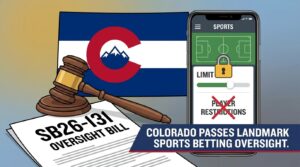
Colorado’s General Assembly has approved Senate Bill 26-131, a sweeping sports betting oversight measure that now heads to Governor Jared Polis for signature. The bill cleared the Senate on May 13, 2026, with a 20-15 concurrence vote, capping months of contentious debate over how far a state can go in regulating the digital mechanics of licensed sportsbooks. At its core, the legislation introduces first-of-their-kind restrictions on mobile app engagement features and bans the widely criticized practice of player limiting, where operators restrict or close accounts of consistently profitable bettors. If signed, Colorado would become the first U.S. state to codify such a comprehensive framework at the intersection of consumer protection and digital wagering design.
What SB26-131 Means for Operators and Bettors Alike
The bill is not a single policy lever. It is a multi-pronged package that touches nearly every surface of the operator-bettor relationship, from how a mobile app nudges a user toward placing another wager to how deposits and withdrawals are processed. Before unpacking the details, here are the strategic takeaways that matter most for industry stakeholders:
- Player limiting is banned outright. Sportsbooks operating in Colorado will no longer be permitted to restrict, suspend, or close accounts based on a bettor’s profitability. This directly challenges a practice that operators have long defended as essential to risk management.
- Mobile app engagement tactics face new guardrails. Push notifications encouraging continued wagering, streak-based reward systems, and certain gamification elements will be subject to explicit regulatory limits.
- Account funding rules tighten considerably, with new requirements around deposit velocity checks and mandatory cooling-off prompts for users who exceed predefined thresholds within short timeframes
- Operators face compliance deadlines. Licensed sportsbooks will reportedly have a defined transition window to align their platforms with the new standards, though the exact timeline awaits the governor’s action and subsequent rulemaking by the Colorado Division of Gaming.
- The bill sets a regulatory precedent that other states with active sports betting markets are almost certainly watching, particularly those where similar legislative proposals have stalled.
Why the Player Limiting Ban Changes the Calculus
For years, sharp bettors (a term the industry uses for skilled, data-driven wagerers) have faced account restrictions from major sportsbooks. The practice is legal in most jurisdictions, and operators argue it protects their margins against sophisticated actors who exploit line inefficiencies. But Colorado’s legislature has drawn a different line.
By prohibiting player limiting, SB26-131 reframes the relationship between operator and bettor. The implicit message: if you hold a license to offer wagering to the public, you accept the full spectrum of that public, including those who win consistently. Whether this shifts operator behavior nationally depends on how other regulators respond, but the precedent is now tangible.
Sharp betting communities have already signaled support. And while DraftKings and other major sportsbook platforms have not issued formal statements on the bill’s final passage, the operational implications are significant. Compliance teams will need to redesign risk management protocols that currently rely on limiting as a first-line tool.
Digital Engagement Restrictions: A Regulatory First
Perhaps the most forward-looking element of SB26-131 is its treatment of app design as a regulatory surface. Until now, most state frameworks have focused on licensing, taxation, and advertising standards. Colorado’s bill goes further, targeting the behavioral architecture embedded in mobile sportsbook apps.
Specifically, the legislation addresses:
| Feature Category | Regulatory Action Under SB26-131 |
|---|---|
| Push notifications | Restricted during defined hours; cannot reference active losing streaks or recent deposits |
| Gamification mechanics | Streak rewards and achievement badges tied to wagering volume must include risk disclosures |
| Deposit prompts | Operators must implement velocity checks and mandatory pause screens when deposit frequency exceeds set thresholds |
| Session duration alerts | Required after continuous app usage beyond a configurable time window, with opt-out limitations |
These provisions borrow conceptually from responsible gambling frameworks in the UK and Australia, but adapt them to the American regulatory context where enforcement sits at the state level (a distinction that has historically fragmented oversight).
How This Reshapes Risk Management Strategy
Operators have traditionally balanced their books through a combination of line movement, promotional targeting, and, yes, player limiting. Removing that last tool forces a recalibration. In practice, sportsbooks may invest more heavily in algorithmic pricing accuracy, since they can no longer simply cut off bettors who expose weak lines.
That shift matters because it could accelerate the already-growing investment in real-time odds modeling and machine learning infrastructure across the industry. Smaller operators, arguably, face the steepest climb here. They lack the data scale and engineering depth of market leaders like FanDuel’s sportsbook operations, which can absorb sharper action more efficiently across a larger volume base.
Still, even major operators will feel the pressure. The margin buffer that limiting provided is not trivial.
Broader Market and Regulatory Implications
Colorado is not acting in isolation, even if it is acting first. Several states, including New Jersey and Illinois, have seen legislative proposals targeting player limiting or app engagement practices in recent sessions. None have advanced as far as SB26-131. What remains less clear is whether Colorado’s move accelerates those efforts or whether operators successfully lobby to contain the precedent.
Governor Polis has not publicly indicated whether he will sign the bill, though his administration has generally supported consumer protection measures in the gaming space. If enacted, the Colorado Division of Gaming will oversee rulemaking, a process that typically involves public comment periods and industry consultation before final standards take effect.
Frequently Asked Questions
What is player limiting in sports betting?
Player limiting refers to the practice where sportsbooks restrict bet sizes, suspend promotional access, or close accounts of bettors who consistently win. Operators have historically used it as a risk management tool, though critics argue it penalizes skill and undermines market fairness.
When would SB26-131 take effect?
The bill awaits Governor Polis’s signature. Once signed, the Colorado Division of Gaming would initiate a rulemaking process to establish compliance timelines and detailed operational standards. Licensed operators should expect a defined transition period, though no specific date has been confirmed.
Does this affect daily fantasy sports platforms?
SB26-131 is specifically targeted at licensed sports betting operators. Daily fantasy sports contests operate under a separate regulatory framework in Colorado, and the bill’s provisions on app engagement and player limiting do not appear to extend to DFS platforms at this stage.
Could other states follow Colorado’s approach?
Possibly. Similar proposals have surfaced in New Jersey, Illinois, and Massachusetts. Colorado’s bill gives those efforts a concrete legislative template to reference, though each state’s political dynamics and industry lobbying landscape differ considerably.



