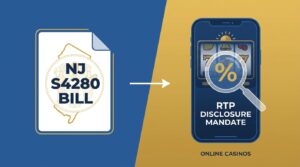
New Jersey Senator John McKeon has introduced S4280, a bill that would compel licensed online casinos operating in the state to publicly disclose return-to-player (RTP) percentages for every game they offer. If enacted, the legislation would make New Jersey the first U.S. state to impose such a transparency requirement on iGaming operators. The bill arrives at a moment when consumer protection in digital gambling is drawing sharper scrutiny from both regulators and advocacy groups across the country.
What S4280 Means for Online Casino Operators in New Jersey
Before unpacking the strategic implications, it’s worth framing what this bill actually asks of the market. At its core, S4280 targets a gap that has persisted since New Jersey legalized online gambling in 2013: players have had no standardized, accessible way to compare the theoretical payout rates of the games they wager on. The bill would change that by requiring operators to display RTP data prominently within their platforms.
- Mandatory RTP transparency: Every licensed online casino game would need to show its return-to-player percentage, giving bettors a clearer picture of expected value before they play.
- Regulatory precedent: No other U.S. state currently mandates RTP disclosure for online casino games, positioning New Jersey as a potential model for future legislation elsewhere.
- Operators who fail to comply could face enforcement action from the New Jersey Division of Gaming Enforcement (DGE), though specific penalty structures have not yet been detailed in the bill’s public text.
- Consumer trust as competitive lever: Casinos that already publish RTP data voluntarily may find themselves at an advantage during the compliance transition, while those that have kept this information opaque will need to overhaul their player-facing interfaces.
- The bill could accelerate a broader national conversation about what information online gambling platforms owe their customers.
Why RTP Disclosure Has Become a Flashpoint
Return-to-player percentages describe the theoretical share of wagered money a game returns to players over time. A slot with a 96% RTP, for instance, is designed to pay back $96 for every $100 wagered across millions of spins. But here’s the tension: RTP is a long-run statistical measure, not a guarantee for any individual session, and critics of mandatory disclosure worry it could mislead casual players into false confidence.
Still, the counterargument is hard to dismiss. In the United Kingdom, the Gambling Commission has long required operators to make RTP information available (a distinction regulators in the U.S. have been slow to enforce). European markets broadly treat RTP transparency as a baseline consumer right. Senator McKeon’s bill borrows from that playbook, arguing that informed players are better-protected players.
The timing matters. New Jersey’s online casino market generated over $2 billion in gross gaming revenue in 2024, a figure that has climbed steadily since the pandemic-era surge in digital play. With that growth comes heightened public attention to fairness and accountability.
How Operators Might Respond
For major platforms like those operated under the Borgata Online and similar New Jersey-licensed brands, the operational lift may be modest. Many game suppliers already calculate and certify RTP figures as part of their regulatory submissions to the DGE. The challenge lies less in generating the data than in presenting it clearly to players without creating confusion.
Some operators may push back. Displaying RTP prominently could, in theory, steer players away from lower-RTP games that tend to carry higher margins for the house. That dynamic creates a quiet commercial tension beneath the consumer protection framing of the bill.
And while the bill focuses on online casinos, it raises an adjacent question nobody in Trenton has answered yet: should land-based slot machines be held to the same standard?
The Broader Regulatory Landscape Shifts
| Jurisdiction | RTP Disclosure Required? | Applies To |
|---|---|---|
| United Kingdom | Yes | All licensed online games |
| Malta | Yes | Online slots and table games |
| New Jersey (proposed) | Pending (S4280) | Licensed online casino games |
| Pennsylvania | No | N/A |
| Michigan | No | N/A |
If S4280 passes, other states with mature iGaming markets arguably face pressure to follow. Pennsylvania and Michigan, the two largest online casino states after New Jersey, have active legislative sessions where consumer protection bills routinely surface. A successful New Jersey model gives reformers in those states a concrete template rather than an abstract principle.
Framing Transparency as a Market Advantage
There is a subtler dimension to this bill that extends beyond compliance checklists. In behavioral terms, transparency functions as a trust signal. Research in consumer psychology consistently shows that when companies voluntarily disclose information that could, at least on paper, work against their commercial interests, customers interpret that openness as a marker of reliability. The effect compounds over time.
For the New Jersey iGaming sector, mandatory RTP disclosure could paradoxically strengthen player engagement rather than weaken it. Players who understand the odds are more likely to view the platform as fair, which in practice tends to increase session frequency and lifetime value. Operators in regulated European markets have observed exactly this pattern. The fear that transparency drives players away has not materialized in jurisdictions where disclosure is already the norm.
What remains less clear is whether the bill will survive the legislative process intact. Industry lobbying in Trenton is well-resourced, and the DGE may seek to shape the final rules through its own rulemaking authority rather than accept a rigid statutory mandate. Senator McKeon’s office has not publicly indicated whether amendments are expected before committee review.
Frequently Asked Questions
What is return-to-player (RTP) in online casino games?
RTP is a statistical measure representing the percentage of total wagered money a game is designed to return to players over an extended period. It does not predict outcomes for any single session or player.
Does any U.S. state currently require RTP disclosure?
No. If S4280 is enacted, New Jersey would become the first state to mandate that licensed online casinos display RTP percentages to players.
Would this bill affect land-based casinos in New Jersey?
The bill as introduced targets licensed online casino platforms specifically. Whether similar requirements could extend to physical slot machines or table games remains an open question that legislators have not yet addressed.
When could S4280 take effect?
The bill must pass through committee review and both chambers of the New Jersey Legislature before reaching the governor’s desk. No timeline for a vote has been announced, and the legislative calendar could push consideration into 2026.



