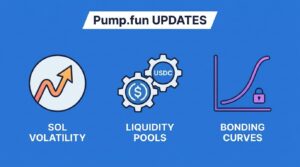
Pump.fun, the Solana-based token launch platform that became a magnet for memecoin speculation in 2024, has introduced USDC-paired liquidity pools alongside its existing SOL-paired bonding curve mechanism. The shift responds to a concrete problem: SOL price swings had compressed starting market caps for newly launched tokens to roughly $2,000, undermining the platform’s core value proposition. By anchoring liquidity to a stablecoin, Pump.fun is attempting to decouple token launches from the volatility of the underlying chain asset.
Why USDC Pools Signal a Structural Pivot for Pump.fun
Before unpacking the mechanics, it helps to frame what this change actually addresses. Pump.fun’s bonding curve model prices tokens algorithmically based on supply and demand within a SOL-denominated pool. When SOL trades sideways or dips, the dollar-equivalent starting valuations for new tokens shrink in lockstep. A $2,000 starting market cap isn’t just optically small; it distorts early-stage price discovery and discourages creators who need a credible floor to attract initial buyers.
- Stablecoin insulation: USDC-paired pools fix the denominator, meaning token launch valuations remain consistent regardless of SOL’s spot price movements
- Creator confidence: Projects launching on Pump.fun gain more predictable initial pricing, reducing the risk that a sudden SOL drawdown wipes out perceived value before a community even forms
- The move positions Pump.fun closer to how centralized exchanges handle listing pairs, where stablecoin denominators are the default for price stability
- Competitive pressure: Rival launchpad protocols on Solana and other chains have already experimented with stablecoin pools, making this arguably a defensive move as much as an innovative one
- Liquidity depth: USDC pools could attract a different class of liquidity provider, one less exposed to directional SOL risk and more focused on fee generation
How Bonding Curves Hit Their Limits
Pump.fun’s original model was elegant in its simplicity. Tokens launched along a bonding curve denominated in SOL, with price rising automatically as more buyers entered. The system worked well during SOL’s rallies, when rising denominator values inflated starting market caps and created a sense of momentum. But that same mechanism works in reverse.
When SOL dropped, starting market caps for freshly minted tokens collapsed. At approximately $2,000, many launches became functionally invisible to traders scanning for opportunities. The feedback loop was punishing: lower starting caps attracted fewer buyers, which meant less fee revenue for the platform, which meant less incentive for creators to launch there at all.
That dynamic is worth sitting with. A platform built on permissionless token creation lives or dies by launch volume. And launch volume depends on perceived opportunity, which depends on credible starting valuations. The bonding curve’s SOL dependency had become, in practice, a single point of fragility.
Stablecoin Pairing and the Broader DeFi Trend
Pump.fun’s decision mirrors a wider pattern across decentralized finance. Protocols that initially denominated everything in native chain tokens have gradually introduced stablecoin alternatives as volatility proved too disruptive for certain use cases. Uniswap V3’s most liquid pools, for instance, are overwhelmingly USDC or USDT pairs. The logic is straightforward: when the goal is price discovery for a new asset, you want the other side of the pair to be as boring as possible.
Still, there are trade-offs. SOL-paired pools create natural buy pressure for Solana’s native token. Every token launch on Pump.fun’s Solana-based launchpad that uses SOL as the base pair effectively generates demand for SOL itself. Shifting volume toward USDC pools could, at the margin, reduce that reflexive demand loop (a distinction the Solana ecosystem may not welcome).
What This Means for Token Creators
For projects considering a Pump.fun launch, the calculus shifts in a few important ways. USDC pools offer more predictable initial pricing and reduce the risk of launching into a SOL downturn. But they also remove the upside optionality that comes with a rising SOL: if SOL rallies post-launch, a SOL-paired token benefits from denominator appreciation. USDC pools neutralize that effect entirely.
Which pool type a creator chooses will likely depend on their time horizon and risk appetite. Short-term memecoin plays may still favor SOL pairs for the reflexive momentum. Projects seeking more stable early-stage price action will gravitate toward USDC.
Market Implications and Unanswered Questions
| Factor | SOL-Paired Pools | USDC-Paired Pools |
|---|---|---|
| Starting market cap stability | Fluctuates with SOL price | Fixed in dollar terms |
| Upside from denominator appreciation | Yes | No |
| Liquidity provider risk profile | Directional SOL exposure | Neutral, fee-focused |
| Impact on SOL demand | Generates native buy pressure | Minimal direct effect on SOL spot demand |
| Creator predictability | Lower | Substantially higher, at least on paper |
Whether USDC pools cannibalize SOL-paired volume or simply expand the total addressable market for Pump.fun launches remains to be seen. The platform hasn’t disclosed whether it will incentivize one pool type over the other through fee structures or visibility in its interface.
Reading Between the Lines: What Drives Platform Decisions Like This
Decisions like Pump.fun’s USDC integration don’t happen in a vacuum. They reflect how platform operators perceive their users’ pain points and, more subtly, how they frame the problem internally. In behavioral terms, the shift from SOL to USDC pairing is a reframing exercise. The underlying product hasn’t changed: permissionless token launches along a bonding curve. What changed is the reference point against which value is measured.
This matters because perception of value drives action. When a creator sees a $2,000 starting market cap, the anchoring effect is powerful and negative. It doesn’t matter that the number is a function of SOL’s price rather than the token’s intrinsic merit. The number itself becomes the story. By switching the denominator to USDC, Pump.fun resets that anchor. A $5,000 starting cap in USDC feels fundamentally different from a $2,000 cap in SOL-equivalent, even if the underlying liquidity depth is identical. The platform is, in effect, managing the psychological frame around its product without altering the product’s mechanics.
And this kind of reframing has downstream consequences. Creators who feel confident about their launch conditions are more likely to invest in community building, marketing, and post-launch engagement. Liquidity providers who see stable denominators are more likely to commit capital for longer durations. The compounding effect of a better initial frame can reshape an entire platform’s trajectory, not because the technology changed, but because the story around it did.
Frequently Asked Questions
What is a USDC-paired liquidity pool on Pump.fun?
It’s a liquidity pool where the base trading pair uses USDC, a dollar-pegged stablecoin, instead of SOL. This means token prices and market caps are denominated in a stable asset rather than a volatile one.
Will SOL-paired pools still be available?
Yes. Pump.fun has introduced USDC pools as an alternative, not a replacement. Creators can choose which pairing suits their launch strategy.
Does this affect existing tokens launched on Pump.fun?
The announcement pertains to new liquidity pool options. Existing tokens already trading on SOL-paired bonding curves would not automatically migrate to USDC pools.
Why does the starting market cap matter so much?
Because it shapes first impressions. A token launching at $2,000 market cap reads differently than one at $5,000 or $10,000, even if the underlying liquidity and mechanics are comparable. Early perception drives early participation, and early participation drives everything else.



