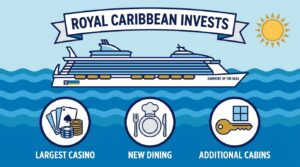
Royal Caribbean International has announced a sweeping renovation of Harmony of the Seas, one of the world’s largest cruise ships, set to introduce the cruise line’s biggest casino ever built on a vessel. The upgrade also brings new dining concepts, additional staterooms, and refreshed entertainment spaces to the Oasis-class ship. Dry-docked for the extensive refit, Harmony of the Seas will re-enter service with a significantly expanded onboard offering aimed at capturing higher per-passenger revenue and attracting a broader demographic of guests.
What the Harmony of the Seas Renovation Signals for Royal Caribbean’s Strategy
This isn’t a routine refresh. The scale of investment in a single ship reflects a deliberate strategic pivot by Royal Caribbean toward maximizing yield from its existing fleet, not just from newbuilds. Here’s what matters most from a business perspective:
- Largest casino at sea: The expanded gaming floor positions Harmony of the Seas as a floating destination for high-spend leisure travelers, directly competing with land-based resort casinos in the Caribbean corridor.
- New staterooms added: Increasing cabin inventory on an already massive ship suggests Royal Caribbean sees unmet demand on itineraries served by this vessel, and is willing to reconfigure existing space to capture it.
- Dining and entertainment overhaul: New restaurant concepts and refreshed public areas target repeat cruisers who expect novelty, a segment increasingly important to the line’s loyalty economics.
- The renovation aligns with a broader industry trend of mid-life refurbishments that extend a ship’s competitive relevance by a decade or more
- Revenue diversification: Casino expansion, premium dining, and enhanced retail all point toward growing onboard spend per guest rather than relying solely on ticket pricing.
Inside the Casino Expansion
The new casino aboard Harmony of the Seas will be the largest in Royal Caribbean’s global fleet, surpassing even the gaming spaces on newer Icon-class ships. That distinction is worth pausing on. Building the biggest casino not on your newest, most technologically advanced vessel but on a 2016-vintage Oasis-class ship tells you something about where the demand data is pointing.
Caribbean itineraries, where Harmony of the Seas primarily operates, draw a guest mix that skews toward leisure spending. Casino revenue on these routes has historically outperformed other deployment regions. By expanding the gaming footprint here, Royal Caribbean is essentially doubling down on a proven revenue stream in its strongest market.
The move also raises a question competitors will have to answer: does the arms race in onboard gaming reshape how other major cruise lines allocate refit capital?
More Cabins on an Already Massive Ship
Adding staterooms to a ship that already carries nearly 6,700 guests at maximum occupancy is no small engineering feat. The additional cabins are expected to include a mix of interior, ocean-view, and balcony categories, though Royal Caribbean has not disclosed exact numbers or configurations in full detail.
What’s clear is the commercial logic. Harmony of the Seas consistently sails at high occupancy rates. Rather than simply raising fares (a strategy with ceiling effects, particularly in price-sensitive family segments), adding inventory allows the line to grow revenue without proportionally increasing operating costs. The marginal cost of an additional cabin on a ship already staffed and provisioned for thousands is relatively low.
Dining Concepts and the Experience Economy at Sea
New restaurant additions are part of a broader effort to reposition the onboard experience. Royal Caribbean has been steadily introducing specialty dining venues across its fleet, and Harmony of the Seas will receive several new options that have proven successful on other ships. These aren’t buffet extensions. They are ticketed, reservation-based restaurants designed to generate supplemental revenue while creating differentiated experiences.
The cruise industry has learned something from land-based hospitality: guests will pay premiums for exclusivity and novelty, even on a ship where a main dining room meal is already included in the fare. That behavioral insight underpins the entire refit philosophy.
How Fleet Modernization Shapes Competitive Positioning
Royal Caribbean’s decision to invest heavily in Harmony of the Seas reflects a calculation that mid-life refurbishments deliver strong returns relative to newbuild costs. A new Oasis-class ship costs upward of $1.3 billion. A comprehensive dry-dock renovation, even one this ambitious, runs at a fraction of that figure while delivering measurable uplift in guest satisfaction scores and per-diem spending.
| Feature | Before Renovation | After Renovation |
|---|---|---|
| Casino Size | Standard fleet configuration | Largest casino in the Royal Caribbean fleet |
| Stateroom Count | ~2,747 cabins | Increased (exact figure not yet disclosed) |
| Dining Venues | Existing specialty and complimentary options | Expanded with new specialty restaurant concepts |
| Entertainment Spaces | Original 2016 configuration | Refreshed and modernized throughout |
Still, not every ship in the fleet will receive this level of attention. Royal Caribbean has to be selective, and the choice of Harmony of the Seas likely reflects both its deployment economics and its remaining service life (a distinction that matters more than brand sentiment when allocating refit budgets).
The Broader Industry Context
Cruise lines globally are spending record amounts on fleet modernization. Carnival Corporation, MSC Cruises, and Norwegian Cruise Line Holdings have all announced significant dry-dock programs in the past 18 months. The competitive pressure is real: guests who sailed on Icon of the Seas or MSC World Europa expect a certain baseline of onboard quality. Ships that fall below that threshold lose repeat bookings.
And while newbuilds grab headlines, the quieter story is in refits. Arguably, the return on invested capital for a well-executed renovation outperforms a newbuild in the first five years of operation, because the ship is already proven, crewed, and deployed on optimized itineraries. Royal Caribbean appears to be betting on exactly that math.
Frequently Asked Questions
When will the renovated Harmony of the Seas return to service?
Royal Caribbean has confirmed the ship is undergoing dry-dock renovation, though a precise re-entry date depends on the scope of work completed. Guests with existing bookings should check directly with the cruise line for updated sailing schedules.
Will the casino expansion affect other public spaces on the ship?
The refit involves reconfiguring existing space rather than simply expanding the ship’s footprint. Some areas will be repurposed, but Royal Caribbean has designed the layout to maintain the overall guest experience across entertainment, dining, and relaxation zones. Trade-offs are inevitable on a fixed hull.
How does this compare to renovations on other cruise lines?
Most major cruise operators are investing in mid-life refurbishments, but the scale of the Harmony of the Seas project, particularly the casino expansion, sets it apart. Few competitors have committed to building their largest-ever gaming venue on an existing ship rather than a newbuild.



