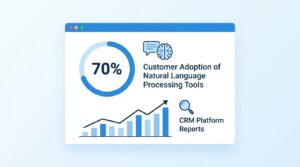
A CRM supplier has disclosed that 70 per cent of its customer base now actively uses the natural language processing capabilities embedded in its platform. The milestone signals a broader shift in how businesses interact with their customer data, moving from manual queries and structured searches toward conversational, AI-driven interfaces. While adoption figures for AI features across the SaaS industry have varied widely, a 70 per cent uptake rate stands out as notably high for a capability that, until recently, many enterprise buyers treated as experimental.
What 70% NLP Adoption Tells Us About Enterprise CRM Strategy
Reaching this threshold is more than a product milestone. It reflects a change in how sales, support, and marketing teams expect to work with their tools daily. Below are the key strategic takeaways from this development:
- Conversational interfaces are no longer optional. When seven in ten customers use NLP features, the technology has crossed from novelty into operational dependency.
- Data accessibility is the real product. NLP layers reduce the friction between a business question and the answer sitting inside a CRM, which means faster decisions and fewer bottlenecks at the analyst level.
- Vendors that fail to embed similar capabilities risk losing ground not on features, but on usability
- Training costs drop as interfaces become intuitive. Natural language queries lower the barrier to entry for non-technical users, compressing onboarding timelines across departments.
- Customer expectations are being reset. Once users experience conversational CRM interaction, tolerance for legacy search-and-filter workflows erodes quickly.
Why NLP Adoption in CRM Matters Right Now
The timing of this announcement is worth examining. Enterprise software vendors across the board have been racing to integrate generative AI and language models into their platforms, but adoption metrics have lagged behind the marketing. Many organisations have deployed AI features only to see them underutilised, buried in menus, or ignored by teams that default to familiar workflows. A 70 per cent usage rate suggests something different happened here: the NLP capability was either deeply integrated into core workflows or genuinely useful enough that users sought it out.
That distinction matters. In practice, most AI feature rollouts in enterprise software see adoption rates closer to 20–30 per cent within the first year. Reaching 70 per cent implies the feature solves a real, recurring pain point rather than serving as a demonstration of technical ambition.
How Natural Language Processing Is Reshaping CRM Workflows
Traditional CRM platforms require users to navigate structured fields, build filtered views, or write reports using predefined parameters. NLP changes that dynamic entirely. A sales manager can type or speak a question like “Which accounts in the Midwest haven’t been contacted in 90 days?” and receive an immediate, actionable answer. No report builder. No waiting on a data team.
This has downstream effects that extend beyond convenience:
| Traditional CRM Interaction | NLP-Enabled CRM Interaction |
|---|---|
| Build a custom report with filters | Ask a question in plain language |
| Requires training on report builder tools | Minimal training; intuitive for most users |
| Results depend on knowing the right fields | System interprets intent and maps to relevant data |
| Often handled by analysts or admins | Accessible to frontline sales and support staff, reducing dependency on specialised roles within the organisation |
The shift is not just about speed. It democratises access to customer intelligence across the organisation, which in turn changes who makes decisions and how quickly those decisions get made.
The Behavioural Shift Behind the Numbers
Beyond the technology itself, there is a behavioural dimension worth unpacking. When users interact with software through natural language, they frame their needs differently. Instead of thinking in database terms (fields, filters, date ranges), they think in business terms (opportunities, risks, next steps). This reframing, arguably one of the most underappreciated effects of NLP in enterprise tools, aligns the software more closely with how people actually think about their work.
From a neuro-linguistic programming perspective, the language patterns users employ when querying a system shape their cognitive engagement with the data. A question phrased as “Show me at-risk accounts” activates a problem-solving orientation. The user is already mentally preparing to act on the answer before it arrives. Contrast that with navigating a dashboard of static charts, where the cognitive load is higher and the intent less focused. NLP interfaces, by their nature, encourage outcome-oriented thinking. They prompt users to articulate what they want to know, which in turn clarifies what they want to do.
This has implications for team performance that go beyond software usability. When CRM interactions are framed through natural language, teams develop sharper internal vocabularies for discussing customer health, pipeline risk, and account strategy. The tool doesn’t just answer questions. It trains users to ask better ones. And organisations that recognise this feedback loop (a distinction not all vendors have articulated clearly) stand to gain a compounding advantage in how their teams process and act on customer intelligence.
Still, not every user engages with NLP features in the same way. Power users may chain complex queries, while occasional users stick to simple lookups. The 70 per cent figure, while impressive, leaves open the question of depth: are most users scratching the surface, or are they building NLP into their daily rhythm?
What Comes Next for AI-Driven CRM Platforms
The competitive pressure this creates across the enterprise CRM and customer intelligence market is substantial. Vendors that have not yet embedded robust NLP capabilities face a narrowing window. Buyers are increasingly benchmarking platforms not on feature lists but on how intuitively their teams can extract value from the system without specialised training.
Expect the next phase to centre on contextual NLP, where the system doesn’t just answer what you ask but anticipates what you should be asking based on your role, recent activity, and pipeline changes. That’s the gap between a search tool and an intelligence layer. Whether this particular vendor or its competitors close that gap first will likely shape CRM buying decisions well into 2026.
Frequently Asked Questions
What does NLP mean in the context of CRM software?
Natural language processing in CRM allows users to query their customer data using everyday language rather than structured filters or report builders. The system interprets the user’s intent and returns relevant results.
Why is a 70 per cent adoption rate significant?
Most AI features in enterprise software see adoption rates well below 50 per cent in their first year. Hitting 70 per cent suggests the NLP capability addresses a genuine workflow need rather than functioning as a novelty. It also indicates strong integration into core platform usage patterns.
Does NLP replace traditional CRM reporting?
Not entirely. Complex, recurring reports and dashboards still serve a purpose, particularly for executive-level visibility. But for ad hoc queries and day-to-day decision-making, NLP is rapidly becoming the preferred interface.



