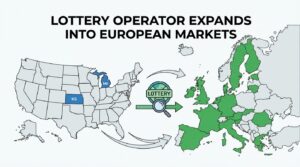
A lottery operator that recently secured footholds in Kansas and Michigan is now pivoting toward European expansion, signalling a broader strategic ambition that extends well beyond its initial US state operations. The move marks a significant step for the company as it seeks to diversify revenue streams across regulated markets on both sides of the Atlantic. While details of the specific European jurisdictions remain limited, the trajectory suggests a deliberate push into mature lottery ecosystems where regulatory frameworks and consumer habits differ substantially from those in the United States.
What the European Push Means for the Operator’s Growth Strategy
Before unpacking the specifics, it’s worth framing what this expansion represents in practical terms for stakeholders across the lottery and gaming sectors.
- Geographic diversification: Moving into Europe reduces the operator’s dependency on a small number of US state contracts, hedging against the political and regulatory volatility that can accompany American state-level procurement cycles.
- Regulatory complexity increases: European lottery markets operate under distinct national frameworks, and in some cases sub-national ones, requiring tailored compliance infrastructure that US-focused operators may not yet possess.
- The operator’s ability to win contracts in Kansas and Michigan first demonstrates a track record that European lottery authorities may view favourably during tender evaluations.
- Revenue potential: Europe’s lottery sector generates tens of billions of euros annually, with countries like Italy, Spain, and the UK among the world’s largest markets by per-capita spend.
From the Midwest to the Continent: A Rapid Timeline
Launching in Kansas and Michigan provided the operator with two distinctly different US market environments. Kansas, with its smaller population and more conservative gaming culture, contrasts sharply with Michigan’s larger, digitally engaged player base. That the operator managed to establish operations in both states suggests a degree of operational flexibility that translates well to international expansion.
And yet, Europe presents a fundamentally different challenge.
Unlike US states, where lottery operations are typically governed by a single state authority, European markets often involve layered regulatory oversight. In some jurisdictions, national gambling commissions set the rules while separate bodies handle licensing, taxation, and consumer protection. The operator will need to navigate these structures without the benefit of a unified federal framework (a distinction that catches many US-based operators off guard when they first cross the Atlantic).
Why European Lottery Markets Attract US-Based Operators
The appeal is straightforward but worth quantifying. Europe’s combined lottery market exceeded €90 billion in total sales in recent years, according to data from the European Lotteries association. Countries like Italy alone generate upward of €20 billion annually from lottery products. Spain’s El Gordo Christmas lottery is arguably the world’s most valuable single draw event. These are not emerging markets; they are deeply established ecosystems with sophisticated distribution networks and entrenched consumer behaviour.
For a US operator, entering this space offers scale that no single American state can match. But the barriers to entry are real. Incumbent operators in countries like France (Française des Jeux) and the UK (Allwyn, which recently took over the National Lottery licence from Camelot) have deep institutional relationships and decades of operational history. Breaking into these markets, even as a technology or services partner rather than a primary licence holder, demands credibility that only a proven track record can provide.
Comparing US and European Lottery Landscapes
| Factor | US State Lotteries | European Lotteries |
|---|---|---|
| Regulatory structure | State-by-state oversight | National and sometimes sub-national regulation |
| Digital adoption | Growing but uneven across states | More advanced in markets like the UK and Nordics |
| Market maturity | Varies significantly by state | Generally mature with established player bases |
| Competitive landscape | Fragmented vendor ecosystem | Dominated by a smaller number of large incumbents |
| Taxation models | State-determined, often complex | Varies widely; some jurisdictions tax turnover, others tax gross gaming revenue |
Operational Readiness and the Compliance Question
One dimension that doesn’t always surface in expansion announcements is compliance infrastructure. European regulators, particularly in jurisdictions like Sweden, Denmark, and the Netherlands, have grown increasingly assertive in enforcing responsible gambling standards, anti-money laundering protocols, and advertising restrictions. An operator entering these markets must demonstrate not just technical capability but a mature compliance culture.
The European Lotteries industry body has consistently advocated for high regulatory standards across member states, and operators seeking partnerships or contracts within this ecosystem will face scrutiny that goes beyond what many US state procurement processes require. Still, the operator’s successful launches in Kansas and Michigan suggest it has at least cleared a meaningful compliance threshold domestically.
How Market Perception Shapes Expansion Outcomes
Beyond the mechanics of regulation and licensing, there’s a subtler dynamic at work. How an operator is perceived by lottery authorities, retail partners, and end consumers in a new market can determine whether an expansion gains traction or stalls. In the lottery sector, trust is not a soft metric; it directly influences contract awards and renewal decisions.
Operators entering European markets often benefit from framing their value proposition around innovation rather than disruption. European lottery authorities tend to favour partners who enhance existing systems rather than those who promise to replace them entirely. This is where the operator’s US experience becomes a double-edged asset: it proves capability, but it must be translated into language and operational models that resonate with European stakeholders who operate under different assumptions about what lottery modernisation looks like.
What remains less clear is whether the operator intends to pursue primary operating licences in European countries or position itself as a technology and services provider to existing national lotteries. The distinction matters enormously, both in terms of capital requirements and regulatory exposure.
Frequently Asked Questions
Which US states has the operator launched in so far?
The operator has established operations in Kansas and Michigan, two states with notably different market profiles and player demographics.
Why is European expansion significant for a US lottery operator?
Europe’s lottery market is one of the largest globally, with annual sales exceeding €90 billion. Entering this market provides geographic diversification and access to mature, high-revenue ecosystems that no single US state can replicate.
What challenges does the operator face in Europe?
Regulatory fragmentation across national jurisdictions, entrenched incumbent operators, and increasingly stringent responsible gambling and AML requirements all present substantial hurdles. The compliance bar in several European countries has risen sharply in recent years.
Is the operator seeking full licences or technology partnerships?
That hasn’t been specified. The strategic approach, whether as a licence holder or a services partner, will shape the operator’s risk profile and capital commitments in ways that are difficult to overstate.