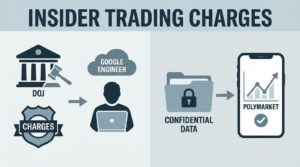
Federal prosecutors in Manhattan have arrested Michele Spagnuolo, a 36-year-old senior software engineer at Google, alleging he exploited privileged access to internal company metrics to place winning bets on the decentralised prediction platform Polymarket. The criminal complaint, unsealed by the U.S. Attorney’s Office for the Southern District of New York, charges Spagnuolo with multiple counts of fraud. If the allegations hold, this case could set a precedent for how insider trading law applies to decentralised event contract markets — a legal frontier that, until now, has remained largely untested.
What the Charges Against Spagnuolo Actually Mean for Prediction Markets
Before unpacking the mechanics of the alleged scheme, it helps to understand why this case carries weight far beyond one individual’s conduct. The intersection of proprietary corporate intelligence and decentralised finance has been a regulatory grey zone. This prosecution signals that the DOJ views prediction market activity through the same lens it applies to traditional securities fraud — at least when non-public information is involved.
- A senior Google engineer allegedly used administrative credentials to access confidential internet metrics unavailable to the public, then translated that data into financial positions on Polymarket
- The DOJ’s decision to pursue criminal fraud charges (not merely civil penalties) reflects a hardening posture toward misuse of proprietary data on decentralised platforms
- Polymarket, which operates as a decentralised prediction network, now faces indirect scrutiny over whether its market structure enables or inadvertently facilitates information asymmetry
- This is among the first federal insider trading cases explicitly targeting activity on a blockchain-based prediction platform
- The case may accelerate regulatory efforts to bring event contract markets under clearer oversight frameworks
How the Scheme Allegedly Worked
According to the complaint, Spagnuolo held specialised administrative access within Google’s infrastructure — the kind of elevated credentials typically reserved for engineers managing backend systems. Prosecutors allege he harvested non-public internet metrics, data points that could reveal trends in user behaviour, search volume, or platform activity before those trends became publicly visible.
He then allegedly used that information to take positions on Polymarket’s decentralised event contracts, where users wager on the outcomes of real-world events. The edge was structural: while other market participants relied on publicly available signals, Spagnuolo allegedly possessed a private window into data that could materially predict outcomes.
That distinction matters. Prediction markets derive their value from the assumption that participants operate on roughly equal informational footing. When someone trades on systematically superior private data, the market’s price discovery function breaks down.
A Regulatory Grey Zone Gets Its First Real Test
Decentralised prediction platforms have operated in a curious regulatory limbo. The Commodity Futures Trading Commission (CFTC) has asserted jurisdiction over certain event contracts, and Polymarket itself settled with the CFTC in 2022 over operating an unregistered trading facility. But criminal insider trading charges tied to prediction market activity? That’s new territory.
The DOJ’s approach here borrows from the playbook used against insider trading in equities and commodities, applying fraud statutes rather than relying on securities-specific regulations. This is arguably a strategic choice: by framing the case around fraud, prosecutors sidestep the unresolved question of whether prediction market contracts qualify as securities or commodities under existing law.
Still, the case raises a harder question. If the DOJ can prosecute someone for trading on non-public corporate data in a prediction market, does that same logic extend to anyone with asymmetric information — a journalist sitting on a scoop, a government employee aware of an upcoming policy decision? The boundaries remain undefined, and this prosecution will likely force courts to start drawing them.
Google’s Exposure and Internal Controls
For Google, the reputational implications are immediate even if the company itself faces no charges. The complaint suggests that Spagnuolo’s access was a function of his legitimate engineering role, not the result of a system breach. That raises uncomfortable questions about how effectively the company monitors the use of privileged credentials.
| Dimension | Detail |
|---|---|
| Accused | Michele Spagnuolo, 36, senior software engineer |
| Employer | |
| Charges | Multiple counts of fraud |
| Platform used | Polymarket (decentralised prediction market) |
| Alleged method | Harvesting non-public internet metrics via admin credentials |
| Prosecuting body | U.S. Attorney’s Office, Southern District of New York |
Large technology firms routinely grant engineers broad system access to maintain operational efficiency. But the trade-off between productivity and data security is one that most companies resolve through audit logs, access reviews, and behavioural monitoring. Whether Google’s internal controls failed or simply weren’t designed to catch this kind of misuse remains unclear from the public record.
What This Prosecution Reveals About Enforcement Strategy
Beyond the facts of this single case, the DOJ’s move carries a signal worth reading carefully. Federal prosecutors chose to unseal a criminal complaint — not issue a civil referral to the CFTC or SEC. That choice reflects a deliberate escalation. It tells market participants, corporate insiders, and platform operators that decentralised infrastructure does not insulate conduct from traditional criminal liability.
And while Polymarket is not named as a defendant, the platform’s architecture is now part of a federal court record. Regulators examining whether decentralised prediction markets need tighter guardrails will inevitably point to this case as evidence that the current framework is insufficient (a conclusion not everyone in the crypto and DeFi space will accept).
The timing also matters. Prediction markets gained mainstream visibility during the 2024 U.S. presidential election cycle, with Polymarket emerging as a widely cited barometer of political sentiment. Greater public attention invites greater regulatory scrutiny. This prosecution lands at precisely the moment when policymakers are debating whether and how to regulate these platforms more aggressively.
Frequently Asked Questions
What is Polymarket?
Polymarket is a decentralised prediction market platform where users buy and sell contracts tied to the outcomes of real-world events, from elections to economic data releases. It operates on blockchain infrastructure and settled with the CFTC in 2022 over registration issues.
Has anyone been charged with insider trading on a prediction market before?
This case appears to be among the first where federal prosecutors have brought criminal fraud charges explicitly linked to trading on a decentralised prediction platform using non-public corporate data. The legal territory is largely uncharted.
Is Polymarket itself facing charges?
No. The criminal complaint targets Spagnuolo individually. However, the case draws attention to the platform’s market structure and could influence future regulatory decisions about decentralised trading venues.
What kind of data did Spagnuolo allegedly access?
Prosecutors allege he used administrative credentials at Google to access confidential internet metrics — data reflecting user behaviour and platform activity trends that were not available to the public. The specific datasets have not been detailed in public filings.



