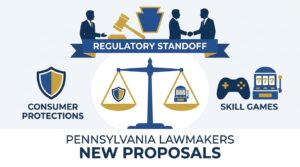
Pennsylvania legislators have introduced fresh proposals aimed at regulating the state’s sprawling skill games market, a sector that has operated in a legal gray area for years. The move comes as an estimated 67,000 skill game terminals generate billions in revenue across convenience stores, bars, and truck stops throughout the commonwealth. At stake is not just consumer safety but a significant stream of potential tax revenue that Harrisburg has so far been unable to capture. And while the gambling industry watches closely, the outcome could set a precedent for how other states handle similar unregulated gaming devices.
What the Skill Games Debate Actually Hinges On
Before diving into the legislative specifics, it helps to understand why this issue has proved so stubborn. Skill games occupy a peculiar regulatory gap in Pennsylvania. They resemble slot machines in appearance and function, yet their manufacturers argue the devices require player skill, which places them outside the jurisdiction of the Pennsylvania Gaming Control Board. That distinction (one regulators have been slow to enforce) has allowed the machines to proliferate without licensing, taxation, or meaningful consumer oversight.
Here is what matters most for stakeholders tracking this story:
- Revenue at risk: Skill games reportedly generate an estimated $8 billion to $9 billion annually in Pennsylvania, with virtually none of that flowing into state coffers as gaming tax revenue.
- Retail dependency: Thousands of small businesses rely on skill game commissions as a meaningful share of their income, complicating any regulatory crackdown.
- The proposed legislation would impose a tax rate and licensing framework, potentially bringing skill games under formal state oversight for the first time.
- Casino operators have long argued that unregulated skill games cannibalize their licensed, taxed operations, creating an uneven competitive landscape.
- Consumer protection provisions in the new proposals include age verification requirements and responsible gaming disclosures, features currently absent from most skill game terminals.
A Market Too Large to Ignore
Pennsylvania’s skill games footprint is staggering. With terminals scattered across gas stations, laundromats, fraternal clubs, and restaurants, the machines have become a fixture of daily commerce in both urban and rural communities. Pace-O-Matic, one of the largest skill game manufacturers operating in the state, has consistently maintained that its products are legal under Pennsylvania law and distinct from games of chance.
But the sheer scale of the market has made inaction increasingly untenable. Licensed casinos, which paid more than $2.3 billion in gaming taxes during the 2022–2023 fiscal year, view unregulated skill games as direct competition operating without comparable obligations. That tension has fueled years of litigation, lobbying, and legislative gridlock.
Still, the politics are far from simple. Rural legislators whose districts host few casinos but many skill game locations face pressure from small business owners who depend on the devices. Banning them outright would eliminate a revenue lifeline for establishments already operating on thin margins.
How the Proposed Framework Would Work
The latest legislative proposals seek a middle path. Rather than prohibition, lawmakers are exploring a regulatory and taxation model that would legitimize skill games while subjecting them to state oversight. Key elements under discussion include:
| Provision | Details |
|---|---|
| Tax Rate | A proposed percentage on gross gaming revenue, though the exact figure remains under negotiation among committee members |
| Licensing | Manufacturers and terminal operators would need state-issued licenses, with background checks and compliance audits |
| Age Restrictions | Mandatory age verification mechanisms at point of play |
| Location Limits | Caps on the number of terminals permitted per establishment, varying by venue type |
| Revenue Allocation | A portion of tax proceeds directed toward property tax relief and local government funding |
Whether this framework survives committee negotiations is another question entirely. Previous attempts at regulation have stalled, often caught between casino lobbyists pushing for stricter controls and skill game advocates resisting what they see as punitive taxation.
The Broader Regulatory Signal
Pennsylvania is not alone in wrestling with skill games. Virginia enacted its own regulatory framework in 2020, initially banning the machines before later allowing them under a taxed and licensed model. Georgia, Illinois, and several other states face similar debates. What Pennsylvania decides carries outsized weight given the state’s position as one of the largest regulated gambling markets in the country, home to the Pennsylvania Gaming Control Board’s extensive oversight infrastructure.
Arguably, the real question is not whether skill games will be regulated but how much of the existing market survives the transition. Operators who have invested heavily in terminal placement and distribution networks face uncertainty about whether new licensing costs and tax burdens will erode their margins to the point of unviability.
Why Consumer Protection Sits at the Center
Lost in much of the tax-and-turf debate is the consumer angle. Skill game terminals currently operate without the responsible gaming safeguards mandated for licensed slot machines. No self-exclusion programs. No problem gambling disclosures. No spending limits. For a product that functions, in practice, much like a slot machine, the absence of these protections is difficult to justify regardless of how the skill-versus-chance argument resolves.
The proposed legislation would require operators to display responsible gaming information and implement mechanisms to prevent underage play. These provisions mirror standards already in place at Pennsylvania’s 16 licensed casinos and numerous online gaming platforms.
What Happens If Lawmakers Stall Again?
The risk of continued inaction is not abstract. Every legislative session that passes without a resolution allows the unregulated market to entrench further, making eventual regulation more disruptive. Small businesses build deeper financial dependencies on skill game revenue. Manufacturers expand their terminal networks. And the state forgoes hundreds of millions in potential tax collections annually.
Courts have offered no definitive resolution either. A 2023 Commonwealth Court ruling found that certain skill games were not illegal gambling devices, but the decision was narrow and left broader regulatory questions unanswered. That judicial ambiguity, combined with legislative paralysis, has created a vacuum that benefits incumbents in the unregulated space while frustrating licensed operators and consumer advocates alike.
For Pennsylvania’s legislature, the current session may represent the clearest window yet to act. The convergence of bipartisan interest, mounting fiscal pressure, and growing public awareness of consumer protection gaps has shifted the political calculus. Whether that momentum translates into law remains the open question hanging over Harrisburg this session.
Frequently Asked Questions
What are skill games in Pennsylvania?
Skill games are electronic gaming terminals found in convenience stores, bars, and other retail locations across Pennsylvania. Their manufacturers contend the devices require an element of player skill, distinguishing them from traditional slot machines, though critics and regulators have challenged that characterization.
Are skill games currently legal in Pennsylvania?
Their legal status remains contested. A 2023 Commonwealth Court decision found certain devices were not unlawful gambling machines, but the ruling did not establish a comprehensive legal framework. At least on paper, they exist in a regulatory gap rather than under any formal authorization.
How much tax revenue could Pennsylvania collect from skill games?
Estimates vary depending on the tax rate applied, but given the billions in annual revenue the machines generate, state analysts have suggested potential collections in the hundreds of millions per year. No official projection has been released tied to the current proposals.



