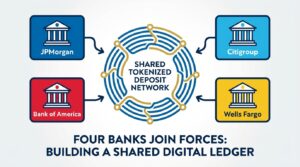
Four of the largest commercial banks in the United States have agreed to develop a joint tokenized deposit network, a move that could fundamentally alter how interbank settlements and commercial payments operate. JPMorgan Chase, Citigroup, Bank of America, and Wells Fargo are collaborating through The Clearing House, the bank-owned payments infrastructure company, to bring tokenized deposits into mainstream banking rails. The announcement, made via a joint press release on Friday, signals that Wall Street’s biggest players are no longer experimenting at the margins of blockchain technology — they’re building shared infrastructure.
What the Tokenized Deposit Network Means for Banking
Before diving into the strategic implications, it’s worth grounding what this initiative actually represents. A tokenized deposit is a digital representation of a bank deposit on a distributed ledger, enabling near-instant settlement, programmability, and 24/7 availability. Unlike stablecoins, which are issued by non-bank entities and sit outside the traditional banking perimeter, tokenized deposits remain liabilities of regulated banks. That distinction matters enormously (a point regulators have been keen to emphasize but slow to codify into clear frameworks).
The network is being built through The Clearing House, which already operates critical US payment systems including CHIPS and RTP. By anchoring the project in an existing, trusted payments utility, the four banks are arguably reducing the regulatory friction that a standalone blockchain venture might face.
- Interbank settlement reimagined: Tokenized deposits could compress settlement times from days to seconds, reducing counterparty risk across wholesale transactions.
- Programmable money enters commercial banking: Smart contract functionality layered onto deposits opens the door to automated escrow, conditional payments, and real-time treasury management.
- The collaboration positions regulated banks to compete directly with stablecoin issuers and fintech payment networks on speed and efficiency, without ceding ground on regulatory standing.
- Shared infrastructure over proprietary silos: Rather than each bank building its own tokenization layer, the joint approach creates network effects from day one — a strategic choice that accelerates adoption.
- Smaller banks and financial institutions could eventually plug into the network, though the initial scope remains limited to the four founding participants.
Why Now — and Why These Four?
JPMorgan has operated its own blockchain-based payment system, JPM Coin (now rebranded under Kinexys), since 2019. Citigroup has been piloting tokenized deposits and digital asset custody through its institutional clients division. Bank of America has filed dozens of blockchain-related patents. Wells Fargo participated in early distributed ledger experiments through the R3 consortium years ago.
Each of these institutions has invested independently in digital asset infrastructure. What’s changed is the competitive landscape. Stablecoin legislation is advancing in Congress. The Office of the Comptroller of the Currency has issued interpretive letters clarifying that national banks can engage in certain digital asset activities. And perhaps most critically, non-bank players like Circle, Tether, and PayPal have demonstrated that tokenized value transfer at scale isn’t theoretical — it’s operational.
The four banks collectively hold over $9 trillion in assets. Their decision to build together rather than separately suggests a recognition that interoperability, not proprietary advantage, determines who wins in payment infrastructure. A fragmented approach would have replicated the very inefficiencies tokenization is supposed to eliminate.
The Clearing House as the Anchor
The Clearing House’s role in US payment systems stretches back more than 170 years. It processes roughly $2 trillion in transactions daily through CHIPS alone. Embedding a tokenized deposit layer within this existing framework gives the initiative immediate credibility with regulators, counterparties, and correspondent banks.
Still, questions remain about the technical architecture. Will the network run on a private permissioned ledger? Which consensus mechanism will govern transaction validation? And how will it interface with existing real-time payment rails like FedNow? None of these details have been publicly disclosed.
Regulatory Positioning
One dimension that deserves scrutiny: this initiative lands at a moment when Congress is actively debating stablecoin regulation. The GENIUS Act and competing legislative proposals would establish federal oversight frameworks for payment stablecoins. By launching a tokenized deposit network, these banks are effectively making a case that regulated deposits — not stablecoins — should serve as the foundation for tokenized commercial payments.
Whether regulators see it that way remains an open question. The Federal Reserve has been cautious about endorsing any single approach to digital money, and the OCC’s recent guidance, while permissive, stops short of a full endorsement of tokenized deposit schemes at scale.
Competitive Implications Across the Financial Sector
| Dimension | Tokenized Deposits (Bank Network) | Stablecoins (Non-Bank Issuers) |
|---|---|---|
| Issuer | Regulated commercial banks | Non-bank entities (Circle, Tether) |
| Backing | Bank deposit liabilities, FDIC-insured | Reserves (Treasuries, cash equivalents) |
| Regulatory status | Within existing banking supervision | Pending federal legislation |
| Settlement speed | Near-instant (target) | Near-instant (operational) |
| Programmability | Emerging — smart contract integration planned | Widely available on public blockchains |
| Interoperability | Initially limited to network participants; expansion expected | Broad, cross-chain compatibility |
The competitive tension here isn’t subtle. Banks are staking a claim that tokenized deposits offer the same speed advantages as stablecoins but with the regulatory protections and institutional trust that non-bank issuers cannot match — at least on paper.
What This Signals for Institutional Adoption
For corporate treasurers, asset managers, and large institutional clients, the emergence of a bank-backed tokenized deposit network could simplify a decision that has been fraught with uncertainty. Engaging with stablecoins has required navigating unclear regulatory territory, counterparty risk assessments, and operational integration challenges. A tokenized deposit sitting within the same banking relationship a corporation already maintains changes that calculus considerably.
And yet, the network’s success depends on factors beyond technology. Liquidity depth, transaction costs, governance structures, and the willingness of mid-tier banks to join will all shape whether this becomes the backbone of next-generation commercial payments or another pilot that plateaus.
Frequently Asked Questions
How do tokenized deposits differ from stablecoins?
Tokenized deposits are digital representations of traditional bank deposits, remaining on the issuing bank’s balance sheet as regulated liabilities. Stablecoins, by contrast, are issued by non-bank entities and backed by reserve assets. The regulatory treatment, deposit insurance implications, and counterparty risk profiles differ substantially between the two.
When will the tokenized deposit network launch?
No official launch date has been announced. The initiative is in its development phase, and key technical and regulatory details have not yet been disclosed publicly.
Could other banks join the network?
While the founding participants are JPMorgan, Citigroup, Bank of America, and Wells Fargo, the use of The Clearing House as the underlying infrastructure suggests the network could expand to include additional member institutions over time. The specifics of onboarding remain unclear.
What regulatory approvals are needed?
That depends on the final design. Tokenized deposits issued by nationally chartered banks fall under OCC supervision, but the Federal Reserve and FDIC may also weigh in depending on how the network’s settlement and risk-sharing mechanisms are structured. Existing interpretive guidance provides a foundation, though no bespoke regulatory framework for tokenized deposit networks currently exists in the US.



