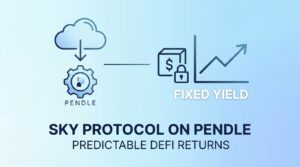
Sky, the protocol formerly known as MakerDAO and the issuer behind the $11 billion USDS stablecoin, has launched a fixed-yield product that allows depositors to lock in predetermined returns tied to specific maturity dates. Built on Pendle’s yield-tokenization infrastructure, the product — branded Fixed Yield — went live Wednesday and represents a notable step toward bringing structured finance mechanics into decentralized markets. The move positions Sky at the intersection of stablecoin liquidity and yield predictability, two qualities institutional participants have long demanded from DeFi.
What Sky’s Fixed Yield Launch Signals for DeFi Markets
Before unpacking the mechanics, it helps to understand why this matters commercially. DeFi yields have historically been variable, subject to protocol incentives, liquidity shifts, and governance votes that can change rates overnight. Fixed-yield instruments address that volatility head-on, offering depositors something closer to a bond-like experience. Here are the strategic takeaways:
- Institutional appeal sharpens: A fixed return to a named maturity date mirrors the structure of traditional fixed-income products, lowering the cognitive barrier for allocators accustomed to treasuries and money-market funds.
- Pendle’s infrastructure gains validation: By choosing Pendle’s yield-tokenization layer, Sky effectively endorses the protocol as viable plumbing for structured DeFi products at scale.
- The $11 billion USDS stablecoin now has a native yield destination that doesn’t require depositors to accept floating-rate risk.
- Competitive pressure builds: Other stablecoin issuers will likely face questions about whether they can offer comparable predictability, particularly as rate environments shift.
- Sky’s rebranding from MakerDAO continues to take on functional meaning, not just cosmetic — this is a product MakerDAO never shipped.
How the Mechanics Work
Pendle’s yield-tokenization system splits yield-bearing assets into two components: a principal token and a yield token. The principal token represents the underlying deposit redeemable at maturity, while the yield token captures the income stream generated over the lock-up period. By purchasing the principal token at a discount, depositors effectively lock in a fixed rate.
Sky’s Fixed Yield product leverages this architecture to let USDS holders choose a maturity date and receive a guaranteed return denominated in USDS. That guarantee, at least on paper, depends on the continued solvency of both the Sky protocol and the Pendle infrastructure layer beneath it. Smart contract risk hasn’t disappeared. But the user-facing experience is considerably simpler than manually managing yield positions across multiple protocols.
What remains less clear is how Sky will manage the underlying collateral to honor fixed commitments if market conditions deteriorate sharply. The protocol’s governance mechanisms, inherited from the MakerDAO era, give token holders significant control over risk parameters (a distinction that could either reassure or unsettle prospective depositors, depending on their view of decentralized governance).
Why Pendle Keeps Showing Up
Pendle’s yield-tokenization protocol has quietly become one of the more consequential pieces of DeFi infrastructure in 2024 and into 2025. Its total value locked has grown substantially as protocols seek to offer more sophisticated financial products without building tokenization layers from scratch.
Sky choosing Pendle over a proprietary solution says something. Building yield-splitting infrastructure internally would have been feasible for a protocol of Sky’s size, yet the team opted for composability over control. That decision likely accelerated the launch timeline and reduced audit surface area, though it introduces dependency on an external protocol’s continued operation and security.
The Broader Fixed-Income Push in DeFi
Sky isn’t operating in a vacuum. Several protocols have been experimenting with fixed-rate lending and borrowing over the past 18 months, including Notional Finance, Term Finance, and Exactly Protocol. Yet none of those efforts have been anchored to a stablecoin with $11 billion in circulation. Scale matters here. A fixed-yield product is only as useful as the liquidity behind it, and USDS provides a deep enough base to make the offering commercially meaningful rather than experimental.
Traditional finance has spent decades refining fixed-income markets. DeFi’s versions remain rudimentary by comparison. Still, the gap is narrowing. Products like Fixed Yield don’t replicate a treasury bond, but they borrow enough of its logic to serve a similar function for on-chain capital that would otherwise sit in variable-rate pools or idle wallets.
How does this compare to traditional fixed-income?
| Feature | Sky Fixed Yield | Traditional Fixed Income |
|---|---|---|
| Return type | Fixed to maturity | Fixed coupon or discount yield |
| Underlying asset | USDS stablecoin | Government or corporate debt |
| Settlement | On-chain, smart contract | Custodial, T+1 or T+2 |
| Credit risk | Smart contract and protocol governance risk | Issuer default risk, typically rated |
| Regulatory oversight | Minimal, protocol-governed | Extensive, jurisdiction-dependent |
Reframing Risk Perception in Decentralized Finance
One underappreciated dimension of this launch is psychological. For many prospective DeFi users, the unpredictability of returns acts as a barrier that no APY figure can overcome. Behavioral finance research consistently shows that certainty of outcome weighs more heavily in decision-making than expected value alone. A guaranteed 4% often feels more attractive than a variable rate averaging 6%, even when the math favors the latter.
Sky’s Fixed Yield product directly addresses this cognitive bias. By offering a named return and a defined endpoint, it reframes the DeFi deposit from an open-ended bet into something with boundaries. That reframing matters enormously for capital that currently sits on the sidelines — whether in institutional treasuries, DAO reserves, or individual wallets held by participants who understand DeFi mechanics but distrust floating exposure.
And there’s a compounding effect. Every user who locks in a fixed yield and receives exactly what was promised becomes a reference point for others. Trust in DeFi protocols has historically been built through repeated, verifiable outcomes rather than marketing claims. Sky’s stablecoin ecosystem now has a product that can generate those reference points at scale, assuming execution holds.
The language around the product matters too. “Fixed Yield” is deliberately plain. It doesn’t invoke complex financial engineering or obscure tokenomics. That naming choice reflects an awareness that adoption depends partly on accessibility of framing, not just soundness of mechanism.
Frequently Asked Questions
What is Sky’s Fixed Yield product?
It allows USDS stablecoin holders to deposit funds and lock in a predetermined return tied to a specific maturity date, using Pendle’s yield-tokenization infrastructure to split principal and yield components.
Is the yield truly guaranteed?
The fixed rate is programmatic, enforced by smart contracts. But “guaranteed” carries caveats: smart contract vulnerabilities, protocol governance decisions, and broader systemic risks in DeFi could all affect outcomes. It’s fixed in design, not risk-free in practice.
Why did Sky choose Pendle instead of building its own system?
Composability and speed likely drove the decision. Pendle’s infrastructure is already audited, battle-tested, and widely integrated. Building from scratch would have added months and introduced a new attack surface.
Who is this product designed for?
Arguably, anyone holding USDS who wants rate certainty. In practice, the strongest appeal is likely among DAO treasuries, on-chain funds, and sophisticated individual participants seeking bond-like exposure without leaving DeFi rails.



