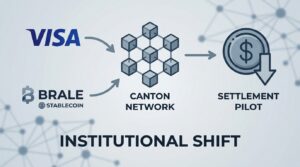
Visa, the global payments giant, and stablecoin infrastructure firm Brale have begun piloting settlement using SBC, a U.S. dollar-backed stablecoin issued by Brale, on the Canton Network. The Canton Network is a permissioned-but-privacy-preserving blockchain developed by Digital Asset, designed specifically for regulated financial institutions. This collaboration marks a notable step in bridging traditional payment rails with blockchain-based settlement infrastructure, and it arrives at a moment when institutional appetite for stablecoin utility is accelerating across the financial sector.
What the Visa-Brale Pilot Means for Institutional Payments
Before diving into the strategic implications, it helps to frame what this pilot actually represents. Visa is not simply experimenting with crypto for optics. The company is testing whether stablecoin-based settlement can function within the compliance and privacy constraints that regulated entities demand. Brale’s SBC stablecoin, pegged to the U.S. dollar, provides the settlement medium, while the Canton Network supplies the infrastructure layer (a distinction that matters more than it might seem at first glance).
- Visa is actively exploring stablecoin rails for settlement, moving beyond card network transactions into blockchain-native payment finality.
- Brale’s SBC stablecoin operates as a dollar-backed instrument designed for institutional use, not retail speculation.
- The Canton Network’s architecture allows institutions to transact with privacy guarantees while still operating on a shared ledger, addressing a persistent concern among banks and payment processors.
- This pilot could establish a template for how major payment networks integrate stablecoins without abandoning regulatory compliance frameworks.
- Timing is significant: U.S. stablecoin legislation is advancing through Congress, and institutional pilots like this one build the operational track record regulators want to see.
Why Canton, and Why Now?
The choice of the Canton Network is deliberate. Unlike public blockchains where transaction data is visible to anyone, Canton offers what Digital Asset calls “privacy-preserving interoperability.” Participants on the network can settle transactions without exposing sensitive commercial details to other network members. For a company like Visa, which processes billions of transactions and guards competitive data fiercely, that feature isn’t optional.
Canton was built by Digital Asset’s enterprise blockchain platform, and it has attracted a growing roster of financial institutions exploring tokenized assets and on-chain settlement. The network already counts participants from banking, asset management, and insurance. Adding a payments heavyweight like Visa raises the stakes considerably.
And while public chains like Ethereum have dominated stablecoin volume, the institutional settlement use case demands something different. Speed matters, yes. But so does confidentiality, regulatory alignment, and the ability to enforce access controls. Canton checks those boxes in ways that permissionless networks, at least on paper, do not.
Brale’s Role in the Stablecoin Stack
Brale occupies an increasingly important niche. The company provides infrastructure for issuing, managing, and settling stablecoins, positioning itself as a backend layer rather than a consumer-facing brand. SBC, its dollar-backed stablecoin, is purpose-built for enterprise settlement workflows.
What separates Brale from the crowded field of stablecoin issuers is its focus on programmability and compliance tooling. Enterprises don’t just need a token pegged to the dollar. They need audit trails, redemption guarantees, and integration with existing treasury systems. Brale’s stablecoin infrastructure targets exactly that gap.
The pilot with Visa validates Brale’s thesis that institutional stablecoin adoption will be driven by infrastructure quality, not token market cap.
How Stablecoin Settlement Reshapes Payment Economics
Traditional cross-border and interbank settlement involves layers of intermediaries, each extracting fees and adding latency. A wire transfer between two banks can still take hours. Correspondent banking relationships add complexity and cost, particularly for smaller institutions.
Stablecoin-based settlement compresses that process. The transaction settles on-chain, with finality measured in seconds or minutes rather than hours or days. The economic implications are substantial:
| Settlement Method | Typical Finality | Intermediary Layers | Privacy Model |
|---|---|---|---|
| Traditional wire (SWIFT) | Hours to days | Multiple correspondent banks | Bilateral, opaque |
| Card network settlement | 1–2 business days | Acquirer, processor, issuer | Network-controlled |
| Stablecoin on Canton | Near real-time | Minimal (issuer + network) | Privacy-preserving, permissioned |
That third row is where Visa and Brale are placing their bet.
Regulatory Landscape and Strategic Timing
This pilot does not exist in a vacuum. U.S. lawmakers are actively debating stablecoin regulation, with multiple bills advancing through committee. The proposed frameworks generally favor dollar-backed, fully reserved stablecoins issued by regulated entities. Brale’s SBC fits that profile.
For Visa, participating in a compliant stablecoin pilot builds credibility with regulators and positions the company as a constructive participant in the policy conversation. It also hedges against a future where stablecoin rails compete with, or complement, traditional card networks. Better to shape that future than react to it.
Still, questions linger. Will other major payment networks follow with similar pilots? How quickly can settlement on permissioned chains scale to handle Visa-level transaction volumes? And perhaps most critically, will the regulatory framework that eventually emerges treat these settlement mechanisms as equivalent to existing payment systems, or impose an entirely separate compliance burden?
Frequently Asked Questions
What is SBC?
SBC is a U.S. dollar-backed stablecoin issued by Brale, designed for institutional settlement rather than retail trading. It maintains a 1:1 peg with the dollar and is built for enterprise compliance requirements.
Why did Visa choose the Canton Network instead of a public blockchain?
Canton offers privacy-preserving settlement on a permissioned ledger, which aligns with Visa’s need to protect transaction confidentiality while still leveraging blockchain-based finality. Public chains expose transaction data to all participants, a non-starter for most regulated financial institutions.
Does this mean Visa is replacing its card network with stablecoins?
No. This is a pilot exploring stablecoin-based settlement as a complement to existing infrastructure. Visa’s card network processes trillions of dollars annually, and any integration of stablecoin rails would augment, not replace, those systems. The pilot tests feasibility and compliance alignment before any broader rollout could be considered.
What regulatory framework governs this pilot?
The U.S. stablecoin regulatory framework remains under development. However, Brale’s SBC is designed to comply with emerging requirements for full dollar reserves and transparent redemption mechanisms, positioning it favorably under most proposed legislative frameworks currently advancing in Congress.



