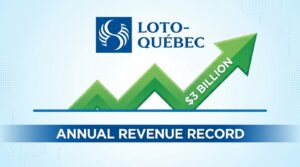
Loto-Québec, the Québec crown corporation responsible for gaming, lotteries, and casinos across the province, has surpassed $3 billion in annual revenue for the first time in its history. The milestone, reported for the fiscal year 2024–2025, signals a period of sustained commercial momentum for one of Canada’s most significant public gaming operators. It also raises questions about what’s driving growth and whether this trajectory is replicable in the years ahead.
What a $3 Billion Year Means for Québec’s Public Gaming Model
Before unpacking the strategic implications, here are the core takeaways from this revenue milestone:
- Loto-Québec has achieved a record-breaking annual revenue exceeding $3 billion, a first in the corporation’s multi-decade history
- The result reinforces the viability of provincial crown corporation models in Canadian gaming, at a time when several provinces are reconsidering their regulatory frameworks
- Revenue growth likely reflects a combination of expanded digital offerings, increased casino visitation, and lottery product diversification
- As a crown corporation, Loto-Québec’s profits flow directly to the provincial government, meaning this result carries fiscal policy weight beyond the gaming sector alone
- The performance sets a benchmark that peer operators in Ontario, British Columbia, and Atlantic Canada will be measured against
How the Crown Corporation Got Here
Loto-Québec has operated since 1969, managing everything from retail lottery terminals to full-scale casino resorts. But the last several years have seen a deliberate push into digital channels, including online casino and sports betting products offered through its regulated platform. That digital expansion, combined with a post-pandemic rebound in physical casino traffic, has created a dual-engine revenue structure that few Canadian provincial operators have managed as effectively.
The $3 billion figure is not just a round number. It represents a meaningful jump from pre-pandemic revenue levels, when the corporation typically reported figures in the $2.5 to $2.7 billion range. What changed? Partly consumer behaviour. Partly product strategy. And partly the competitive landscape (a distinction worth examining more closely).
Unlike Ontario, which opened its iGaming market to private operators in April 2022, Québec has maintained a monopoly model where Loto-Québec remains the sole legal provider of online gambling. That structural advantage means every dollar wagered digitally in the province flows through one entity. Whether this model maximizes consumer choice is debatable. Whether it maximizes revenue capture for the province is less so.
Provincial Revenue and the Fiscal Ripple Effect
Crown corporations like Loto-Québec exist to generate public revenue. Every dollar of profit is returned to the Québec government, funding healthcare, education, and infrastructure. A $3 billion revenue year, depending on margins, could translate into well over $1 billion in net income transferred to provincial coffers.
That makes this result a fiscal event, not merely a corporate one.
Provincial finance ministers across Canada have watched gaming revenue become an increasingly reliable contributor to public budgets. In Québec’s case, the crown corporation model allows the government to retain full economic benefit without sharing margins with private-sector licence holders. Still, the model carries its own risks: operational inefficiency, slower product innovation, and the political complexity of a government entity actively encouraging gambling participation.
Digital Growth as the Differentiator
Arguably the most consequential shift in Loto-Québec’s recent performance has been its digital pivot. Online revenue streams, including virtual casino games, poker, and sports wagering, have grown substantially year over year. The corporation has invested in platform upgrades, mobile experience, and responsible gambling tools, all while operating without direct private-sector competition in the province.
| Revenue Channel | Trend Direction | Strategic Significance |
|---|---|---|
| Lotteries | Stable | Remains the broadest consumer touchpoint across Québec |
| Casinos (physical) | Recovering post-pandemic | Foot traffic has rebounded, though not uniformly across all properties |
| Online gaming | Strong growth | The fastest-growing segment; benefits from monopoly positioning |
| Sports betting | Expanding | Single-event sports betting legalization in 2021 opened a new vertical |
The legalization of single-event sports betting across Canada in August 2021 gave Loto-Québec a new product category to monetize. And unlike Ontario’s fragmented market with dozens of licensed operators, Québec funnelled all legal sports betting through its own platform. The result: a cleaner revenue capture model, even if total market activity may be smaller than Ontario’s.
Reframing What Growth Looks Like in Regulated Markets
There’s a broader narrative embedded in this milestone. Across North America, the conversation around gaming revenue growth has been dominated by U.S. commercial operators and the explosive expansion of sports betting in states like New York and New Jersey. Canadian provincial operators rarely generate the same headlines. Yet Loto-Québec’s $3 billion year demonstrates that government-run models can deliver scale, particularly when digital strategy is executed with discipline.
What remains less clear is whether this growth rate can be sustained without structural changes. Consumer spending on gambling is not infinite. Regulatory pressure around responsible gambling continues to intensify. And the question of whether Québec will eventually open its market to private operators, as Ontario did, lingers in the background of every policy discussion about the province’s gaming future.
Frequently Asked Questions
What is Loto-Québec?
Loto-Québec is a crown corporation established in 1969 by the Government of Québec. It manages all legal gambling activities in the province, including lotteries, casinos, online gaming, and sports betting. Its profits are transferred directly to the provincial government.
How does Loto-Québec’s model differ from Ontario’s?
Québec operates a monopoly model where Loto-Québec is the sole legal provider of gambling services, including online. Ontario, by contrast, opened its iGaming market to private operators in 2022, creating a competitive multi-operator environment. Each approach carries trade-offs in revenue capture, consumer choice, and regulatory complexity.
Where does the revenue go?
As a crown corporation, Loto-Québec’s net income is returned to the Québec government. These funds support public services including healthcare, education, and provincial infrastructure programs.
Is $3 billion in revenue unusual for a Canadian gaming operator?
It is significant. Few provincial gaming corporations in Canada have reached this threshold, making Loto-Québec’s achievement a benchmark for the industry. The figure reflects combined revenue across all product lines, not a single segment.