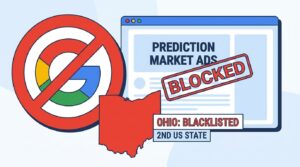
Google has formally updated its advertising policies to impose a blanket prohibition on prediction market advertisements targeting Ohio. The restriction, framed as a localised revision to the company’s broader North American commercial guidelines, outlaws promotional activity involving event contracts, derivatives, and outcome-based financial instruments within the state’s borders. Ohio now joins Nevada as the only two US states where prediction market advertising is entirely banned on Google’s platforms. The tech giant pointed to compliance complexities and shifting jurisdictional classifications around event wagering as the catalysts behind the move.
What Google’s Ohio Ad Ban Signals for the Prediction Market Industry
This isn’t merely a policy footnote. For an industry still negotiating its regulatory identity across US states, Google’s decision carries outsized weight because of the platform’s dominance in digital advertising. When the largest ad distribution network in the world draws a line, the downstream effects ripple through customer acquisition strategies, platform growth trajectories, and investor confidence alike.
- Ohio becomes only the second state explicitly blacklisted from prediction market ads on Google, following Nevada’s permanent ban
- The restriction covers event contracts, derivatives, and any outcome-based financial instruments — a notably broad scope
- Prediction market operators targeting Ohio users will need to find alternative acquisition channels or risk compliance violations on Google’s network
- Google’s rationale centres on “evolving jurisdictional classifications,” suggesting the company sees regulatory ambiguity itself as a risk factor worth avoiding
- The precedent could accelerate similar restrictions in other states where prediction markets sit in a legal grey zone
Why Ohio, and Why Now?
Ohio’s regulatory posture toward prediction markets has been, at best, unsettled. The state legalised sports betting in January 2023, but the classification of event contracts and prediction markets remains a separate and murkier question. Are they gambling products? Financial instruments? Something in between? That ambiguity (a distinction regulators have been slow to enforce) appears to be precisely what prompted Google to act preemptively rather than wait for a definitive ruling.
Nevada’s ban, by contrast, was rooted in a more established regulatory framework around wagering. The state’s gaming commission has long maintained tight control over anything resembling a bet. Ohio’s situation is different. It reflects a newer, less resolved tension between financial innovation and consumer protection mandates.
Google did not disclose whether specific complaints, enforcement actions, or advertiser violations triggered the timing. But the decision aligns with a broader pattern: platforms increasingly choosing to restrict first and revisit later, rather than risk exposure to state-level enforcement that could arrive without warning.
How Prediction Market Platforms Are Affected
For operators like Kalshi, Polymarket, and others building consumer-facing prediction market products, Google’s advertising policy framework represents a critical distribution channel. Losing access to paid search and display inventory in a state with nearly 12 million residents is not trivial.
| Factor | Nevada (Existing Ban) | Ohio (New Ban) |
|---|---|---|
| Population | ~3.2 million | ~11.8 million |
| Legal sports betting | Yes (long-established) | Yes (since January 2023) |
| Prediction market classification | Falls under gaming regulation | Jurisdictionally unresolved |
| Google ad ban scope | All event contracts and derivatives | All event contracts and derivatives, with broader language around outcome-based instruments |
The population difference alone makes Ohio’s ban arguably more consequential in commercial terms. And while organic search, social media, and direct partnerships remain available channels, paid search on Google has historically been the most efficient lever for fintech customer acquisition at scale.
A Regulatory Vacuum That Platforms Are Filling Themselves
What makes this development particularly striking is the direction of the initiative. This isn’t a state regulator ordering Google to pull ads. It’s Google deciding, on its own, that the regulatory environment in Ohio is too uncertain to permit advertising. The company is, in effect, performing a regulatory function that no state agency has yet exercised.
That dynamic raises a harder question. When private platforms begin drawing jurisdictional lines around emerging financial products, what happens to the operators who built their growth strategies on the assumption that advertising access would track legal access? At least on paper, prediction markets are not prohibited in Ohio. Yet they can no longer be advertised there through the world’s largest ad network.
Still, Google’s move is not without internal logic. The company has faced scrutiny over gambling-adjacent advertising in multiple jurisdictions, and a conservative posture reduces litigation risk. Whether other platforms — Meta, Microsoft, Amazon’s ad network — follow suit remains an open variable that prediction market operators are almost certainly modelling right now.
Broader Market and Regulatory Implications
The prediction market sector has been gaining momentum, particularly after the CFTC’s evolving stance on event contracts and Kalshi’s high-profile legal battle to offer election-related contracts. But momentum and regulatory clarity are not the same thing. Google’s decision underscores a gap that the industry has not yet closed: the absence of a unified federal framework for prediction markets.
Without that framework, state-by-state fragmentation will continue. And each time a major platform like Google draws its own boundary, the fragmentation deepens. Operators face a patchwork of rules that varies not only by state law but by the internal policies of their distribution partners.
For investors evaluating prediction market startups, this introduces a new category of risk that sits outside traditional regulatory analysis. Platform policy risk — the possibility that a Google or Meta unilaterally restricts access — now belongs alongside licensing risk and enforcement risk in any serious due diligence process.
Frequently Asked Questions
Does this ban mean prediction markets are illegal in Ohio?
No. Google’s advertising restriction is a platform-level policy decision, not a legal prohibition. Prediction markets have not been formally outlawed by Ohio regulators. The ban reflects Google’s own risk assessment of the state’s unresolved regulatory landscape.
Which states currently have Google prediction market ad bans?
As of this update, only Nevada and Ohio. Nevada’s ban has been in place longer, rooted in the state’s established gaming regulatory framework. Ohio’s is newer and driven by jurisdictional ambiguity.
Can prediction market companies still reach Ohio users through other channels?
Yes — organic search, social media advertising (subject to those platforms’ own policies), email marketing, and direct partnerships remain available. The restriction applies specifically to Google’s ad network.
Will other states likely face similar bans?
Google has not announced additional state-level restrictions, but the rationale cited — evolving jurisdictional classifications — could apply to several other states where prediction market regulation remains unsettled. The precedent is now set, and the pattern suggests Google will act again if it perceives sufficient compliance risk elsewhere.



