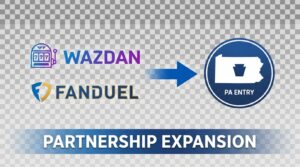
Wazdan, the Malta-based slots and casino games supplier, has extended its existing commercial relationship with FanDuel by going live in Pennsylvania. The deal marks another step in Wazdan’s state-by-state expansion across the regulated U.S. iGaming landscape, building on a partnership that already spans multiple jurisdictions. Pennsylvania, one of the largest legal online gambling markets in the country, gives Wazdan access to a player base that generated over $2 billion in online casino revenue during 2024.
What the Pennsylvania Launch Means for Both Parties
This isn’t Wazdan’s first foray into the American market, but the Pennsylvania expansion carries particular weight. The state ranks among the top three U.S. jurisdictions for iGaming revenue, sitting alongside New Jersey and Michigan. For a supplier still building brand recognition stateside, placement on FanDuel’s platform in this market is arguably more valuable than a dozen smaller-state launches combined.
Before diving into the strategic details, here’s what matters most at a business level:
- Revenue exposure: Pennsylvania’s online casino market surpassed $2 billion in gross gaming revenue in 2024, giving Wazdan access to one of the most lucrative regulated environments in North America.
- Platform reach: FanDuel operates as one of the dominant sportsbook and casino brands in the U.S., meaning Wazdan’s titles will sit in front of a massive, already-engaged audience.
- The deal builds incrementally on prior agreements between the two companies across other U.S. states, suggesting a tested and stable commercial relationship.
- Competitive positioning: Entering Pennsylvania strengthens Wazdan’s credentials when negotiating with other U.S. operators who prioritize suppliers already certified in high-revenue states.
A Supplier Strategy Shaped by Regulatory Patience
Wazdan’s approach to the U.S. market has been methodical rather than aggressive. The company has pursued certification and licensing on a jurisdiction-by-jurisdiction basis, a process that demands both time and capital (a distinction that separates serious entrants from those merely testing the waters). Each new state requires independent regulatory approval, technical compliance checks, and operator-level integration.
That patience appears to be paying off. By layering Pennsylvania onto an existing FanDuel relationship, Wazdan avoids the cold-start problem that plagues many European suppliers entering the American market. The integration infrastructure already exists. What changes is the regulatory wrapper and the player pool.
Still, the question of how quickly Wazdan can convert market access into meaningful revenue share remains open. Pennsylvania’s online casino sector is competitive, with established content libraries from suppliers like Evolution, Pragmatic Play, and IGT already deeply embedded in operator lobbies.
Why FanDuel Keeps Adding Content Partners
From FanDuel’s perspective, the calculus is straightforward. Player retention in online casino depends heavily on content freshness. Slots players, in particular, cycle through titles rapidly, and operators that fail to refresh their game libraries risk losing engagement to competitors who do.
Wazdan’s portfolio of online slot games includes mechanics like the Hold the Jackpot series and volatility-adjustment features that give players some control over gameplay variance. These aren’t revolutionary in the European market, where they’ve been available for years, but they carry novelty value in U.S. jurisdictions where the content ecosystem is still maturing.
FanDuel, which operates under the Flutter Entertainment umbrella, has been systematically broadening its supplier base across all active states. The operator’s strategy reflects a broader industry trend: diversification of content supply chains to reduce dependency on any single provider.
Pennsylvania’s Regulatory Framework and Market Dynamics
Pennsylvania legalized online casino gambling in 2017 under Act 42, with the first operators launching in 2019. The state applies a 54% tax rate on online slots revenue and 16% on table games, among the highest in the country. That tax structure shapes operator economics in ways that ripple down to supplier deals.
| State | Online Casino Tax Rate (Slots) | Market Launch Year | 2024 Est. GGR |
|---|---|---|---|
| Pennsylvania | 54% | 2019 | $2B+ |
| New Jersey | 17.5% | 2013 | $2.1B+ |
| Michigan | 20–28% | 2021 | $1.9B+ |
| West Virginia | 15% | 2020 | ~$300M |
Under Pennsylvania’s high-tax regime, operators are selective about which suppliers earn lobby placement. Content that doesn’t perform gets rotated out quickly. For Wazdan, this means the real test begins after launch: can their games generate enough player engagement to justify continued prominence on FanDuel’s Pennsylvania platform?
Framing the Opportunity Through Behavioral Engagement
What often gets overlooked in supplier-operator announcements like this is the behavioral dimension of content performance. Player engagement with slot games isn’t purely a function of RTP percentages or jackpot sizes. It operates at the intersection of visual design, reward pacing, and perceived player agency. Wazdan’s volatility-level selection feature, which lets players choose between low, standard, and high variance within the same game, taps directly into a principle that behavioral scientists have studied for decades: the illusion of control increases engagement duration.
When players feel they are making meaningful choices, even within a system governed by random number generation, session times tend to extend. This isn’t speculation. Academic research on variable-ratio reinforcement schedules, dating back to B.F. Skinner’s foundational work, confirms that perceived autonomy amplifies the reward response. Wazdan has, whether by design or intuition, embedded this principle into its product architecture. And in a market like Pennsylvania, where operators face steep tax obligations and need every session to count, games that hold attention longer carry disproportionate commercial value.
The broader lesson for suppliers entering the U.S. is that differentiation increasingly lives in game mechanics, not just themes or graphics. Operators are becoming more sophisticated in how they evaluate content performance, using data on spin counts, session duration, and cross-sell conversion rather than relying on subjective assessments of game quality. Suppliers who understand the behavioral levers behind player retention will find it easier to secure and maintain premium lobby positions.
Frequently Asked Questions
Which Wazdan games are available on FanDuel in Pennsylvania?
Specific titles have not been publicly confirmed at the time of the announcement. Wazdan’s U.S.-certified portfolio typically includes popular Hold the Jackpot series entries and titles featuring their proprietary volatility-selection mechanic.
Is Wazdan licensed in other U.S. states?
Yes. The company has been building its American footprint incrementally, with certifications and operator partnerships across multiple regulated jurisdictions. Pennsylvania represents the latest addition to that list.
How does Pennsylvania’s tax rate affect game suppliers?
Pennsylvania’s 54% tax on online slots revenue is among the highest in the nation. While the tax is levied on operators, it creates downstream pressure on supplier revenue-share agreements, making game performance metrics critically important for maintaining platform placement.



