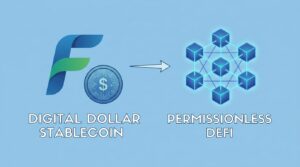
Fidelity Investments’ stablecoin, the Fidelity Digital Dollar, has reportedly deployed liquidity onto two of decentralized finance’s most prominent protocols in a single Ethereum block. The move, flagged Thursday evening by on-chain data analyst LytninCrypto, marks the first time the Fidelity-branded token has appeared on permissionless DeFi rails. Liquidity was directed to both Curve Finance and Uniswap, signalling that one of the world’s largest asset managers is no longer content to observe DeFi from the sidelines.
Why Fidelity’s DeFi Entry Reshapes the Stablecoin Conversation
Before unpacking the mechanics, it helps to frame what this deployment actually represents for institutional participation in decentralized markets. A firm managing over $4.9 trillion in assets choosing to interact with permissionless protocols is not a routine treasury operation. It carries regulatory, reputational, and strategic weight that few other market participants can match.
- Fidelity’s Digital Dollar stablecoin deployed liquidity to Curve Finance and Uniswap simultaneously within a single Ethereum block, suggesting a coordinated, deliberate strategy rather than an exploratory test.
- This is the first confirmed instance of a Fidelity-branded digital asset operating on permissionless DeFi infrastructure, a meaningful departure from the custodial and permissioned environments traditional finance typically favours.
- The dual-protocol approach hints at a liquidity strategy designed to capture both stablecoin swap depth (Curve) and broader trading pair exposure (Uniswap).
- Institutional DeFi participation at this scale could accelerate regulatory clarity around stablecoin usage in decentralized venues, particularly as U.S. stablecoin legislation remains under active congressional review.
- Competing asset managers now face a sharper question: engage with DeFi directly, or risk ceding ground to Fidelity’s first-mover positioning in on-chain liquidity provision.
What Happened On-Chain
According to LytninCrypto’s analysis, the Fidelity Digital Dollar contract interacted with both Curve Finance’s stablecoin liquidity pools and Uniswap’s automated market maker in the same block. Executing across two protocols simultaneously is not trivial. It typically requires either a bundled transaction through a smart contract or precise coordination at the block level, both of which suggest a degree of technical sophistication behind the deployment.
Curve, known for its deep stablecoin-to-stablecoin swap liquidity, would be a natural venue for a new dollar-pegged token seeking to establish trading pairs against USDC, USDT, or DAI. Uniswap, by contrast, offers broader exposure across Ethereum’s trading ecosystem. The choice to seed both at once points toward a strategy that values immediate accessibility over a cautious, staged rollout.
Still, the exact size of the liquidity deployment has not been publicly confirmed by Fidelity.
A Calculated Risk or an Inevitable Step?
For years, institutional players have circled DeFi without fully committing. Permissioned pools, whitelisted addresses, and KYC-gated protocols were the preferred compromise. Fidelity’s decision to deploy on fully permissionless infrastructure breaks that pattern in a way that is hard to walk back.
Whether this reflects a broader internal policy shift at Fidelity’s digital assets division or a contained experiment remains an open question. But the optics alone carry weight. When a firm of Fidelity’s stature places assets into pools where any counterparty can interact without identity verification, it sends a signal to regulators, competitors, and DeFi-native participants alike.
(It is worth noting that Fidelity has not issued a formal public statement on the deployment, a silence that itself may be strategic.)
Regulatory Backdrop: Timing That Isn’t Coincidental
This move arrives during a particularly active period for U.S. stablecoin regulation. The GENIUS Act and competing legislative proposals are working their way through Congress, each attempting to define the supervisory framework for dollar-denominated digital tokens. Fidelity entering DeFi with its own stablecoin arguably strengthens the case that regulated entities can operate safely within decentralized environments, a narrative that proponents of lighter-touch regulation have been pushing for months.
Yet the counterargument writes itself. Permissionless pools carry smart contract risk, composability risk, and exposure to pseudonymous counterparties. How regulators weigh Fidelity’s participation against those risks will likely shape enforcement posture for the next cycle of stablecoin oversight.
How This Compares to Other Institutional DeFi Moves
| Institution | Protocol | Approach | Permissionless? |
|---|---|---|---|
| Fidelity (Digital Dollar) | Curve Finance, Uniswap | Direct liquidity deployment in a single block | Yes |
| BlackRock (BUIDL) | Securitize, select DeFi integrations | Tokenized fund with controlled distribution | Partially |
| JPMorgan (Onyx) | Proprietary blockchain | Permissioned institutional settlement | No |
| Franklin Templeton | Stellar, Polygon | Tokenized money market fund | Limited |
The table makes the distinction plain. Fidelity’s approach is, at least on paper, the most open-ended institutional engagement with DeFi to date.
What Market Participants Should Watch Next
Several dynamics will determine whether this deployment becomes a footnote or a turning point. First, the depth and duration of Fidelity’s liquidity provision matters. A one-time deposit that gets withdrawn within days would suggest experimentation. Sustained or growing positions would indicate conviction.
Second, how other stablecoin issuers respond could reshape competitive dynamics. Circle and Tether have dominated DeFi liquidity for years. A Fidelity-backed stablecoin with deep institutional credibility could pull volume, particularly from risk-conscious participants who have avoided DeFi stablecoins lacking traditional finance backing.
And third, the regulatory response. Silence from the SEC or OCC would be telling. So would any informal guidance or public commentary from officials.
Frequently Asked Questions
What is the Fidelity Digital Dollar?
It is a dollar-pegged stablecoin developed by Fidelity Investments, designed for use in digital asset markets. Its deployment on DeFi protocols marks its first interaction with permissionless blockchain infrastructure.
Why did Fidelity choose Curve and Uniswap?
Curve specializes in efficient stablecoin swaps with low slippage, while Uniswap provides the broadest decentralized trading access on Ethereum. Together, they cover both stablecoin depth and general market exposure, a pairing that suggests deliberate strategic planning rather than a random selection.
Does this mean Fidelity endorses DeFi?
Not explicitly. The firm has not released a public statement accompanying the on-chain activity. Deploying liquidity to permissionless protocols is operationally significant, but interpreting it as a blanket endorsement would outrun the available evidence.
How does this affect stablecoin regulation?
Fidelity’s participation could influence ongoing legislative debates by demonstrating that regulated institutions can engage with decentralized protocols. But it also raises questions about counterparty risk and compliance standards that lawmakers have yet to resolve.



