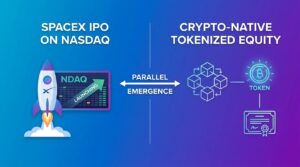
SpaceX is set to begin trading on the Nasdaq exchange under the ticker SPCX, with shares priced at $135 in an IPO that values the company through roughly 555.6 million shares offered, translating to a $75 billion raise. But the listing carries a second, less conventional storyline: a stack of crypto-native tokenized-equity products designed to mirror or redeem against SPCX will go live on the same day, signaling a collision between traditional capital markets and decentralized finance infrastructure that few predicted would arrive this quickly.
What the SpaceX IPO Means for Public Markets and DeFi Simultaneously
Before unpacking the mechanics, here’s what matters most for executives, investors, and regulators tracking this convergence:
- Scale of the offering: At $135 per share across approximately 555.6 million shares, SpaceX’s IPO ranks among the largest U.S. public listings in recent years, drawing institutional demand that had been building through years of private secondary trading
- Tokenized equity products launching in parallel suggest that DeFi protocols now view major IPOs as synchronization events, not afterthoughts
- Regulatory ambiguity persists: the legal standing of tokenized mirrors or redemption-linked products tied to newly listed equities remains unresolved in most jurisdictions (a distinction regulators have been slow to enforce)
- The dual-track debut could establish a template for how future high-profile IPOs interact with on-chain capital markets infrastructure
- Liquidity fragmentation across traditional and tokenized venues may complicate price discovery in the first days of trading
A $75 Billion Debut, Years in the Making
SpaceX’s path to public markets has been one of the most closely watched in technology and aerospace. For years, Elon Musk resisted taking the company public, citing the short-term pressures of quarterly reporting. That resistance shaped a sprawling private secondary market where accredited investors traded SpaceX shares at valuations that fluctuated wildly depending on launch cadence, Starlink subscriber growth, and broader sentiment around space commercialization.
The $135 pricing lands within a range that reflects both the company’s dominant position in commercial launch services and the revenue trajectory of SpaceX’s Starlink satellite internet division, which has reportedly crossed 4 million subscribers globally. Whether that valuation holds through the first week of trading depends on allocation dynamics and how much retail demand materializes against what is expected to be heavy institutional participation.
Still, the IPO itself is only half the story.
Tokenized Equity: Mirror Products and On-Chain Redemption
The simultaneous launch of crypto-native tokenized products tied to SPCX shares represents something qualitatively different from previous experiments in tokenized stocks. Earlier attempts by platforms like FTX (before its collapse) and Binance offered synthetic exposure to equities but operated in regulatory grey zones with limited redemption guarantees.
What distinguishes this wave is the explicit design around redemption against actual SPCX shares. In theory, holders of these tokenized products can convert their on-chain positions into traditional equity through designated intermediaries. In practice, whether that redemption mechanism functions smoothly under stress remains untested.
Three structural questions hang over the launch:
| Question | Current Status |
|---|---|
| Are tokenized SPCX products registered securities? | No public registration filings have been identified; most appear structured as offshore instruments or exempted offerings |
| Who serves as the redemption counterparty? | Varies by product; some reference custodial arrangements with regulated broker-dealers, others remain vague |
| How will price parity be maintained? | Arbitrage mechanisms are proposed but depend on liquidity depth in both venues, which is uncertain at launch |
The absence of clear answers to any one of these would be notable. The absence of clarity on all three simultaneously is harder to dismiss.
Why This Convergence Matters Beyond SpaceX
Tokenized real-world assets have been a recurring theme in crypto markets throughout 2024 and into 2025, with U.S. Treasuries, money market funds, and private credit all finding on-chain representations. Equities, however, have lagged, partly because the regulatory framework around securities tokenization in the United States remains fragmented between the SEC and CFTC.
SpaceX’s IPO arriving alongside tokenized mirror products forces a question that regulators have managed to defer: when a tokenized product tracks a listed security in real time and offers redemption into that security, at what point does it become the security? And if it does, which jurisdiction’s rules apply when the token trades on a decentralized exchange with no geographic anchor?
These are not hypothetical concerns. The volume that tokenized SPCX products attract in their first trading sessions will determine whether this remains a niche experiment or becomes a precedent that reshapes how IPOs interact with decentralized infrastructure.
Frequently Asked Questions
What is the SpaceX IPO ticker symbol?
SpaceX will trade on the Nasdaq under the ticker SPCX.
How much did SpaceX raise in its IPO?
The company offered approximately 555.6 million shares at $135 each, targeting a raise of around $75 billion. Final allocation figures may shift based on overallotment provisions.
Are tokenized SpaceX equity products legal?
Their legal status varies by jurisdiction and product structure. No public SEC registration has been identified for the tokenized products launching alongside SPCX. Investors should assess the regulatory standing of any tokenized equity instrument independently before participating.
Can tokenized SPCX products be redeemed for actual shares?
Some products are designed with redemption mechanisms against real SPCX shares through intermediaries, though the reliability of these mechanisms under market stress has not been demonstrated yet.



