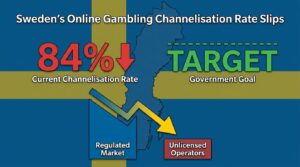
Spelinspektionen, Sweden’s gambling regulator, has published its 2025 market assessment confirming that the country’s online gambling channelisation rate has fallen to 84%. The figure extends a three-year decline from 86% in 2023 and 85% in 2024, pulling the licensed market further from the government’s 90% statutory target. The assessment draws on both consumer surveys and automated web-traffic modelling, and the divergence between those two methodologies tells its own story about how difficult it has become to measure unlicensed activity with precision.
What the 84% Figure Actually Signals for Sweden’s Licensed Market
Before unpacking the strategic implications, it helps to frame the core data points and what they mean for operators, regulators, and policymakers navigating Sweden’s gambling landscape.
- Three consecutive years of decline: Channelisation has dropped two percentage points since 2023, a trajectory that undermines the regulatory framework’s core promise of absorbing the vast majority of gambling activity into the licensed ecosystem.
- Methodology gap matters: The consumer player survey alone suggested an 89% channelisation rate for the competitive commercial sector, while web-traffic-based turnover models pulled the composite figure down to 84%. That five-point spread raises questions about which measurement better reflects reality.
- The 90% target set by the Swedish government now sits six points above the current rate, a gap wide enough to invite legislative scrutiny or regulatory recalibration.
- Unlicensed operators are gaining ground despite Sweden’s enforcement posture, suggesting that either the product restrictions on licensed sites are too aggressive or that enforcement tools lack sufficient reach.
Two Measurement Models, Two Different Pictures
One of the more revealing details in Spelinspektionen’s report is the tension between its dual measurement approaches. The player survey method, which relies on self-reported behaviour from Swedish consumers, returned a channelisation estimate of 89% for the competitive commercial gambling segment. That number, taken alone, would place Sweden comfortably close to its 90% benchmark.
But the web-traffic-based model told a different story.
By analysing automated internet traffic data and correlating it with turnover estimates, the regulator arrived at a significantly lower composite figure. The implication is that consumers either underreport their use of unlicensed platforms or that web-traffic analysis captures activity invisible to survey instruments (a distinction regulators have been slow to reconcile). Which dataset should drive policy? That question remains conspicuously unanswered in the report.
Why the Gap to 90% Keeps Widening
Sweden introduced its modern gambling licensing framework in 2019, and the early years showed promising channelisation rates. Yet the trend has reversed. Several structural factors arguably contribute to the erosion. Licensed operators face advertising restrictions, deposit limits, mandatory loss caps, and a bonus limitation regime that permits welcome bonuses only. Unlicensed platforms, by contrast, operate without these constraints, offering Swedish players higher bonuses, fewer friction points, and products not available on licensed sites.
Enforcement actions by Sweden’s gambling inspectorate Spelinspektionen have included payment blocking orders and ISP-level interventions, but the effectiveness of these tools against offshore operators with rotating domains and cryptocurrency payment options remains limited. And while the regulator has pursued fines and licence revocations against non-compliant licensed operators, those actions may paradoxically push some activity further offshore rather than containing it.
Comparative Channelisation Benchmarks
| Year | Channelisation Rate | Gap to 90% Target |
|---|---|---|
| 2023 | 86% | 4 percentage points |
| 2024 | 85% | 5 percentage points |
| 2025 | 84% | 6 percentage points |
The arithmetic is straightforward. Each year, one more percentage point of gambling activity migrates outside the regulated perimeter.
Reframing the Regulatory Conversation
What makes this data particularly consequential is the broader European context. Several EU member states are grappling with the same channelisation challenge, and Sweden has long been cited as a mature, well-regulated market. If a jurisdiction with Sweden’s institutional capacity and enforcement infrastructure cannot hold the line at 84%, it raises uncomfortable questions for smaller regulators attempting similar frameworks.
Still, the debate is not purely about enforcement muscle. Some industry stakeholders argue that Sweden’s product restrictions have become counterproductive. Deposit limits and strict bonus rules were designed to protect consumers, but if those same measures drive players toward unlicensed sites with no consumer protections whatsoever, the net harm calculus shifts. The regulator faces a genuine policy tension: tighten rules and risk further leakage, or loosen them and face criticism from public health advocates.
Even so, there is a third path that some Nordic analysts have floated. Rather than adjusting product rules, Sweden could invest more heavily in technological enforcement, including AI-driven detection of unlicensed platform traffic, real-time payment interdiction, and coordinated cross-border enforcement with other EU regulators. Whether the political appetite exists for that level of investment is another matter entirely.
How Operators and Stakeholders Should Read This Data
For licensed operators in Sweden, the declining channelisation rate carries direct commercial consequences. A shrinking share of total market activity flowing through licensed channels means reduced revenue potential, even as compliance costs remain fixed or increase. Operators who have invested heavily in the Swedish licence now compete not only with each other but with an expanding unlicensed segment that faces no equivalent cost base.
For investors evaluating Nordic gambling exposure, the trend line matters more than any single data point. Three consecutive years of decline suggest a structural issue rather than a statistical anomaly. And for the Swedish government, the widening gap to 90% may eventually force a policy review, whether that takes the form of relaxed product rules, enhanced enforcement funding, or a fundamental rethink of the channelisation target itself.
Frequently Asked Questions
What does channelisation rate mean in gambling regulation?
Channelisation rate measures the percentage of total gambling activity in a jurisdiction that occurs through licensed, regulated operators rather than unlicensed or offshore platforms. Sweden’s government has set a 90% target, meaning nine out of every ten gambling transactions should ideally occur within the legal framework.
Why is Sweden’s channelisation rate declining?
Multiple factors contribute, including strict product and advertising restrictions on licensed operators that make unlicensed alternatives more attractive to some players. Enforcement tools against offshore operators have also shown limitations, particularly as those platforms adopt cryptocurrency payments and domain rotation strategies to evade blocking orders.
How does Spelinspektionen measure channelisation?
The regulator uses two complementary methods: a consumer player survey capturing self-reported gambling behaviour, and an automated web-traffic-based turnover model. The two approaches produced notably different results in the 2025 assessment, with the survey suggesting 89% and the composite landing at 84%.
What could reverse the trend?
Options under discussion range from recalibrating product restrictions to make licensed platforms more competitive, to deploying more sophisticated technological enforcement against unlicensed operators. No single measure is likely to close the gap alone; a combination of regulatory adjustment and enforcement innovation would arguably be required.