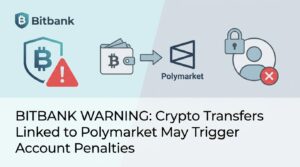
Bitbank, one of Japan’s prominent centralised cryptocurrency exchanges, has drawn a hard line against accounts interacting with decentralised prediction markets. The Tokyo-based platform issued a formal compliance warning stating that digital asset transfers connected to event-contract platforms like Polymarket may result in severe account restrictions. The move reflects growing tension between borderless DeFi protocols and Japan’s domestic gambling statutes, placing users who engage with overseas prediction markets squarely in regulatory crosshairs.
Why Bitbank’s Warning Matters for Crypto Users in Japan
Before diving into the specifics, it helps to understand what this announcement signals for the broader Japanese crypto landscape. This isn’t a routine compliance update. It marks one of the first instances where a licensed Japanese exchange has publicly threatened enforcement action against users for interacting with a specific category of decentralised application.
- Direct account consequences: Users sending or receiving crypto assets tied to prediction market platforms face potential account suspension or termination.
- Legal framing: Bitbank has tied its rationale to Japan’s Penal Code, arguing that speculation on uncertain real-world outcomes for financial gain may constitute illegal gambling under domestic law.
- The warning names Polymarket explicitly, but the language is broad enough to encompass any event-contract protocol operating outside Japan’s regulatory perimeter.
- Precedent risk: Other Japanese exchanges may follow Bitbank’s lead, potentially cutting off a wider swath of DeFi activity for domestic users.
- Cross-border enforcement challenge: The policy highlights the difficulty of policing on-chain activity that originates from permissionless, non-custodial platforms.
Japan’s Penal Code and the Prediction Market Problem
At the core of Bitbank’s position is a legal argument that has been simmering for years. Japan’s gambling laws, rooted in the Penal Code, prohibit wagering on uncertain outcomes unless explicitly authorised by statute (as with horse racing, certain lotteries, and a handful of other carve-outs). Prediction markets, which allow participants to buy and sell contracts pegged to the probability of real-world events, sit in an uncomfortable grey zone globally. In Japan, the ambiguity tilts toward prohibition.
What makes this enforcement posture notable is the mechanism. Bitbank isn’t attempting to block access to Polymarket itself (a task beyond any centralised exchange’s reach). Instead, it targets the on-ramp and off-ramp: the movement of funds between user wallets and the exchange. That distinction matters. It means the exchange is using transaction monitoring to flag addresses associated with prediction market smart contracts, then applying administrative penalties to the account holder.
Whether this approach survives legal scrutiny remains an open question. Identifying wallet interactions with specific protocols is technically feasible through blockchain analytics, but the accuracy and fairness of such flagging (a distinction regulators have been slow to enforce) could become contentious if users challenge penalties.
How This Fits Into Japan’s Broader Crypto Regulatory Posture
Japan has long occupied a peculiar position in global crypto regulation. It was among the first nations to establish a licensing framework for exchanges under the Financial Services Agency (FSA), yet its rules remain among the most restrictive in developed markets. Stablecoin regulations, token listing requirements, and leverage caps all reflect a philosophy of tight consumer protection.
Bitbank’s warning extends that philosophy into DeFi territory. And while the FSA has not issued a blanket directive against prediction market participation, the exchange’s pre-emptive action suggests that industry players are reading regulatory signals and acting before formal guidance arrives. That dynamic, where compliance teams move faster than regulators, is increasingly common across Asia-Pacific jurisdictions.
Still, the approach raises a harder question: can centralised gatekeepers effectively police decentralised activity without creating a chilling effect on legitimate DeFi usage? A user who interacts with a multi-purpose DeFi protocol that also hosts prediction market functionality could, in theory, be flagged for entirely unrelated transactions.
Polymarket’s Growing Regulatory Footprint
Polymarket’s event-contract trading platform gained significant global attention during the 2024 U.S. presidential election cycle, when trading volumes surged past $1 billion. That visibility brought regulatory scrutiny from multiple jurisdictions. France’s gaming authority, the ANJ, moved to restrict access earlier in 2024. The U.S. Commodity Futures Trading Commission has maintained its own complex stance on prediction markets, having previously settled enforcement actions against similar platforms.
Japan’s situation adds another layer. Unlike the U.S., where prediction markets exist in a regulatory grey area between commodities law and gambling statutes, Japan’s legal framework arguably leaves less room for interpretation. The Penal Code provisions are broad, and the absence of a specific exemption for blockchain-based prediction contracts means that exchanges like Bitbank face genuine compliance risk if they facilitate fund flows to and from such platforms.
What Users and Industry Participants Should Watch
The ripple effects of this decision extend beyond Bitbank’s user base. Several developments are worth tracking in the coming months:
| Factor | Potential Impact |
|---|---|
| FSA formal guidance on prediction markets | Could either validate Bitbank’s stance or introduce a more nuanced framework that distinguishes between different types of event contracts |
| Other exchanges adopting similar policies | A coordinated industry response would effectively shut down fiat off-ramps for Japanese prediction market participants |
| User migration to non-custodial wallets | Likely acceleration of self-custody adoption among users seeking to avoid exchange-level surveillance |
| Legal challenges from affected users | Could test the boundaries of exchange authority to restrict accounts based on on-chain activity analysis |
The Psychological Dimension: How Compliance Warnings Shape User Behaviour
Beyond the legal and technical mechanics, Bitbank’s announcement operates on a psychological level that deserves attention. Compliance warnings from trusted platforms carry outsized influence on user decision-making, often far exceeding their actual enforcement weight. When a licensed exchange frames an activity as potentially criminal, it triggers loss aversion, one of the most powerful cognitive biases documented in behavioural economics. Users don’t just evaluate the probability of getting caught; they anchor on the worst-case scenario and adjust their behaviour accordingly.
This framing effect is deliberate, even if not consciously designed as such. By invoking the Penal Code rather than simply citing terms-of-service violations, Bitbank elevates the perceived stakes from “account inconvenience” to “criminal liability.” The language choice matters enormously. Research in neuro-linguistic programming and persuasion science consistently shows that authority-linked framing (legal codes, government agencies, criminal penalties) produces stronger behavioural compliance than abstract policy language.
There is also a social proof element at play. When one major exchange takes a public stance, it creates a perception that the entire industry views the activity as unacceptable. Users who might otherwise have continued interacting with prediction markets now face not just a single platform’s policy but what feels like an emerging consensus. Whether that consensus actually exists is almost beside the point; the perception alone reshapes behaviour. For industry observers, the lesson is clear: how compliance messages are framed can be as consequential as the rules themselves.
Frequently Asked Questions
Can Bitbank actually detect if I used Polymarket?
Yes, through blockchain analytics tools that trace wallet interactions with known smart contract addresses. The accuracy of such detection varies, and false positives remain a concern that the industry has not fully resolved.
Is using Polymarket illegal in Japan?
No court has ruled definitively on blockchain-based prediction markets under Japan’s Penal Code. Bitbank’s position is that participation risks violating domestic gambling provisions, but this interpretation has not been tested through formal legal proceedings.
Will other Japanese exchanges follow Bitbank’s lead?
Arguably, yes. Compliance teams at licensed exchanges tend to converge on similar risk assessments, particularly when one platform takes a public stance that could make competitors appear lax by comparison. But the timing and scope of any such moves remain uncertain.
What happens to funds already transferred from Polymarket?
Bitbank’s notice references administrative countermeasures for accounts found interacting with prediction market platforms, though the specific treatment of historical transactions versus future activity has not been detailed publicly.