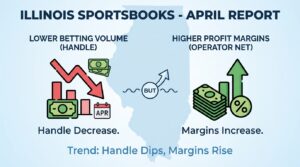
Illinois sportsbooks recorded a year-over-year decline in total wagering volume during April, yet operators managed to retain a larger share of revenue than the same period in 2024. The state’s regulated sports betting market, one of the largest in the United States, continues to mature in ways that suggest handle growth alone no longer tells the full story. What the latest figures reveal is a market where efficiency and hold rates are beginning to matter more than raw volume.
What April’s Numbers Signal for Illinois Sports Betting
The monthly data from Illinois paints a nuanced picture. While a dip in total handle might prompt surface-level concern, the underlying revenue dynamics point to a healthier operating environment for licensed sportsbooks. Here are the key strategic takeaways:
- Total sports wagering handle in April fell compared to the same month last year, reflecting seasonal patterns and a lighter sports calendar
- Operator hold rates improved, meaning sportsbooks kept a higher percentage of every dollar wagered
- Adjusted gross revenue remained resilient despite the volume decline, cushioning the impact on state tax collections
- The shift suggests Illinois operators are getting better at managing risk and pricing lines, rather than relying purely on volume growth
- Tax revenue implications remain stable for now, though sustained handle declines could eventually pressure state coffers
Handle Decline in Context
April is never the strongest month for U.S. sportsbooks. The NFL and college football seasons are long over. March Madness wraps up in early April, and the NBA and NHL playoffs are only just beginning to generate serious betting interest. So a dip in handle relative to peak months is expected.
But a year-over-year decline is a different signal.
Illinois had been on a trajectory of near-continuous handle growth since launching mobile sports betting in 2020. That trajectory appears to be flattening. Whether this represents market saturation, promotional fatigue among bettors, or simply a statistical blip tied to the sports calendar remains an open question. Still, the state processed billions in wagers over the trailing twelve months, keeping it firmly among the top three U.S. sports betting markets alongside New York and New Jersey.
Why Stronger Hold Rates Matter More Than They Seem
Hold rate (the percentage of total wagers that operators retain as gross revenue before taxes and expenses) is arguably the most underappreciated metric in the sports betting industry. A sportsbook can process enormous handle and still lose money if its hold rate is thin. Conversely, a smaller handle with a stronger hold can produce better financial outcomes for both operators and the state.
In April, Illinois operators demonstrated exactly that dynamic. The improved hold rate offset the lower volume, keeping adjusted gross revenue at levels that didn’t alarm regulators or fiscal planners. For major operators like FanDuel’s Illinois sportsbook and DraftKings, this kind of margin improvement reflects years of investment in pricing algorithms, risk management infrastructure, and a gradual pullback from the aggressive promotional spending that defined the market’s early years.
That last point deserves emphasis. The promotional era of Illinois sports betting, when operators were essentially giving away free bets to acquire customers, has largely wound down. Fewer promotional credits in circulation means bettors are wagering more of their own money, which in turn produces cleaner revenue figures.
Regulatory and Fiscal Implications
Illinois imposes a graduated tax structure on sports betting revenue, with rates that increase at higher revenue tiers. Governor J.B. Pritzker signed legislation in 2024 that raised the top marginal tax rate on sports betting operators, a move that generated significant industry pushback. The question now is whether improved hold rates can absorb the higher tax burden without pushing operators to reduce their Illinois footprint.
At least on paper, April’s results suggest the math still works. But operators have been vocal about the cumulative pressure of rising state taxes, federal excise taxes, and ongoing compliance costs. A sustained decline in handle, combined with higher tax rates, could eventually squeeze margins enough to force strategic recalculations.
| Metric | April 2024 | April 2025 | Trend |
|---|---|---|---|
| Total Handle | Higher | Lower | Year-over-year decline |
| Operator Hold Rate | Lower | Higher | Improved margin retention |
| Adjusted Gross Revenue | Baseline | Resilient | Stable despite handle drop |
| Tax Rate Environment | Pre-increase | Post-increase (graduated structure) | Higher operator tax burden in 2025 |
The Behavioral Shift Behind the Data
Beyond the spreadsheets, there’s a behavioral dimension worth examining. Illinois bettors, like their counterparts in other mature markets, appear to be settling into more consistent wagering patterns. The early frenzy of a newly legal market, where curiosity drove first-time bets and promotional offers inflated handle figures, has given way to a steadier baseline of regular bettors placing more deliberate wagers.
This maturation process mirrors what behavioral economists describe as the transition from novelty-driven engagement to habit-based participation. When a market is new, external triggers like sign-up bonuses and media hype drive activity. As those triggers fade, what remains is a core user base whose betting behavior is more predictable and, critically, more profitable for operators to serve. The cost of acquiring a new customer far exceeds the cost of retaining an existing one, and Illinois appears to be entering the retention phase in earnest.
Operators who understand this shift are reallocating resources accordingly. Rather than blanket promotional campaigns, the focus has moved toward personalized engagement, loyalty programs, and product features designed to increase session frequency among existing users. This approach aligns with broader principles of anchoring and reframing (presenting odds, parlays, and in-game betting options in ways that feel intuitive and rewarding to the bettor) rather than relying on blunt financial incentives to drive volume.
The psychological framing of sports betting products has become a competitive differentiator. Operators who can make the betting experience feel seamless, informed, and entertaining will capture a disproportionate share of a market that is no longer growing through sheer expansion.
Frequently Asked Questions
Did Illinois sports betting revenue fall in April?
Total handle declined year-over-year, but adjusted gross revenue held up because operators retained a higher percentage of wagers. The revenue picture was more stable than the handle number alone would suggest.
Why did the handle drop?
April sits in a seasonal lull between major football seasons and the early stages of NBA and NHL playoffs. Market maturation and reduced promotional activity likely contributed as well.
How does Illinois tax sports betting operators?
The state uses a graduated tax structure on adjusted gross revenue. Legislation signed in 2024 raised the top marginal rate, increasing the fiscal burden on higher-earning operators. Whether this discourages long-term investment in the state is something the industry is watching closely.
Is Illinois still a top sports betting market?
Yes. Even with a softer April, Illinois remains one of the three largest legal sports betting states in the U.S., trailing only New York in total handle and competing closely with New Jersey.