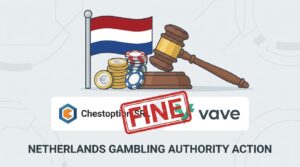
Dutch gambling regulators have imposed a financial penalty on Chestoption Sociedad de Responsibilidad Limitada, the company behind online gambling platforms including Vave, for operating without proper authorisation in the Netherlands. The enforcement action underscores the country’s increasingly aggressive posture toward unlicensed iGaming operators targeting Dutch consumers. While the exact size of the fine has not been publicly detailed in full, the move aligns with a broader pattern of regulatory crackdowns across European jurisdictions seeking to tighten control over cross-border digital gambling.
What the Dutch Penalty Signals for Unlicensed Operators
Before diving into the specifics, it helps to frame what this enforcement action means in practical terms for the wider online gambling sector. The Netherlands has been steadily building its enforcement apparatus since the Remote Gambling Act (Kansspelen op afstand, or KOA) took effect in April 2021, and penalties like this one are no longer isolated events. They represent a maturing regulatory ecosystem with real teeth.
- Chestoption SRL, operating sites including the Vave online gambling platform, was found to be offering services to Dutch players without holding a licence from the Kansspelautoriteit (KSA)
- The fine reinforces the KSA’s stated priority of targeting operators that actively market to or accept players from the Netherlands without authorisation
- Operators structured as foreign limited liability entities (in this case, a Sociedad de Responsibilidad Limitada) are not shielded from Dutch enforcement simply by virtue of being domiciled elsewhere
- The action may prompt other unlicensed platforms to reassess their exposure to Dutch regulatory risk, particularly those relying on Curaçao or similar offshore licences
- For licensed operators in the Netherlands, this penalty levels the competitive playing field, at least on paper
The KSA’s Expanding Enforcement Reach
The Kansspelautoriteit has issued dozens of fines and warnings since the KOA framework launched. But the pace has accelerated. In 2023 alone, the regulator pursued multiple enforcement actions against operators it deemed to be illegally targeting Dutch residents, with cumulative penalties running into the millions of euros.
What makes the Chestoption case notable is less the fine itself and more the entity structure involved. Sociedad de Responsibilidad Limitada is a corporate form common in Spanish-speaking jurisdictions, which raises questions about how the operator was structured, where its servers and payment processing sat, and whether intermediary service providers bear any secondary liability (a distinction regulators have been slow to enforce).
Still, the KSA has shown it will pursue enforcement regardless of where an operator is incorporated. The regulator has previously fined entities based in Curaçao, Malta, and Cyprus, signalling that jurisdictional arbitrage offers diminishing protection.
How the Netherlands Identifies Unlicensed Platforms
The KSA employs a combination of consumer complaints, market scanning tools, and payment flow analysis to identify unlicensed operators serving Dutch players. Its approach has grown more sophisticated over time, incorporating data from internet service providers and financial institutions.
| Enforcement Tool | How It Works | Effectiveness |
|---|---|---|
| IP-based market scanning | Identifies gambling sites accessible from Dutch IP addresses without geo-blocking | High for detecting availability; limited for proving intent to target Dutch market |
| Payment flow monitoring | Tracks transactions between Dutch bank accounts and unlicensed operators | Increasingly effective as banks cooperate with KSA data requests |
| Consumer complaint analysis | Aggregates reports from Dutch players about unlicensed sites | Variable; depends on player willingness to report |
| Cooperation with other regulators | Information sharing with MGA, Curaçao Gaming Control Board, and others | Growing but uneven across jurisdictions |
One sentence captures the core tension here: detection is getting easier, but cross-border enforcement remains hard.
Broader Implications Across European Markets
The Dutch action against Chestoption SRL does not exist in a vacuum. Germany’s Gemeinsame Glücksspielbehörde der Länder (GGL) has pursued a parallel strategy of targeting unlicensed operators, including IP blocking orders and payment blocking directives. Italy’s ADM has similarly expanded its blacklist of unauthorised gambling domains. And while each country’s regulatory framework differs in detail, the directional trend is unmistakable: European regulators are coordinating more, tolerating less, and investing in enforcement infrastructure that would have seemed ambitious five years ago.
For operators like Chestoption, the calculus is shifting. The cost of operating without a licence in regulated European markets now includes not just potential fines but reputational damage, payment processing disruptions, and the risk of being named publicly by regulators. Whether that changes behaviour across the broader grey market remains an open question.
What This Means for Players and the Licensed Market
Dutch players who used Vave or other Chestoption-operated sites may find themselves in a precarious position. Consumer protections that apply to licensed operators, including responsible gambling tools, dispute resolution mechanisms, and self-exclusion registers, do not extend to unlicensed platforms. Arguably, this is the most tangible harm that enforcement actions like this one seek to address.
Licensed operators in the Netherlands, meanwhile, have long argued that unlicensed competition distorts the market. They face advertising restrictions, tax obligations, and compliance costs that unlicensed rivals simply bypass. Each enforcement action chips away at that imbalance, though the sheer volume of unlicensed sites accessible online means the problem is far from resolved.
Frequently Asked Questions
What is Chestoption Sociedad de Responsibilidad Limitada?
Chestoption SRL is the corporate entity that operates several online gambling platforms, including Vave. It is structured as a limited liability company under a Spanish-language corporate framework, though its exact jurisdiction of incorporation has not been widely disclosed in regulatory filings.
Why was the company fined in the Netherlands?
The Kansspelautoriteit determined that Chestoption was offering online gambling services to Dutch consumers without holding a valid licence under the Remote Gambling Act (KOA), which has been in force since April 2021.
Does this fine affect players who used Vave?
Directly, no. But players on unlicensed platforms lack the consumer protections available through licensed Dutch operators, including access to the CRUKS self-exclusion register and formal complaint procedures. That gap matters more than most players realise at the point of sign-up.
Can the KSA enforce fines against foreign companies?
Enforcement across borders is challenging. The KSA can impose fines and publicise them, but collecting from entities domiciled outside the EU often requires cooperation from foreign authorities. In practice, the reputational and operational consequences of being named by a European regulator tend to carry weight beyond the fine itself.