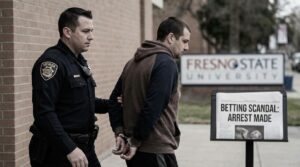
Nevada gaming regulators have arrested the first individual connected to a betting scandal involving Fresno State’s men’s basketball program. The arrest marks a significant escalation in what has become one of the more closely watched integrity cases in college sports betting this year. While details surrounding the broader investigation remain partially under wraps, the enforcement action signals that regulators are willing to pursue criminal accountability, not just sanctions, when the integrity of legal wagering markets is compromised.
What the First Arrest Tells Us About the Investigation’s Direction
Before dissecting the broader implications, here are the critical takeaways from this development:
- Criminal enforcement, not just regulatory discipline: Nevada’s decision to pursue an arrest rather than limit action to fines or license suspensions suggests the evidence gathered points to conduct that crosses into criminal territory.
- College sports betting remains a high-risk integrity zone: This case reinforces longstanding concerns about the vulnerability of lower-profile college programs to manipulation schemes.
- The timing matters: with legal sports betting expanding across more than 30 U.S. states, regulators face mounting pressure to demonstrate that oversight can keep pace with market growth.
- Deterrence signal to market participants: The arrest sends a pointed message to bettors, intermediaries, and anyone adjacent to game-fixing that Nevada treats integrity violations as prosecutable offenses.
- Broader investigation likely ongoing: A single arrest in a scheme of this nature typically precedes additional charges or cooperating witness agreements.
How the Fresno State Case Unfolded
The investigation centers on suspicious betting activity tied to Fresno State men’s basketball games. Nevada’s regulatory apparatus, which includes the Nevada Gaming Control Board, detected anomalous wagering patterns that triggered a deeper review. That review, conducted in coordination with law enforcement, ultimately produced enough evidence to justify a criminal arrest.
Fresno State competes in the Mountain West Conference. And while the program doesn’t carry the national profile of a power-conference school, that relative obscurity arguably makes it a more attractive target for manipulation. Lower-profile games draw less media scrutiny, thinner betting markets, and less sophisticated line movement monitoring from sportsbooks outside Nevada.
The identity of the arrested individual and the specific charges have not been fully disclosed in all public reporting, though the case is expected to generate additional filings in the coming weeks.
Why College Basketball Remains Uniquely Vulnerable
Point-shaving and game-fixing scandals in college basketball are not new. From the 1951 CCNY scandal to the Boston College scheme of 1978–79 to the more recent FBI probe into corruption across multiple NCAA programs, the sport has a recurring integrity problem that legalization has not fully resolved (a distinction regulators have been slow to enforce at the preventive level).
Several structural factors keep college basketball exposed:
| Factor | Why It Matters |
|---|---|
| Unpaid or modestly compensated athletes | Financial vulnerability creates leverage for fixers, even in the NIL era where compensation remains uneven across programs |
| Volume of games | With over 350 Division I teams playing 30+ games each season, monitoring capacity is stretched thin |
| Thin betting markets | Games with lower handle attract less sportsbook scrutiny, making irregular line movement easier to obscure |
| Limited institutional oversight | Many mid-major programs lack dedicated compliance staff focused on betting integrity |
That last row deserves emphasis. Schools in conferences outside the Power Four often operate compliance departments with skeleton crews. The gap between regulatory expectation and institutional capacity is real.
Regulatory Pressure in an Expanding Market
Nevada has long served as the gold standard for sports betting regulation in the United States. But the post-PASPA landscape, where dozens of states now operate legal sportsbooks, has complicated the enforcement picture. Suspicious wagers placed in Nevada may be connected to actors operating in other jurisdictions, or to offshore platforms entirely outside U.S. regulatory reach.
Still, Nevada’s willingness to make an arrest here carries weight. It demonstrates that the state’s enforcement infrastructure remains active and capable of producing criminal referrals, not just administrative penalties. For other state regulators watching from the sidelines, the Fresno State case could serve as a template, or a benchmark they’ll be measured against.
What remains less clear is how effectively information-sharing between state regulators and the NCAA’s own integrity monitoring systems actually functions in practice. The leagues and governing bodies have invested in detection technology, but coordination between private monitoring and public law enforcement has historically been uneven.
The Psychology of Deterrence in Sports Betting Integrity
Enforcement actions like this arrest operate on multiple psychological levels. For potential bad actors, the visibility of a criminal case creates what behavioral economists call a “salience effect”: the perceived risk of getting caught increases disproportionately to the actual statistical probability. One high-profile arrest can reshape risk calculations across an entire network of would-be fixers and corrupt bettors.
For the legal betting public, the arrest serves a different function. It reinforces trust. Bettors who wager through licensed operators need to believe that the games they’re betting on are legitimate. Every unresolved integrity question erodes that trust incrementally, and in a market where customer acquisition costs are already elevated, trust erosion carries a direct financial cost for operators.
There’s also a framing dimension worth noting. When regulators act visibly and decisively, it reframes the narrative around legal sports betting from “the Wild West” to a regulated, accountable market. That reframing matters for legislators still debating whether to authorize sports wagering in their states. Perception shapes policy, and policy shapes market access.
Even athletes themselves respond to these signals differently than they might to an NCAA sanction. A compliance seminar warning about eligibility consequences operates in one psychological register. A news headline about a criminal arrest operates in another entirely.
Frequently Asked Questions
What sport is at the center of this Nevada betting investigation?
The investigation involves Fresno State’s men’s basketball program, which competes in the Mountain West Conference at the NCAA Division I level.
Is this the only arrest expected?
Unlikely. Investigations of this nature typically involve multiple individuals, and a first arrest often precedes additional charges as cooperating witnesses or new evidence emerge. The full scope of the case has not been publicly disclosed.
Does this affect legal sports betting in Nevada?
Not directly for bettors. The arrest reflects the enforcement side of Nevada’s regulatory framework working as intended. If anything, it reinforces that Nevada’s oversight mechanisms remain among the most robust in the country.
How are suspicious bets detected?
Sportsbooks and regulators monitor line movement, bet timing, stake sizes, and account histories. Unusual patterns, such as a sudden surge of large wagers on a specific outcome in a low-profile game, trigger alerts that can escalate to formal investigations.