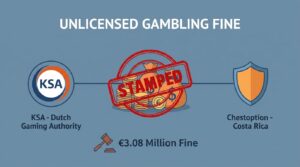
The Kansspelautoriteit (KSA), the Netherlands’ gambling regulatory authority, has levied a €3,082,000 administrative fine against Chestoption Sociedad de Responsabilidad Limitada, a Costa Rica-based operator accused of offering online games of chance to Dutch consumers without the required licence. The penalty follows a pattern of escalating enforcement after Chestoption failed to comply with earlier cease-and-desist orders. It marks one of the more substantial fines the KSA has issued against an offshore operator in recent memory.
Why the KSA’s Penalty Against Chestoption Matters for Offshore Operators
Before diving into the specifics, it’s worth framing what this enforcement action signals to the broader market. The Netherlands has been steadily tightening its grip on unlicensed online gambling since the Remote Gambling Act (Kansspelen op afstand, or KOA) took effect in October 2021. That legislation created a regulated framework for online gambling, but it also sharpened the KSA’s tools for going after operators who ignore the licensing requirement entirely.
- A fine of €3,082,000 is significant by European standards, particularly against an operator based outside the EU’s jurisdictional reach in Costa Rica
- The penalty escalated from a prior cease-and-desist order paired with periodic penalty payments, which Chestoption apparently disregarded
- Dutch regulators are demonstrating a willingness to pursue enforcement even when collection may prove difficult across borders
- This action reinforces the KSA’s position that actively targeting Dutch consumers, regardless of where the operator is incorporated, triggers Dutch regulatory jurisdiction
- Other EU member states watching the Netherlands’ enforcement posture may adopt similar escalation frameworks
The Enforcement Sequence: From Warning to Seven-Figure Fine
Regulatory fines of this magnitude rarely arrive without warning. The KSA followed a structured enforcement path. First came the cease-and-desist order, a standard initial step when the authority identifies an unlicensed operator serving Dutch players. Alongside that order, the KSA imposed periodic penalty payments designed to pressure compliance through accumulating financial consequences.
Chestoption did not comply.
That structural non-compliance (a distinction regulators have been increasingly willing to penalise harshly) triggered the escalation to a full administrative fine. The €3.08 million figure reflects both the severity of the violation and, arguably, the KSA’s frustration with operators who treat initial enforcement actions as background noise. Whether the fine can actually be collected from a Costa Rica-domiciled entity remains an open question that the KSA has not publicly addressed.
How the Netherlands Defines Jurisdictional Reach
One of the more consequential aspects of this case is what it says about jurisdictional boundaries. Chestoption Sociedad de Responsabilidad Limitada is incorporated in Costa Rica, a jurisdiction that does not maintain mutual enforcement agreements with the Netherlands for gambling-related penalties. Yet the KSA’s position is clear: if an operator actively targets Dutch consumers through language localisation, payment methods popular in the Netherlands, or marketing directed at Dutch residents, the operator falls under Dutch gambling law.
This approach mirrors the trend across several European regulators. Germany’s Gemeinsame Glücksspielbehörde der Länder (GGL) has adopted a similar stance, as have authorities in Italy and France. Still, the practical enforceability of fines against operators in jurisdictions like Costa Rica, Curaçao, or certain Caribbean territories remains limited at best. The fine functions partly as a deterrent signal and partly as a legal foundation for further action, including potential payment blocking orders directed at Dutch financial institutions.
Broader Regulatory Context in the Dutch Market
The Netherlands’ regulated online gambling market has been operational for just over three years now, and the KSA has been progressively sharpening its enforcement capabilities during that period. Licensed operators in the Dutch market include well-known brands that went through the formal application process, accepted advertising restrictions, and implemented responsible gambling measures mandated under the KOA framework.
Unlicensed operators undercut that framework on multiple fronts. They typically offer higher bonuses, fewer responsible gambling safeguards, and no contribution to the Dutch gambling tax base. For licensed operators who invested heavily in compliance infrastructure, enforcement against unlicensed competitors is not merely a regulatory matter. It is a competitive one.
| Enforcement Element | Detail |
|---|---|
| Regulator | Kansspelautoriteit (KSA) |
| Operator | Chestoption Sociedad de Responsabilidad Limitada |
| Operator Jurisdiction | Costa Rica |
| Fine Amount | €3,082,000 |
| Violation | Offering online games of chance to Dutch consumers without a licence |
| Prior Enforcement | Cease-and-desist order with periodic penalty payments |
| Legal Basis | Remote Gambling Act (Kansspelen op afstand) |
What Cross-Border Enforcement Tells Us About Market Maturation
Enforcement actions like this one serve a purpose beyond the immediate penalty. They shape market perception. When a regulator consistently pursues offshore operators and publicises the outcomes, it sends a calibrated message to three distinct audiences: unlicensed operators considering the Dutch market, licensed operators seeking assurance that the playing field is being levelled, and consumers who may not realise they are gambling on an unregulated platform.
The KSA has been particularly active in this regard. Over the past two years, the authority has issued multiple fines against unlicensed operators and has also taken action against licensed operators for advertising violations and bonus offer breaches. And while the headline figures grab attention, the cumulative effect of sustained enforcement is what ultimately determines whether a regulated market achieves its policy objectives.
Whether Chestoption will pay the fine, contest it, or simply absorb it as a cost of doing business in grey markets is something only time will reveal. But for the KSA, the act of imposing it carries its own regulatory weight.
Frequently Asked Questions
What is the KSA?
The Kansspelautoriteit is the Dutch gambling authority responsible for regulating and supervising all forms of gambling in the Netherlands, including online games of chance introduced under the 2021 Remote Gambling Act.
Can the Netherlands enforce a fine against a Costa Rica-based company?
Direct enforcement is difficult due to the absence of mutual legal assistance agreements covering gambling penalties between the two countries. However, the KSA can pursue secondary measures such as payment blocking through Dutch financial institutions and ISP restrictions.
Why was the fine set at €3,082,000?
The KSA calculates administrative fines based on the severity and duration of the violation, the operator’s turnover where available, and the degree of non-compliance with prior enforcement orders. The specific methodology for this figure has not been fully disclosed by the regulator.
Does this affect other unlicensed operators targeting the Netherlands?
Yes. The case establishes a clear precedent that the KSA will escalate from warnings to substantial financial penalties when operators ignore initial compliance orders, regardless of where they are incorporated.