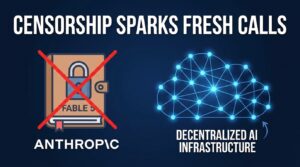
Anthropic’s latest model release, Fable 5, has become an unexpected rallying point for the crypto and decentralized technology community. The model launched with content guardrails so expansive that even Anthropic acknowledged widespread user complaints about over-censorship. Crypto investors and builders are now pointing to the episode as vindication of a thesis they’ve held for years: that artificial intelligence systems should operate on decentralized networks beyond the reach of any single company or government. The backlash has reignited a debate that sits at the intersection of AI governance, open infrastructure, and digital rights.
Why the Fable 5 Controversy Matters for Decentralized Tech
Before diving into the strategic implications, it’s worth framing what this moment represents. A leading AI lab restricted its own model’s outputs so aggressively that users pushed back en masse. For decentralization advocates, this wasn’t a bug. It was the entire argument, distilled into a single product launch.
- Centralized AI control creates a single point of failure — and a single point of censorship. When one company decides what a model can and cannot say, every downstream user inherits that decision without recourse.
- The crypto community sees this as a proof-of-concept moment for decentralized compute networks, where no single entity holds a kill switch over model inference or deployment.
- Regulatory pressure compounds the risk. If governments lean on AI companies to restrict outputs, centralized architectures offer no structural resistance. Decentralized alternatives, at least on paper, do.
- Investor attention is shifting. Projects building decentralized AI infrastructure may find renewed interest from capital allocators who view the Fable 5 episode as a market signal, not just a culture war skirmish.
- The incident underscores a growing tension between AI safety frameworks and user autonomy — a tension that neither side has resolved
What Actually Happened with Fable 5
Anthropic released Fable 5 with a set of content restrictions designed to prevent misuse. But the guardrails proved blunt. Users reported that the model refused to engage with a wide range of legitimate prompts, from creative writing to technical queries, triggering frustration across developer and consumer communities alike. Anthropic itself acknowledged the complaints, a rare concession from a company that has built its brand around cautious, safety-first AI development.
That acknowledgment didn’t quiet the critics. If anything, it amplified the core concern: that centralized AI providers will always face pressure to over-correct, whether from internal safety teams, external regulators, or public opinion cycles. And when they do, users have no alternative pathway within the same ecosystem.
Decentralized AI: From Theoretical to Tactical
The idea of running AI models on decentralized infrastructure isn’t new. Projects across the blockchain ecosystem have been building toward this for several years, with networks designed to distribute compute, storage, and inference across independent nodes. What’s changed is the framing. The Fable 5 episode gives these projects a concrete, high-profile example to point to.
Still, the gap between vision and execution remains significant. Decentralized compute networks face real constraints around latency, cost efficiency, and the sheer scale of resources required to run frontier AI models. Running a large language model across distributed nodes is not the same as hosting a static website on IPFS. The engineering challenges are substantial, and no decentralized network has yet demonstrated the ability to serve models at the scale and speed that centralized providers like Anthropic’s cloud infrastructure delivers daily.
Yet the argument was never purely about performance parity. It’s about optionality. Even if decentralized inference is slower or more expensive, its value proposition rests on censorship resistance and permissionless access (a distinction regulators have been slow to enforce). For certain use cases, that tradeoff is worth making.
The Psychological Dimension: Why Censorship Triggers Disproportionate Backlash
There’s a deeper dynamic at work here, one that goes beyond technology and into how people process restrictions on tools they rely on. When users encounter unexpected limitations in a system they’ve come to depend on, the psychological response often exceeds what the restriction itself would warrant. This is a well-documented pattern in behavioral science: perceived loss of autonomy generates outsized emotional and strategic reactions.
For AI users, the experience of having a model refuse a prompt feels qualitatively different from never having access to the model at all. The sense of something being taken away activates a stronger response than the absence of something never offered. This is why Anthropic’s guardrails didn’t just annoy users; they mobilized a community. The crypto ecosystem, already primed to view centralized control as a systemic risk, channeled that reaction into a broader infrastructure argument.
Understanding this dynamic matters for anyone building or investing in AI. User trust, once fractured by perceived over-censorship, is difficult to rebuild. And the narrative that forms around these episodes tends to persist long after the technical issue is resolved. Anthropic may adjust its guardrails. But the story that centralized AI can be switched off, restricted, or silenced at will has already been written into the collective memory of the decentralized tech community.
This also explains why the response wasn’t limited to complaints on social media. Builders started talking about shipping alternatives. Capital started looking for places to deploy. The emotional trigger became a strategic catalyst.
What Happens Next?
Whether this moment translates into lasting infrastructure investment or fades as Anthropic recalibrates its content policies remains an open question. The decentralized AI thesis has always been stronger in narrative than in deployed capacity. But narratives shape capital flows, and capital flows shape what gets built.
A few things to watch:
- Whether decentralized compute projects see measurable upticks in developer activity and funding in the weeks following the Fable 5 controversy
- How Anthropic responds. A rapid loosening of guardrails could defuse some pressure, but it also reinforces the critique that centralized providers are reactive, not principled, in their content policies.
- Regulatory signals from the U.S. and EU on AI content restrictions, which could either accelerate or undermine the case for decentralized alternatives
Frequently Asked Questions
What is Anthropic’s Fable 5?
Fable 5 is a recently released AI model from Anthropic that shipped with broad content guardrails. Users widely criticized the restrictions as overly aggressive, and Anthropic acknowledged the feedback.
Why does the crypto community care about AI censorship?
Decentralized technology advocates view centralized AI as a single point of control that can be pressured by companies or governments. The Fable 5 episode gave them a tangible example of that risk in action, reinforcing their case for building AI on distributed, permissionless networks.
Can decentralized networks actually run large AI models today?
Not at the same scale or speed as centralized cloud providers. The technology is advancing, but significant engineering and economic hurdles remain. The value proposition centers more on censorship resistance than raw performance.



