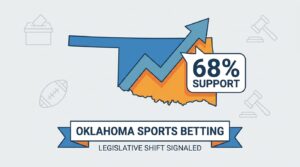
Oklahoma sports betting has a new number attached to it, and it’s a significant one: 68%. That figure, drawn from a recent estimate presented by Tom Gruenwald of the Sovereign Wealth Fund Institute, reflects the share of Oklahoma residents who now support legalizing sports wagering. The data lands at a moment when the state legislature faces growing pressure to act on a market that neighboring states have already tapped. With tribal gaming compacts, regulatory frameworks, and revenue projections all in play, the question is no longer whether Oklahomans want sports betting but how the state chooses to deliver it.
What 68% Approval Means for Oklahoma’s Betting Landscape
Before diving into the strategic implications, it’s worth framing the scale of what this polling figure represents. A two-thirds supermajority of public support doesn’t just suggest appetite; it arguably removes the political cover legislators have used to delay action. Here are the key takeaways for industry stakeholders and policymakers:
- Legislative urgency is rising. With neighboring states like Kansas and Arkansas already operating legal sportsbooks, Oklahoma risks losing both revenue and bettors to cross-border competition.
- Tribal compacts remain the central negotiation point. Oklahoma’s gaming economy is deeply intertwined with tribal nations, and any sports betting framework will need to navigate existing compact structures.
- Revenue estimates vary widely depending on the model adopted, but even conservative projections suggest tens of millions in annual tax receipts for the state.
- Mobile and online wagering will likely dominate any eventual market, mirroring trends in nearly every state that has legalized since 2018.
- Public sentiment at this level creates a mandate that elected officials will find increasingly difficult to sidestep heading into election cycles.
The Tribal Compact Question
Oklahoma’s relationship with tribal gaming is unlike almost any other state’s. More than 130 tribal casinos operate across the state under compacts negotiated with the governor’s office. These agreements generate hundreds of millions in exclusivity fees paid to the state annually. Any sports betting legislation that bypasses or undermines tribal interests risks not just political backlash but legal challenge.
Still, several tribal nations have signaled openness to incorporating sports wagering into their existing operations. The Chickasaw Nation and Cherokee Nation, two of the state’s largest gaming operators, have the infrastructure and digital platforms to launch sportsbooks relatively quickly (a distinction that gives them a structural advantage over potential commercial entrants). What remains less clear is whether the legislature will pursue a tribal-only model, a hybrid framework, or attempt to open the market to commercial operators as well.
That choice will define the economics of the entire market.
How Oklahoma Compares to Neighboring States
Context matters here. Oklahoma isn’t operating in a vacuum. The competitive dynamics of the region have shifted considerably over the past three years.
| State | Sports Betting Status | Launch Year | Mobile Wagering |
|---|---|---|---|
| Kansas | Legal and operational | 2022 | Yes |
| Arkansas | Legal, retail and mobile | 2019 (retail), 2022 (mobile) | Yes |
| Texas | Not legal | N/A | No |
| Oklahoma | Pending legislation | N/A | Under discussion |
| Missouri | Legal | 2024 | Yes, following voter approval |
Kansas alone handled over $3 billion in total wagers during its first full calendar year. Missouri voters approved sports betting in November 2024, adding yet another border-state market. Every dollar wagered legally in Kansas or Missouri by an Oklahoma resident is a dollar the state doesn’t see.
Why the Revenue Conversation Is More Nuanced Than Headlines Suggest
Proponents of legalization often cite headline revenue figures that can be misleading. Total handle (the gross amount wagered) is not the same as gross gaming revenue, which is not the same as taxable revenue. Oklahoma’s eventual tax take will depend on the rate structure, the number of licensed operators, and whether the state permits statewide mobile access or restricts wagering to physical locations.
In practice, states with mobile-first models generate substantially more revenue. New Jersey, for instance, sees roughly 90% of all sports wagers placed online. A retail-only model in Oklahoma would capture a fraction of the potential market. And with DraftKings and other major sportsbook operators already positioned in adjacent states, the infrastructure for rapid digital deployment exists.
But tax rate negotiations tend to be where legislative momentum stalls. New York’s 51% tax on operator revenue generates enormous state income but compresses operator margins. States like Iowa and Indiana, with rates closer to 6–10%, attract more operators but collect less per dollar wagered. Oklahoma will need to find its own equilibrium.
Public Sentiment and the Psychology of Legislative Action
The 68% approval figure carries weight beyond its statistical value. In the framework of decision-making psychology, public opinion at this threshold creates what behavioral economists call a “social proof cascade.” When a clear majority signals acceptance, it lowers the perceived risk for legislators to act. The political calculus shifts: inaction becomes the riskier position.
This dynamic is amplified by generational attitudes toward sports betting. Younger voters, particularly those in the 21–40 demographic, view wagering as a form of entertainment rather than a vice. Framing matters enormously here. Legislators who position sports betting as consumer choice and economic development rather than gambling expansion find broader coalition support. The language used in bill drafting, public hearings, and media coverage shapes perception as much as the policy itself.
And there’s a reciprocal effect at work. As more states legalize, the normalization feedback loop strengthens. Oklahoma residents who already bet through offshore or gray-market platforms represent both a regulatory gap and a revenue leak. Legalization doesn’t create new bettors so much as it redirects existing activity into a taxed, regulated channel.
Anchoring the conversation in consumer protection rather than morality has proven effective in other states. Responsible gaming provisions, self-exclusion programs, and advertising restrictions all serve as policy anchors that make legislation more palatable to skeptical lawmakers. The question for Oklahoma isn’t really about public will anymore. It’s about political architecture.
Frequently Asked Questions
Is sports betting currently legal in Oklahoma?
No. As of now, Oklahoma has not passed legislation authorizing sports betting. Several bills have been introduced in recent sessions, but none have advanced to the governor’s desk.
How would tribal gaming compacts affect sports betting legalization?
Oklahoma’s tribal compacts grant gaming exclusivity to tribal nations in exchange for revenue-sharing payments. Any sports betting law would need to either include tribes as primary operators or renegotiate compact terms, which is a politically and legally complex process that could take months or longer.
What kind of revenue could Oklahoma expect?
Estimates depend heavily on the regulatory model. A mobile-first approach with multiple licensed operators could generate $50 million or more annually in tax revenue, though early-year figures tend to be lower as the market matures.
When could Oklahoma realistically launch legal sports betting?
If legislation passes during the current or next session, a realistic launch timeline would be 12 to 18 months after the bill is signed, accounting for regulatory rulemaking, licensing, and platform testing.