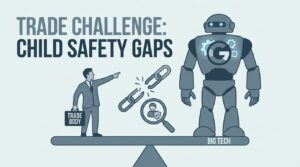
A prominent trade body has publicly questioned whether major technology companies are doing enough to protect children online, despite possessing what it describes as “extraordinary technological capabilities.” The intervention marks a sharpening of tone from an industry group that has historically favoured collaborative engagement over direct confrontation. It arrives at a moment when regulatory pressure on platforms is intensifying across multiple jurisdictions, and when public patience with self-regulation appears to be thinning.
Why This Challenge Carries Weight for Platform Operators
The statement lands against a backdrop of escalating legislative activity targeting child safety in digital environments. Rather than coming from an external advocacy group or a government regulator, the critique originates from within the broader technology and communications ecosystem, lending it a different kind of credibility. Here are the core strategic takeaways:
- The trade body’s language signals a departure from diplomatic framing, explicitly asking “whether enough is being done” to shield minors from harmful content and predatory behaviour online
- By referencing tech firms’ “extraordinary technological capabilities,” the statement implicitly argues that the gap between what platforms can do and what they choose to do is widening
- Regulatory momentum in the UK, EU, and Australia suggests that voluntary measures alone will no longer satisfy policymakers
- Companies that fail to demonstrate measurable progress on child safety risk facing not just fines but structural mandates around product design
- The intervention may embolden other industry voices to break ranks with the prevailing “we’re working on it” narrative
The Capability-Action Gap
At the heart of this challenge sits an uncomfortable asymmetry. Platforms routinely deploy sophisticated machine learning models to optimise advertising placement, personalise content feeds, and detect fraud at scale. Yet when it comes to identifying and removing content that endangers children, progress has been uneven at best. The trade body’s framing makes this tension explicit: if you can build recommendation engines that predict user behaviour with startling accuracy, the argument goes, why can’t you build equally effective systems for child protection?
That question is harder to dismiss than it sounds.
Some companies have invested heavily in detection tools. Google’s safety engineering teams have developed automated systems for identifying child sexual abuse material (CSAM), and Meta has rolled out age-verification experiments across Instagram. But critics, including this trade body, argue these efforts remain piecemeal. They tend to address the most egregious harms while leaving subtler risks (grooming behaviours, algorithmic amplification of self-harm content, exposure to age-inappropriate material) comparatively under-resourced.
Regulatory Walls Are Closing In
The timing of this statement is not incidental. In the UK, the Online Safety Act has begun imposing enforceable duties on platforms, with Ofcom actively developing codes of practice that will carry real penalties for non-compliance. The EU’s Digital Services Act includes specific provisions around the protection of minors, requiring platforms to conduct risk assessments and implement mitigation measures. Australia, meanwhile, has moved toward age-verification mandates that could fundamentally alter how young people access social media.
| Jurisdiction | Key Legislation | Child Safety Provisions | Enforcement Status |
|---|---|---|---|
| United Kingdom | Online Safety Act 2023 | Duty of care for child users; CSAM removal obligations | Codes of practice under development by Ofcom |
| European Union | Digital Services Act | Mandatory risk assessments; minor-specific design obligations | In force since February 2024 for all platforms |
| Australia | Online Safety Act + proposed age verification | Age-gating proposals; takedown powers for eSafety Commissioner | Age verification legislation advancing through parliament |
| United States | KOSA (Kids Online Safety Act) | Duty of care standard; opt-out of personalisation for minors | Passed Senate in 2024; House action pending |
Still, legislation alone won’t resolve the deeper design problem. Platforms built around engagement maximisation face a structural tension: the same features that keep users scrolling can expose children to escalating risk. And while regulators can mandate outcomes, they are often slower to prescribe the technical means, leaving companies with discretion that some have been reluctant to exercise fully.
What Shifts When Industry Peers Apply Pressure
External regulation gets headlines. But peer pressure from within the technology and telecommunications sector operates through different channels. When a trade body representing companies that depend on digital infrastructure questions the conduct of platform operators, it introduces reputational friction that boardrooms notice. It also provides political cover for regulators who might otherwise face accusations of overreach.
Whether this particular intervention translates into concrete policy proposals remains to be seen. The trade body has stopped short of endorsing specific technical mandates or regulatory frameworks (a distinction that arguably limits its immediate impact). Yet the rhetorical shift matters. Language like “extraordinary technological capabilities” reframes the debate from “can they?” to “why won’t they?” — a far more uncomfortable position for any company defending its track record in parliamentary hearings or regulatory consultations.
Reframing the Conversation Around Accountability
One dimension that often gets lost in these debates is the psychological framing of responsibility. When organisations describe child safety as a “shared challenge” or invoke the complexity of the problem, they distribute accountability so broadly that it becomes diffuse. The trade body’s statement, by contrast, concentrates the lens on a specific set of actors with specific capabilities. This kind of reframing draws on a well-established principle in behavioural communication: specificity drives action, while abstraction enables inertia.
For executives navigating this landscape, the practical implication is straightforward. Stakeholders are increasingly unwilling to accept capability without corresponding accountability. Investors screening for ESG risk, parents organising through advocacy groups, and legislators drafting enforcement mechanisms all share a common expectation: that technological power should carry proportional responsibility. The companies that internalise this framing early will find themselves better positioned when the next wave of regulation arrives. Those that treat child safety as a compliance checkbox rather than a design priority may discover that the cost of inaction compounds faster than anticipated.
And the trade body’s willingness to say so publicly suggests the window for self-correction is narrower than many platform operators assume.
Frequently Asked Questions
What did the trade body specifically criticise?
The trade body questioned whether tech companies are leveraging their full technological capabilities to protect children online, suggesting a gap between what platforms can achieve and what they are currently delivering.
Which companies are being targeted?
The statement does not single out individual firms by name but addresses major technology platforms broadly, particularly those operating social media, messaging, and content-sharing services used by minors.
How does this differ from government criticism?
Criticism from a trade body carries a distinct weight because it comes from within the industry ecosystem rather than from external regulators. It signals that even commercial partners and peers view current efforts as insufficient, which can accelerate both reputational pressure and regulatory momentum.
Will this lead to new regulations?
Not directly. But statements like these strengthen the political case for enforcement. Regulators in the UK, EU, and Australia are already advancing child safety frameworks, and industry-level dissent makes it harder for platforms to argue that self-regulation is working.