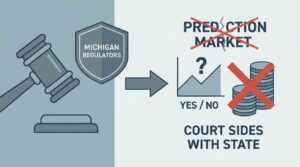
A Michigan court has handed state gambling regulators a decisive legal victory in their ongoing battle against prediction markets operating without proper licensing. The ruling reinforces the position that event-based contracts tied to real-world outcomes fall under existing gambling statutes, a stance that prediction market operators have contested for years. This decision lands at a moment when the regulatory landscape for these platforms is shifting rapidly across multiple U.S. states, and it carries implications well beyond Michigan’s borders.
What the Michigan Ruling Means for Prediction Markets
The legal and commercial stakes around prediction markets have escalated sharply since the 2024 U.S. presidential election cycle, when platforms like Kalshi and Polymarket attracted mainstream attention and significant trading volume. Before unpacking the broader consequences, here are the core takeaways from this development:
- State authority affirmed: The court validated Michigan regulators’ power to classify prediction market contracts as gambling products subject to state oversight.
- Licensing requirements hold: Operators offering event contracts to Michigan residents without a state gambling license are operating in violation of existing law, at least as this court interprets it.
- The ruling creates a persuasive precedent that other state regulators may cite in their own enforcement actions against unlicensed prediction market platforms.
- Federal ambiguity persists: While the CFTC has approved certain event contracts at the federal level, this decision underscores that federal approval does not automatically preempt state gambling laws.
- Operator risk increases: Platforms that have relied on a federal-first regulatory strategy now face a patchwork of state-level legal exposure that complicates nationwide operations.
A Jurisdictional Tug-of-War
Prediction markets occupy an unusual regulatory grey zone. The Commodity Futures Trading Commission has treated certain event contracts as derivatives, placing them under federal jurisdiction. But state gambling regulators see the same products through an entirely different lens. When a consumer places money on whether a political candidate will win or whether a hurricane will make landfall, state authorities argue that looks, functions, and feels like a wager.
Michigan is not the first state to push back. Several state regulators have issued warnings, cease-and-desist orders, or formal opinions asserting jurisdiction over prediction market activity. What makes this court ruling different is the judicial endorsement. Regulators issuing letters is one thing. A court agreeing with them carries substantially more weight in shaping how other jurisdictions and operators respond.
And the timing matters. The prediction market industry has been lobbying aggressively for regulatory clarity at the federal level, hoping that CFTC oversight would serve as a shield against state-by-state enforcement. This ruling punctures that assumption (a distinction regulators have been slow to enforce until now, but one the courts appear willing to uphold).
How Prediction Market Operators Are Exposed
For platforms like Kalshi, which has positioned itself as a regulated prediction exchange, the Michigan decision introduces a layer of legal complexity that federal compliance alone cannot resolve. Operating under CFTC registration may satisfy derivatives law, but it does not grant immunity from state gambling statutes. The result: a market caught between two frameworks.
Smaller operators face even steeper challenges. Without the legal resources to fight state-by-state battles, many may be forced to geoblock users in states where regulators take an aggressive posture. That fragments liquidity and undermines the core value proposition of prediction markets, which depends on broad participation to generate accurate probability signals.
| Regulatory Layer | Position on Prediction Markets | Enforcement Status |
|---|---|---|
| CFTC (Federal) | Approved certain event contracts as regulated derivatives | Active oversight of registered exchanges |
| State Gambling Regulators | Classify many event contracts as wagers requiring state licensing | Increasingly aggressive; Michigan ruling strengthens hand |
| Congress | No comprehensive legislation addressing prediction markets specifically | Bills proposed but none enacted as of mid-2025 |
Why This Fight Is Really About Control
Strip away the legal technicalities and the core dispute becomes clearer. States derive revenue from licensed gambling. They also maintain consumer protection frameworks built around that licensing regime. Prediction markets that bypass state oversight represent both a revenue leak and a regulatory gap.
Yet the industry’s counterargument has some force. Prediction markets, proponents insist, generate socially useful information. They aggregate dispersed knowledge into probability estimates that can outperform polls, models, and expert forecasts. Treating them purely as gambling products, the argument goes, misses their informational function entirely.
Still, courts tend to evaluate what a product does in practice rather than what its advocates say it should be. In Michigan, the court looked at the mechanics of the transaction and concluded that consumers were placing bets. Whether those bets also happen to produce useful data did not change the legal classification.
Reframing the Regulatory Landscape Through Strategic Positioning
From a strategic communication standpoint, prediction market operators face a framing problem that goes deeper than legal briefs. The language they use to describe their products shapes how regulators, judges, and the public perceive them. Calling an event contract a “market” rather than a “bet” is not just branding; it is an attempt to anchor the conversation in financial regulation rather than gambling law. This kind of linguistic reframing, where the choice of words actively constructs the perceived reality, is a well-understood principle in persuasion and negotiation theory.
Operators who want to shift the regulatory conversation need to do more than argue legal definitions. They need to build coalitions with academic researchers who use prediction market data, with media organizations that cite these platforms as forecasting tools, and with policymakers who see value in decentralized information aggregation. The most effective regulatory strategies rarely win on legal merits alone. They win by changing how the relevant audience understands the category itself. Whether prediction market companies can execute that kind of sustained repositioning before state-level enforcement actions multiply remains an open question. The Michigan ruling suggests the window is narrowing.
What remains less clear is whether Congress will step in to resolve the federal-state tension before it produces a truly fragmented regulatory map. Arguably, the longer legislative inaction persists, the more emboldened state regulators become to fill the vacuum on their own terms.
Frequently Asked Questions
Are prediction markets legal in the United States?
At the federal level, certain prediction market contracts have been approved by the CFTC as regulated derivatives products. But individual states can and do classify these same products as gambling, which means legality depends heavily on where the user is located and whether the platform holds the required state licenses.
What did the Michigan court actually decide?
The court agreed with state gambling regulators that prediction market contracts offered to Michigan residents constitute gambling under state law. Operators without a Michigan gambling license are therefore operating without authorisation.
Does CFTC approval protect prediction market platforms from state enforcement?
Not necessarily. Federal registration addresses compliance with derivatives law, but it does not automatically override state gambling statutes. The Michigan ruling makes this distinction explicit.
How might this affect prediction market users?
Users in states where regulators follow Michigan’s approach may find themselves geoblocked from certain platforms. It could also mean fewer contract types available in those jurisdictions, as operators pull back to reduce legal exposure.